- Ramadan likely to slow down market activity
- Sluggish demand results in cautious buying
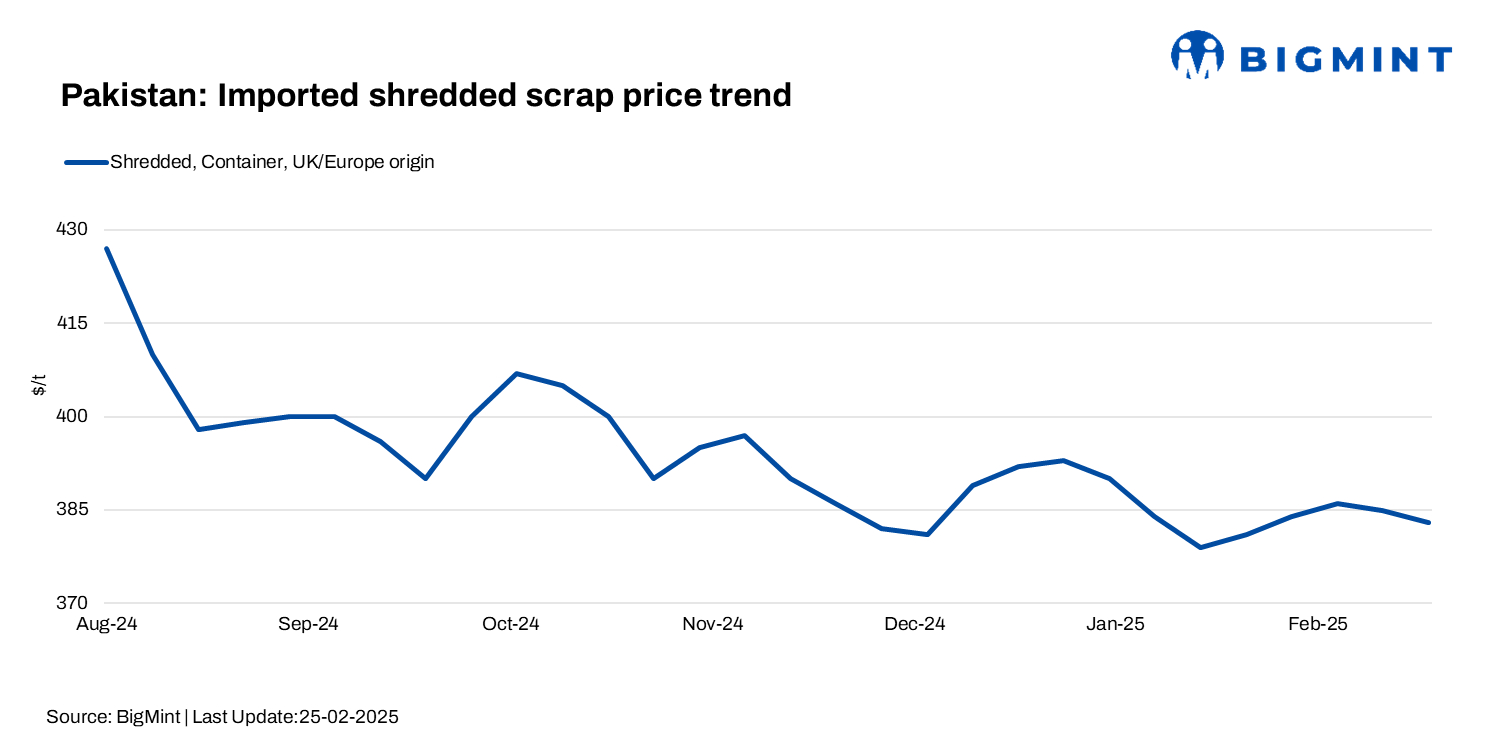
Pakistan’s demand for European scrap remained firm during the beginning of last week, which turned slow towards the weekend and by the start of this week. BigMint’s assessment for European/UK-origin shredded stood at $383/tonne (t) CFR Qasim, down by $2/t w-o-w.
Fresh shredded EU offers touched $385-390/t CFR; on the other hand, deals were concluded lower at $380-385/t CFR.
Meanwhile, in a recent development, the government has revised minimum import trade prices for customs evaluation, alongside a major shift in duty valuation for materials entering via land routes. Previously benefiting from lower freight calculations, these imports will now face normalised valuations, potentially raising clearance costs and impacting supply.
As per market participants, the workable price for shredded scrap in Pakistan is around $375-378/t CFR, prompting suppliers to lower offers to $380-384/t CFR Qasim. However, selling at these levels remains unviable for suppliers and buying activity is limited due to liquidity constraints.
As per a Karachi-based steelmaker, while electricity tariff reductions provided some relief to steelmakers, the range-bound scrap prices keep them slightly cautious about the charge mix, and preference for domestic scrap remains moderate.
Suppliers initially offered at $390-392/t last week but had to lower offers to $385/t as buyers showed little interest in European material at those levels. Domestic scrap demand remains moderate, with some mills keeping bids around PKR 140,000/t ($500/t), while rebar prices remain unchanged.
Current prices:
- Rebar: PKR 240,000-245,000/t ($857-876/t)
- Billet: PKR 210,000-212,000/t ($750-757/t)
- Scrap: PKR 144,000-145,000/t ($500-504/t)
Rebar production in the Karachi region is currently running at around 40-50%.

“We are already booked, so not in the market for fresh purchases. Rebar inventories remain low as production is running at around 60%, roughly 10-11 kt per month. Local scrap prices stand at PKR 140,000-145,000/t ($500-519/t), while rebar is trading at PKR 245,000-250,000/t ($876-894/t). Given the current conditions, we expect a stable market, though liquidity constraints persist,” an official of a major steel mill in Pakistan said.
As per market insiders, Pakistan’s imported scrap inflow is currently around 75,000-80,000 t per week, with the Karachi region receiving 20,000-25,000 t. While annual scrap imports rose to 2.7 mnt last year, volumes remain significantly lower than the pre-COVID levels of 4.5-5 mnt in 2019-2020.
A UK-based scrap yard owner commented, “Last week, we sold around 15,000 t of shredded and other scrap, with 5-6,000 t heading to Pakistan. However, inquiries from Pakistan have declined in recent weeks as our offers appear unviable for buyers. Our last offer stood at $388/t, but counterbids were heard at $380-382/t. The last deal was finalized with a 14-day free time, which remains slightly more negotiable.”
Pakistan’s construction & real estate market update
Pakistan’s construction sector remains sluggish due to a lack of new infrastructure projects and minimal government initiatives, pushing investors towards gold instead.
Meanwhile, the real estate market holds strong potential, driven by a 12-million-home shortage and rapid urbanisation. ABAD Chairman Hassan Bakhshi has urged reforms, with PM Shehbaz Sharif looking to accelerate growth. The cement industry, operating at just 30% capacity, presents untapped opportunities. While financing hurdles persist, a revival of mortgage schemes could boost homeownership and long-term market stability.
Outlook: Rebar sales are improving but remain largely credit-based, limiting cash flow in the market. Prices are expected to stay rangebound as suppliers hold firm. With Ramadan approaching, trading activity is likely to slow further, keeping market sentiment subdued.

Leave a Reply