- September imports remain near the year’s peak
- South African coal gains share; petcoke purchases decline
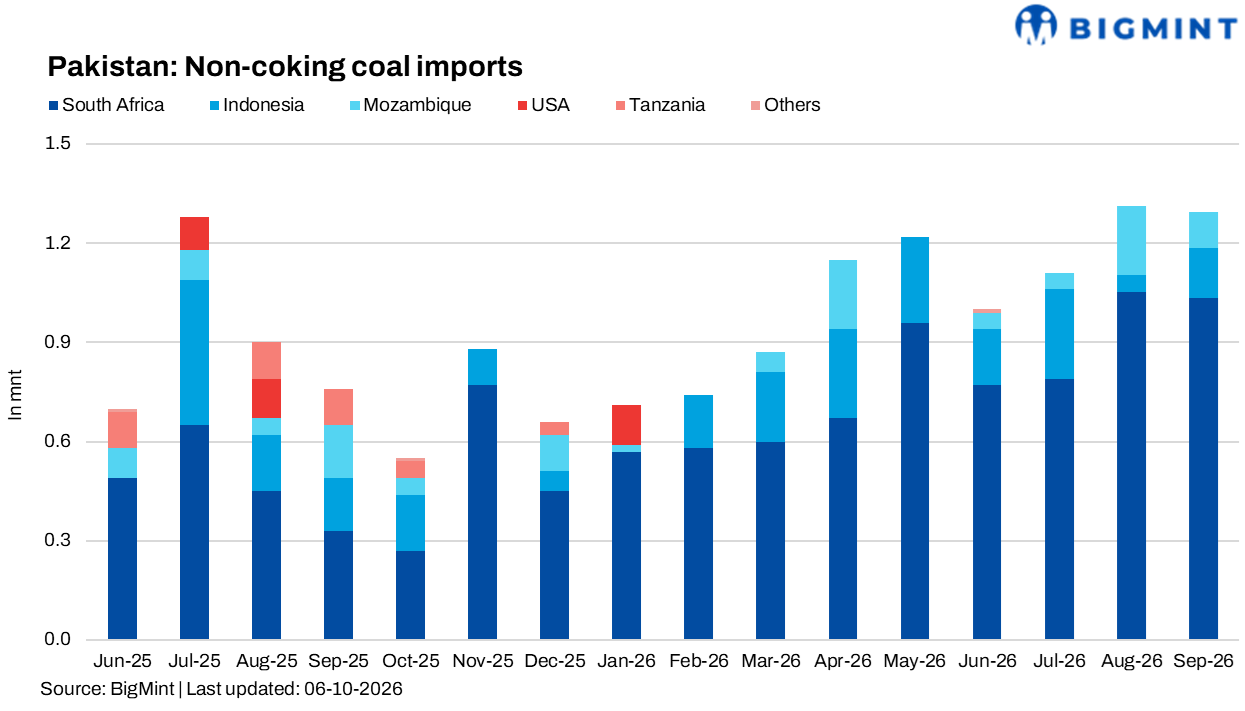
Pakistan’s non-coking coal imports reached 1.30 Mnt in September 2026, up 71.1% year-on-year and broadly unchanged from August’s 1.31 Mnt. Sustained high arrivals lifted January–September imports to 9.40 Mnt, an increase of 63.2% over the corresponding 2025 period.
The expansion was accompanied by a pronounced shift in sourcing. South Africa supplied approximately three-quarters of nine-month coal imports, compared with just over half a year earlier. Indonesian volumes also increased, but US coal shipments contracted sharply and no Tanzanian arrivals were recorded.
Petcoke moved in the opposite direction, with imports falling to 0.05 Mnt from 0.14 Mnt. The recorded import basket therefore became more heavily concentrated in non-coking coal, particularly South African material.
September and nine-month performance

Monthly coal imports rose from 0.70 Mnt in January to 1.22 Mnt in May. Following a June moderation to 1.00 Mnt, arrivals strengthened to 1.10 Mnt in July and remained around 1.30 Mnt in August–September.
September was only 0.8% below August, indicating that the higher shipment pace was sustained rather than immediately reversed.
Q3 imports increased 10.1% from Q2 and 26.2% from Q3 2025. The monthly average was approximately 61% above Q1.
Nine-month coal imports already exceeded the entire 2025 volume of 7.84 Mnt by 19.9%. This demonstrates a substantially higher import requirement, although arrivals alone cannot distinguish consumption growth from inventory replenishment or changes in domestic fuel availability.

South Africa captures the expansion
South African shipments increased by 3.89 Mnt, exceeding Pakistan’s overall coal import increase of 3.64 Mnt. Growth from this origin therefore supplied the net expansion and offset reductions elsewhere.
The concentration became more pronounced in recent months. South Africa supplied 1.03 Mnt in September, equivalent to 79.2% of coal arrivals, against 0.33 Mnt a year earlier. August shipments were similarly high at 1.05 Mnt.
Indonesia remained the second-largest source. Its volumes increased broadly in line with Pakistan’s total imports, leaving its share almost unchanged. September arrivals recovered to 0.15 Mnt from August’s 0.05 Mnt, but remained slightly below September 2025’s 0.16 Mnt.
Mozambique’s shipments increased modestly, but its share declined as the market expanded. US coal was recorded only in January 2026, while Tanzania disappeared from the recorded origin mix.
What the sourcing shift suggests about fuel choices
The clearest change is greater reliance on South African coal rather than broad diversification across suppliers. Pakistan increased Indonesian purchases while concentrating most incremental procurement in South Africa.
This pattern is consistent with South African material offering an attractive combination of delivered cost, quality suitability and availability for the buyers involved. However, the figures do not identify grades, receivers or end uses, so they cannot establish whether the shift was driven principally by power generation, cement production or other industrial demand.
Nor does the origin change necessarily mean a uniform move towards higher-calorific-value coal: origins supply different grades, and cargo specifications are needed to confirm a change in fuel quality.
The commercial implication is nevertheless clear. Pakistan’s import exposure has become more sensitive to South African export prices, cargo availability and freight on that route.
Petcoke’s share of imports fall
Petcoke imports consisted of one recorded US-origin arrival of 0.05 Mnt in April 2026. No further arrivals were recorded through September.
In 2025, imports occurred in June and July and included both Saudi Arabian and US material. Saudi supply was absent in 2026, while the USA became the sole recorded source.
Petcoke’s share of combined imports declined from approximately 2.4% to 0.5%. This indicates a reduced role in the recorded imported-fuel basket, but does not prove direct substitution by coal. Buyer-level consumption, stocks and delivered fuel costs would be needed to establish that relationship.
Outlook
Pakistan entered Q4 with coal imports holding near their 2026 peak and a markedly stronger dependence on South Africa. The sustained quarterly increase suggests the higher shipment requirement extends beyond a single month.
South African replacement costs and freight will consequently have greater influence on Pakistan’s procurement economics. Indonesia remains an established alternative, while the contraction in US supplies and absence of Tanzanian arrivals leave the origin mix narrower.
The near-term indicators are whether monthly coal arrivals remain above 1 Mnt, whether South Africa retains its enlarged share, and whether petcoke purchasing resumes. Continued strength across these coal flows would reinforce the shift towards a larger, more concentrated imported-coal market.
Leave a Reply