- Nepal adds about 1.5 mnt melting capacities in last 3-4 years
- Metallics imports seen rising, sponge iron imports more than double in CY22
- Billet imports drop about 60% last year
Morning Brief: Steel is one of Nepal’s key industries, contributing substantially to its growth story. The per capita steel consumption in this import-dependent country is touching around 35 kg with finished steel demand currently at almost 1.40 million tonnes per annum (mntpa). In this quantum, flats are largely imported while in longs, the imported billet get converted into rebar. In 2022, finished longs consumption hovered a little under 1 mnt with flats at 0.45 mnt.

However, it may be noted that Nepal’s steel consumption last calendar dropped almost 30% y-o-y from 1.94 mnt in 2021. The drop was on account of the high energy prices and power tariffs. Moreover, being import-dependent, Nepal encountered balance of payments issues and needed to preserve foreign exchange by limiting new LCs. In normal circumstances, its consumption hovers between 1.80-2.0 mntpa.
How are market dynamics changing?
But the steel market dynamics are changing and how? Earlier, especially in 2019-2020, the steel topography was dominated by an overwhelming share of imported billets (mainly from India) which were rerolled into rebars. Naturally, earlier, Nepal’s own melting capacities were also comparatively lower, at a modest 0.3-0.5 mntpa. This indicates Nepal has added around 1.50 mnt of melting capacities in the last 3-4 years.
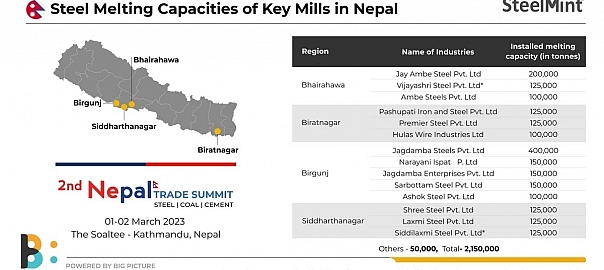
But, with the mills undertaking backward integration since the last couple of years, SteelMint notes that Nepal’s steel melting capacities rose to cross a record 2 mntpa in 2022.
Resultantly, the earlier landscape, marked by active billet imports, is slowly changing. From over 1 mnt of billets imports till 2021, SteelMint’s data reveals, volumes nosedived by around 60% to around 0.46 mnt in 2022.
Some of the major mills which are actively expanding their melting capacities include Jagdamba Steels (with an installed melting capacity of 400,000 tonnes), Jay Ambe Steel (200,000 t), Narayani Ispat, Jagdamba Enterprises and Sarbottam Steel (150,000 t each) and many others. Moreover, in the 2022 Budget, the Nepalese government had imposed import duties on several steel items in a bid to control foreign exchange outgo amid rising inflationary pressure and also generate employment. The proposed emphasis was on ‘Make in Nepal’.
 Last year’s Budget had raised excise duties on several steel products like billets, wire rods and structural steel. For instance, excise duty on billets was increased from NPR 2500 to NPR 3500.
Sponge iron imports escalate: On the other hand, imports of sponge iron, a key feed, have more than doubled from 0.26 mnt in 2021 to 0.54 mnt in 2022, reveals SteelMint data, with the increase in Nepal’s melting capacity. It is to be noted that almost the entire sponge volume is supplied by India.
Nepal, in a bid to expand its feed base, is also importing an estimated 20,000 tonnes of ferrous scrap per annum.
Outlook
With increase in indigenous melting capacities, imports of metallics like sponge iron and scrap are seen increasing in the medium-to-long term. The emphasis on home-grown crude steel production will help to stem costlier imports and foreign exchange drain. Plus, it is beneficial for any country to strengthen its manufacturing base.
Where ferrous scrap is concerned, India, of course, is not in a position to export the same, which gets consumed domestically. Thus, Nepal is buying small parcels from the US and UK.
“The year 2022 was not very good for Nepal, as with the rest of the world, However, as its economy improves, so will its melting utilisation rate. This will push up imports of both sponge iron and scrap,” said a source.
At the same time, billet imports will drop in tandem.
Nepal Steel and Raw Material Trade Summit:
SteelMint will hold the 2nd Nepal Trade Summit, in Kathmandu, Nepal over 1-2 March, 2023, where 300 participants, 20-plus speakers, and more than 30 exhibitors will gather under one roof to further explore opportunities in steel, coal and cement.
Speakers will include representatives from Nepal’s Ministry of Industry, Commerce & Supplies, Nepal’s Chamber of Commerce as well as from prominent steel mills in Nepal. Speakers from India’s leading electric furnace manufacturers will explore latest steel melting technologies and a lot more.
Senior officials from major trading houses will give indications on the latest trade headwinds.
Sessions will throw the spotlight on government policies and their impact on Nepal’s economy. Experts will discuss the future of Nepal’s steel and cement industries, the changing dynamics of the global steel markets, Nepal’s raw material sourcing options and rationalization of input costs.
Register now. Become a part of Nepal’s growth story.


Leave a Reply