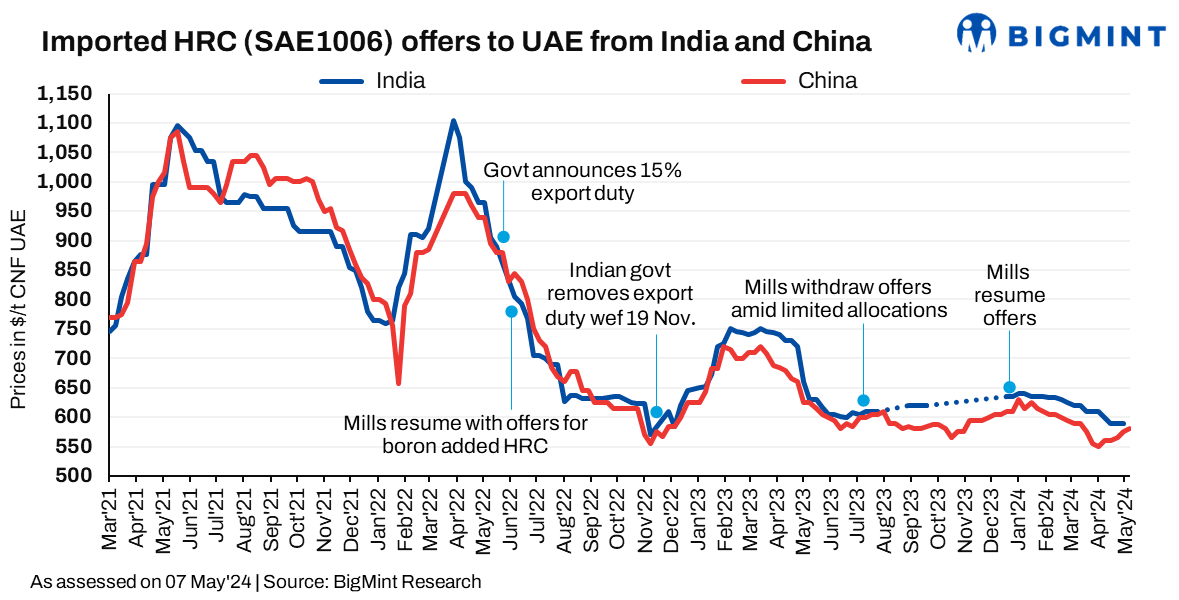
Chinese HRC (grades S235 and S275) export offers to Middle East (ME) increased by $5-10/t w-o-w this week. The current offers range from $580-585/t CFR UAE, compared to $575/t CFR UAE a week ago. However, no major deals have been heard concluded, as buyers were in a wait and watch mode in the absence of competitive import offers from other origins like Japan and India, sources informed BigMint. No firm offers were heard from Japan, last heard indicative offers were around $580-590/t CFR UAE.
In China, before Labour Day holidays, the market held steady. However, post holidays, raw material suppliers began increasing which led to higher offers on the Shanghai Futures Exchange (SHFE). While, market participants in China are awaiting Baosteel’s price revision for June 2024.
Shanghai Futures Exchange (SHFE) HRC futures inched up RMB 13/t ($2/t) d-o-d to RMB 3,871/t ($536/t) on 7 May against RMB 3,858 ($534) a day ago. Moreover, the same rose by RMB 53/t ($7/t) w-o-w against RMB 3,818/t ($529/t) on 30 April.
“Chinese mills are trying to quote prices on the higher side and waiting for market reaction since there are no offers from competitive origins like Japan and India,” informed a reliable ME-based source.
Indian mills have continued to hold HRC export offers due to limited export allocations and higher domestic realisation. However, market participants expect “Indian mills may resume HRC export offers towards the end of this week for June-July 2024 shipments”.
In the UAE , there is a noticeable improvement in domestic steel demand due to the expanding real estate market, which is attracting interest from both international and local investors. Additionally, in the Middle East market, Chinese hot-rolled coil (HRC) is easily accessible, and construction sites are on the rise in Saudi Arabia.
Outlook:
The ongoing infrastructure projects in UAE are expected to drive demand for steel in the long term, which could result in further recovery of market. Prices may be impacted by increasing production costs and competition from other suppliers. However, the on-going geo-political keeps market sentiments mixed in the Middle East region.