- Mongolian supply concerns support Australian prices
- Indian buyers wait for govt’s coke policy
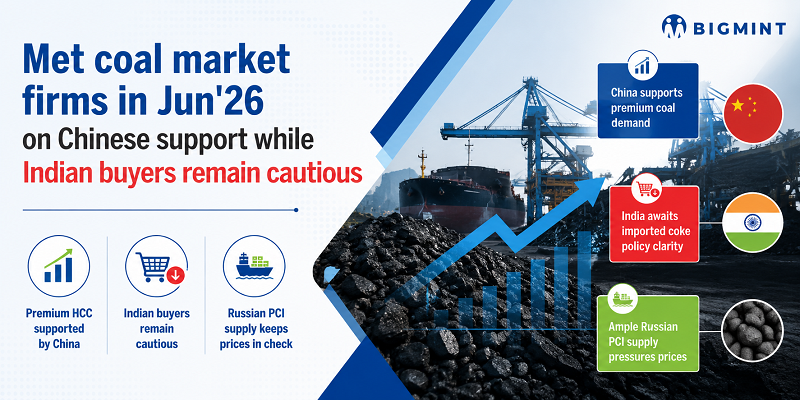
The metallurgical coke market presented a contrasting picture. China’s domestic market continued to strengthen on the back of higher raw material costs, while Indian buyers remained cautious as they awaited clarity on the government’s imported coke policy. Meanwhile, the PCI market softened modestly, with abundant Russian supply continuing to anchor prices in both China and India.
Overall, the market remains finely balanced. China’s improving outlook is providing support for premium coking coal, but weak steel margins and cautious procurement in India continue to limit broader upside.

China continues to support premium HCC
China remained the primary source of support for the seaborne coking coal market during the week.
Expectations of higher July domestic contract prices from major miners, stronger coking coal futures and concerns over possible disruptions to Mongolian coal supplies improved market sentiment and encouraged buying interest for premium Australian cargoes.
The prospect of reduced Mongolian exports–arising from possible labour disruptions and the seasonal Naadam holiday in July–also raised concerns over tightening landborne supply, increasing the attractiveness of imported premium HCC.
Nevertheless, buyers remained disciplined. Many mills continued to seek discounted cargoes, and trading activity remained relatively thin as participants waited to see whether the recent improvement in Chinese sentiment would prove sustainable.
As a result, premium HCC prices held broadly steady, while lower-tier coking coals continued to soften.
Lower-tier coking coals continue to lag
The divergence between premium and lower-quality coking coals became more evident during the week.
While premium HCC remained largely unchanged, low-vol HCC prices weakened as Chinese buyers increasingly favoured competitively priced port inventories over forward cargoes.
This suggests that steel mills are prioritising quality rather than undertaking broad-based inventory replenishment. Demand for second-tier coals remains selective, and sellers continue to adjust prices to compete with readily available domestic and portside material.
India remains a cautious buyer
India continues to be the weakest link in the seaborne coking coal market.
Weak steel margins, adequate raw material inventories, a relatively weak rupee and uncertainty surrounding imported coke policy have encouraged mills to defer fresh purchases.
Premium Australian cargoes have increasingly been directed towards China, where demand has been relatively stronger, further reducing spot activity into India.
Despite the current slowdown, India’s structural dependence on imported coking coal remains unchanged. Current buying patterns appear tactical rather than indicative of weaker long-term demand.
Met coke markets diverge
The metallurgical coke market is increasingly characterised by divergent trends between China and India.
Chinese coke producers continue to benefit from firm coking coal costs, with domestic coke prices moving higher for the ninth time since early March. Rising raw material costs and improving ferrous market sentiment continue to support producer margins.
In contrast, imported coke prices into India softened slightly as buyers resisted higher offers ahead of the government’s decision on imported coke policy following the expiry of the provisional anti-dumping duty.
This has created a temporary disconnect between firm production costs and cautious buyer behaviour. Until policy clarity emerges, Indian buyers are likely to continue limiting spot purchases despite relatively firm international fundamentals.
Russian supply keeps PCI competitive
The PCI market remained under modest pressure during the week.
Australian PCI prices eased slightly, reflecting cautious buying and ample availability, while Russian material continued to dominate spot trade into both China and India.
Russian PCI has increasingly become the benchmark for spot transactions, reflecting evolving global trade flows over the past few years. Competitive pricing and consistent availability continue to make Russian material attractive to steelmakers, limiting the upside for Australian PCI despite relatively stable blast furnace demand.
Although freight rates into Asia eased during the week and improved import economics, lower shipping costs have not been sufficient to trigger aggressive restocking as steel producers remain focused on protecting margins.

Outlook
The seaborne metallurgical coal market appears to be stabilising after several weeks of volatility.
China is expected to remain the principal source of support for premium HCC, underpinned by firmer domestic pricing, healthy blast furnace utilisation and the possibility of tighter Mongolian supply.
However, broader upside will remain constrained until Indian mills return more actively to the spot market. Policy clarity on imported coke, improvement in steel margins and stronger finished steel demand will be key catalysts for renewed Indian buying.
Premium HCC is therefore expected to remain relatively well supported in the near term, while lower-tier coking coals and PCI are likely to remain under pressure owing to selective buying and abundant supply.
The market is unlikely to move sharply in either direction over the coming weeks. Instead, it is expected to remain range-bound, with China providing the principal source of strength while India continues to adopt a cautious and price-sensitive procurement strategy.

Leave a Reply