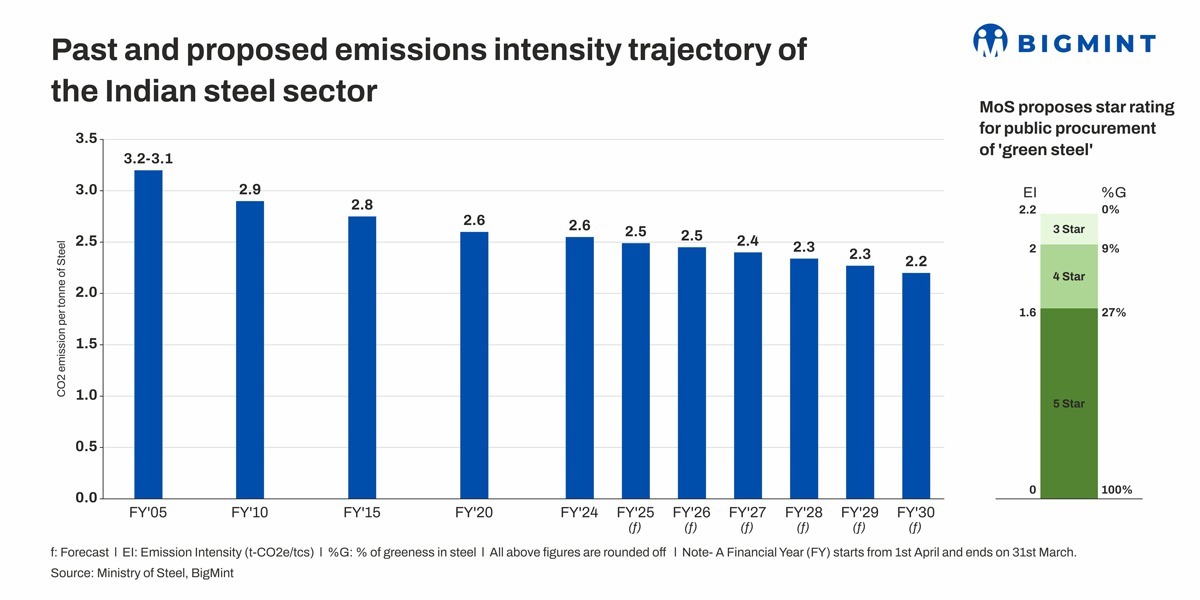
- Govt’s star-rated rebar producers currently fetching a premium of 4-6%
- MoS working on mission for direct monetary compensation for CO2 reductions
India was the first country to formulate a green steel taxonomy and, contrary to expectations, the green steel market in India is already taking shape with the government creating an enabling policy framework to boost demand for low-carbon products.
Green premium
“Some Indian TMT bar manufacturers who have received the Ministry of Steel’s Green Steel Certification are already getting a premium of roughly INR 2,000/t,” informed Kamal Aggarwal, Secretary General, AIIFA Sustainable Steel Manufacturers Association, during a session at the ISA Steel Conclave recently.
Nagendra Nath Sinha, former Secretary, Ministry of Steel (MoS), seconded Aggarwal, saying that sources have informed that a premium of 4-6% is being fetched by low-emissions rebar produced through the IF route, although at the current stage these are only in demand from reputed construction companies that either have their own net-zero and interim targets or adapting to green building codes to enhance their ESG profiles.
The government certification is a great facilitator, observed Aggarwal. Private producers are eyeing a segment of the market which is gradually developing. The green steel star-rating is providing some producers the first-mover advantage in the market to cater to demand from some leading construction companies that prioritise compliance with IGBC codes and emission norms.
Compensation for CO2 reductions
The government is coming up with a mission for the small and medium steel producers in the country, who collectively account for over 50% of India’s steel production, that directly incentivises mills to cut emissions by way of a INR 100 compensation for every 0.1 tonne of reduction in GHG emissions from steel production, informed Saurabh Diddi, Director, Bureau of Energy Efficiency (BEE).
There is a list of over 50 parameters that steel producers have to comply with, for instance energy efficiency, waste heat recovery and utilisation, renewable power consumption, raw materials, etc. to qualify for such compensation as is being worked out by the MoS.
Real incentives, not subsidies
“I have personally never favoured subsidies. We need to create a market and demand for green steel in India and a mechanism that incentivises green production,” Diddi observed. The government’s green public procurement programme (GPPP) is a key policy tool, as the government accounts for over a quarter of steel consumption in the country.
‘I would urge the MSME producers and the secondary steel sector to try to achieve targets set by the BEE over and above the government’s mission for the sector which is yet to be formally announced. Apart from the compliance mechanism, the voluntary mechanism under the CCTS also provides companies the opportunity to earn carbon credits and utilise them,” he added.
Now that private demand for low-emissions steel, as per the government’s taxonomy, is emerging in the construction sector, star-rated producers are in a position to directly monetise their low-emission credentials and capture the emerging market for green steel.
Leave a Reply