- Supply disruptions support prices despite higher LME stocks
- MCX gains as open interest falls 27.7%
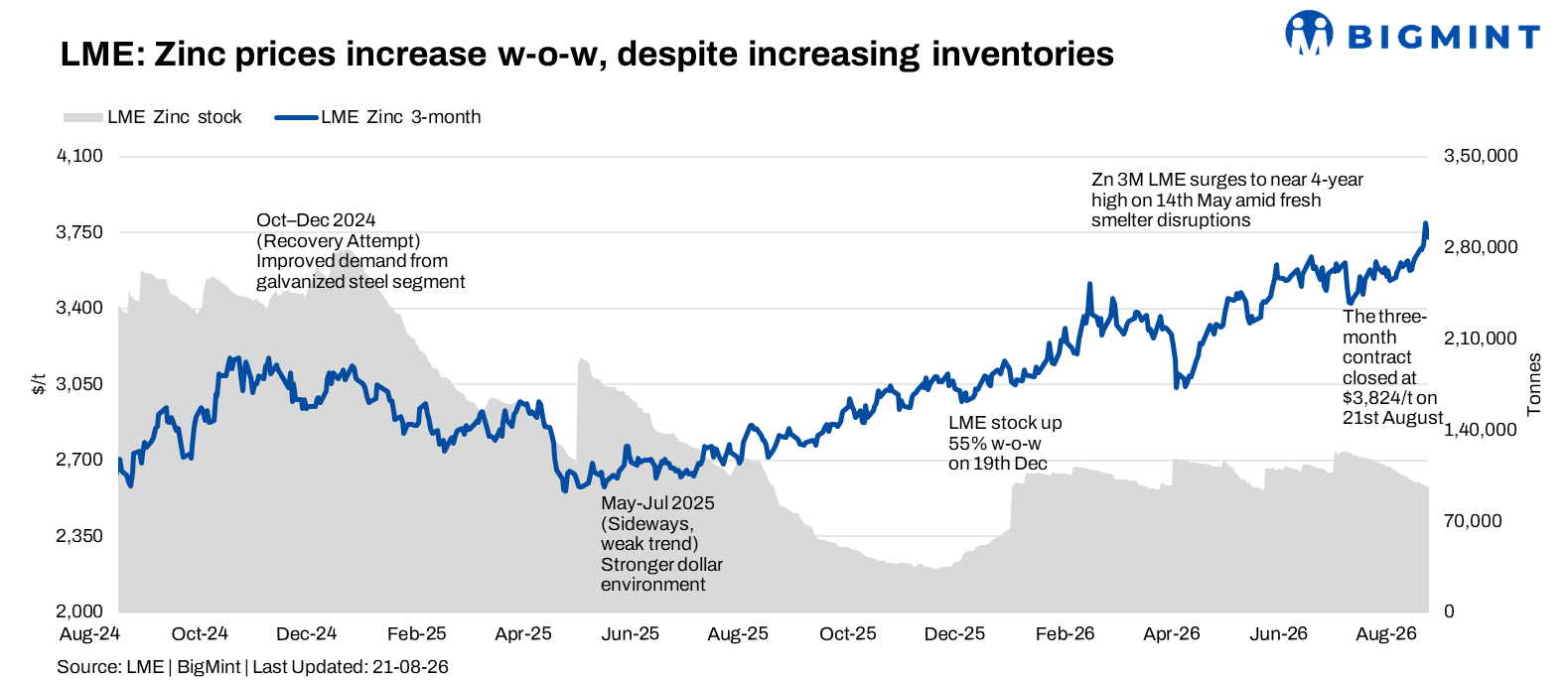
LME zinc prices rose during the week ended 21 August 2026, supported by supply concerns, production disruptions and continued backwardation despite a late-week rebound in exchange inventories. LME cash settlement prices increased 2.7% week on week to $3,980/t on 21 August from $3,875/t on 14 August. The three-month contract rose 1.6% to $3,824/t from $3,763.5/t.
LME inventories increased by 5,125 t to 93,125 t over the same period after falling to a weekly low of 86,525 t on 18 August. Despite the inventory rebound, the cash-to-three-month spread remained elevated at $156/t on 21 August, indicating tight nearby availability.
Supply disruptions support market
Zinc fundamentals remained supported by concerns over mine and smelter availability. Heavy rainfall and flooding in China disrupted mining and smelting operations. Production adjustments at a Southwest China mine are expected to reduce August concentrate output by around 1,000 t, while maintenance at a Central China smelter could lower refined zinc output by 1,000-1,500 t.
Global producer output also showed mixed trends. Glencore’s own-sourced zinc production declined 21% y-o-y to 365,600 t in H1CY’26, while Boliden’s zinc concentrate production fell 16.8% q-o-q to 74,200 t. MMG produced 106,000 t in H1CY’26, equivalent to 48% of its full-year guidance. Nexa’s Q2 zinc production increased 8% y-o-y to 79,300 t.
However, the inventory picture remained mixed. LME stocks rose to 93,125 t by 21 August after falling below 90,000 t earlier in the week, while nearly 10,000 t were delivered into LME warehouses in Asia. Higher inventories and elevated prices may continue to constrain physical demand, particularly in China.
MCX rises as open interest falls
MCX zinc futures tracked the international rally, with the August contract settling at INR 407,650/t on 21 August, up 2% from INR 399,600/t on 14 August. The contract touched a weekly high of INR 408,400/t on 21 August after reaching INR 403,000/t on 17 August.
Open interest, however, declined from 2,995 lots on 14 August to 2,165 lots on 21 August, down 27.7%. The combination of higher prices and lower open interest points to position unwinding rather than significant fresh buying, indicating cautious domestic participation.
SHFE zinc prices moved in the opposite direction, declining around 1.1% to $3,805/t on 21 August from $3,848/t on 14 August. The divergence from LME reflected weaker Chinese market sentiment amid elevated prices and demand concerns.
Domestic market remains above HZL benchmark
India’s domestic zinc market remained firm despite Hindustan Zinc Ltd lowering its benchmark. HZL reduced its zinc ingot benchmark by INR 3,300/t on 20 August to INR 405,800/t. It also cut its lead ingot benchmark by INR 700/t to INR 211,200/t.
However, BigMint assessed SHG zinc ingot at INR 412,600/t ex-Delhi on 21 August, placing the physical market INR 6,800/t above HZL’s benchmark. The premium indicates that replacement costs remained firm despite the producer’s downward revision.
The divergence may keep buyers cautious at elevated price levels, while sustained LME strength and tight nearby availability could continue supporting domestic physical prices.
Outlook
LME zinc prices are expected to remain supported in the coming weeks, with mine and smelter disruptions, tight concentrate availability and persistent backwardation providing a firm fundamental backdrop. However, the rebound in LME inventories, higher Chinese stocks and subdued demand at elevated prices may limit further gains.
The sharp decline in MCX open interest alongside higher prices also indicates cautious positioning in the domestic derivatives market. Meanwhile, the premium of the SHG assessment over HZL’s benchmark suggests firm physical replacement costs despite the recent producer price cut.
Support is seen at $3,750-3,800/t, while resistance is expected around $4,000-4,050/t. LME inventory movements, Chinese supply disruptions, refined zinc production and the cash-to-three-month spread are likely to remain key indicators for price direction.
Leave a Reply