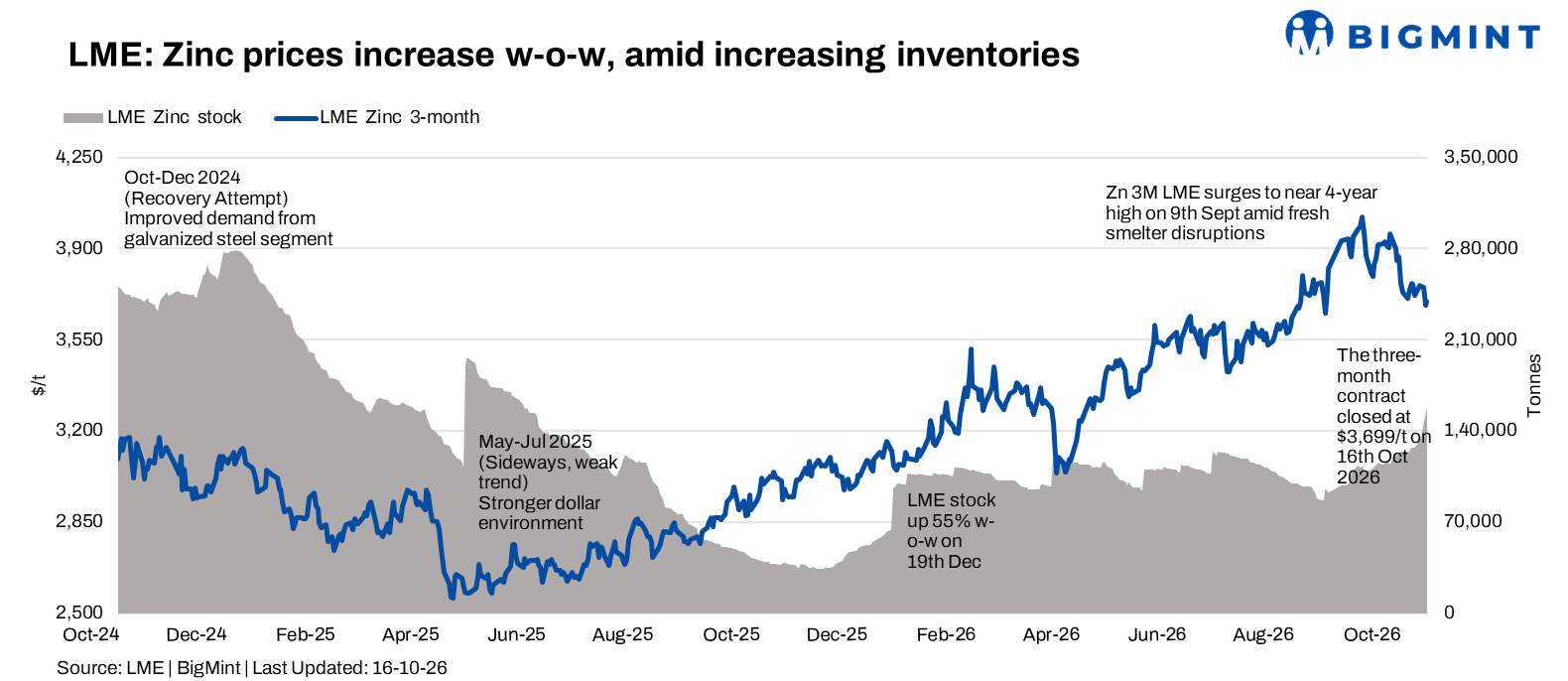
- Western smelter risks persist, limiting price correction
- Market in backwardation, indicating premium for nearby metal
LME zinc prices weakened during the week ended 16 October as a sharp increase in exchange inventories and expectations of improving Chinese concentrate availability weighed on sentiment. However, the market remained in backwardation, indicating that nearby metal continued to command a premium despite rising warehouse stocks.
LME cash settlement fell 2.6% to $3,739/t on 16 October from $3,840/t on 9 October. The three-month contract declined 2.2% to $3,699/t from $3,781.50/t.
LME inventories rose by 31,425 t, or 24.8%, to 158,275 t during the week. The cash-to-three-month backwardation narrowed to $40/t from $58.50/t, indicating an easing of nearby supply tightness as metal availability increased.
Chinese concentrate outlook and global supply risks
Zinc prices remained influenced by contrasting supply dynamics between China and Western markets. Chinese mine output is expected to increase month on month in October as disrupted mines resume operations following accidents and safety inspections, potentially easing concentrate availability for smelters.
However, China’s refined zinc production declined 1.9% month on month and 6.4% year on year in September 2026. This highlights continued pressure on refined output despite the anticipated improvement in mine supply.
Western refined zinc production declined 3.4% year on year in H1CY’26, according to the International Lead and Zinc Study Group (ILZSG). Nyrstar’s strategic review of its loss-making Budel smelter in the Netherlands has added to concerns over potential production losses amid high energy costs and tight raw material availability.
In contrast, Japan’s Mitsui Kinzoku plans to produce 117,700 t of refined zinc in the second half of fiscal 2026, up 32% year on year. The outlook for improving Chinese concentrate supply and higher production in Japan could help ease some supply constraints, although persistent Western smelter risks remain supportive.
LME zinc declines as inventories rise
LME zinc prices retreated during the week, with the three-month contract falling below $3,700/t on 16 October. The contract had closed at $3,760/t on 12 October before recovering briefly to $3,756/t on 13 October, followed by renewed declines over the next three sessions.
The cash settlement price fell to $3,739/t on 16 October, while the three-month contract settled at $3,699/t. During the same period, LME stocks increased from 132,850 t on 12 October to 158,275 t on 16 October, reflecting a substantial inflow of metal into exchange warehouses.
The sharp inventory build and narrowing backwardation indicate that immediate supply pressure has eased. However, the continued premium for cash metal suggests that the market has not moved into contango, while persistent concentrate shortages and Western production risks continue to provide underlying support.
SHFE zinc trading resumes amid mixed supply signals
China’s domestic zinc market resumed trading on 8 October following the National Day holiday. Market sentiment remained under pressure from falling LME prices and expectations of improved concentrate availability as Chinese mines recover from disruptions.
Chinese mine production is expected to improve month on month in October, potentially easing raw material constraints for smelters. However, September refined zinc output declined both month on month and year on year, highlighting continued weakness in refined production.
On the demand side, China’s zinc market remained sensitive to downstream consumption and post-holiday restocking. The direction of social inventories and smelter operating rates will be important in assessing whether improved concentrate supply translates into higher refined output or a sustained recovery in domestic availability.
MCX zinc declines as open interest contracts
MCX zinc futures weakened during the week, with the October contract closing at INR 417.85/kg on 16 October against INR 422.05/kg on 9 October, down INR 4.20/kg, or 1.0%.
The contract touched a weekly high of INR 423.20/kg on 12 October and a low of INR 412.50/kg on 15 October. Open interest declined to 1,831 lots on 16 October from 1,993 lots on 9 October, a decrease of 162 lots, or 8.1%.
The decline in MCX zinc broadly tracked the weakness in international prices. Lower open interest indicates a reduction in outstanding positions but does not, by itself, establish whether traders were predominantly closing long or short positions.
Indian zinc market tracks benchmark reductions
India’s domestic zinc market remained influenced by international price movements and benchmark revisions.
Hindustan Zinc Ltd (HZL) reduced its benchmark Special High-Grade (SHG) zinc ingot price by INR 3,400/t on 14 October to INR 407,900/t. This followed the company’s earlier reduction of INR 1,500/t on 8 October to INR 408,200/t.
The latest benchmark revision reflected the softer international market. However, the extent of the domestic price adjustment will also depend on replacement costs, import premiums and physical demand.
Outlook
LME zinc is expected to remain volatile as accelerating warehouse inventories and the prospect of improved Chinese concentrate availability weigh on prices, while persistent Western smelter risks and tight raw material availability provide support.
The decline towards $3,700/t highlights renewed selling pressure following the earlier recovery. Further inventory accumulation could limit the upside, although sustained backwardation suggests that nearby supply conditions remain relatively tight.
Support is seen around $3,650-3,700/t, while resistance is expected around $3,750-3,850/t. LME inventories, cash spreads, Chinese mine and refined output, treatment charges, smelter developments and downstream demand will remain key indicators for zinc prices.
Leave a Reply