- Indonesian policy uncertainty continues to influence sentiment
- Rising sulphur costs increase cost pressures for HPAL-route producers
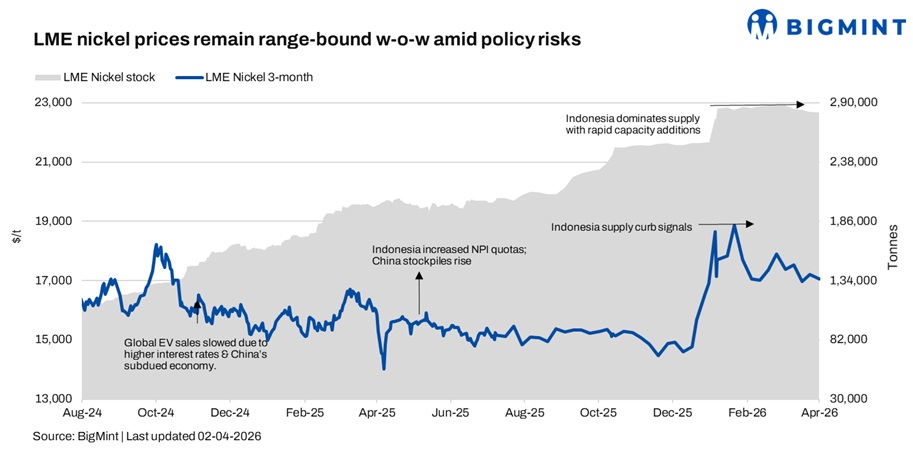
Nickel prices on the London Metal Exchange (LME) remained range-bound in the week ended 02 April, with the three-month contract closing at $17,060/t, range-bound from $17,210/t in the previous week. LME inventories remained largely stable at 281,496 t compared with 281,574 t in the previous week, indicating balanced market conditions.
Cost pressures, policy risks shape sentiment
The global nickel market is gradually transitioning from a prolonged oversupply phase towards a tighter balance, supported by rising cost pressures and increasing policy uncertainty. Indonesia’s dominance in the nickel supply chain continues to influence global pricing dynamics, particularly amid discussions around export tariffs and tighter regulatory controls. Market participants noted that any policy shift in Indonesia has an immediate impact on sentiment, reflecting the market’s structural dependence on the region.
Elevated sulphur and energy costs, driven by ongoing geopolitical tensions, have significantly increased the cost base for nickel producers, especially for high-pressure acid leaching (HPAL) operations producing battery-grade materials. Higher input costs, along with tightening ore availability and delayed mining approvals, have led to cautious selling by miners and active restocking by smelters to secure raw material continuity.
Supply-side constraints support outlook
Tightening ore quotas, along with a reported ~10% y-o-y decline in nickel pig iron (NPI) output during the early months of 2026, and ongoing uncertainty around export taxation are expected to gradually shift the market towards a deficit. In addition, disruptions in logistics and rising freight costs have added further pressure on supply chains.
Industry participants highlighted that sustained cost escalation could delay expansion plans and limit supply growth, particularly in Indonesia’s processing sector. At the same time, demand from stainless steel and the energy transition segment, including EV batteries, remains structurally strong, supporting medium-term consumption.
Outlook
The nickel market is expected to remain firm in the near term, supported by cost-push inflation and supply-side constraints. However, price direction will remain highly sensitive to Indonesia’s policy developments, geopolitical risks, and the pace of demand recovery across key consuming sectors.
Leave a Reply