- Oversupply concerns mount amid revisions to Indonesian production quotas
- Indonesian govt says Weda Bay’s additional quota remains unapproved
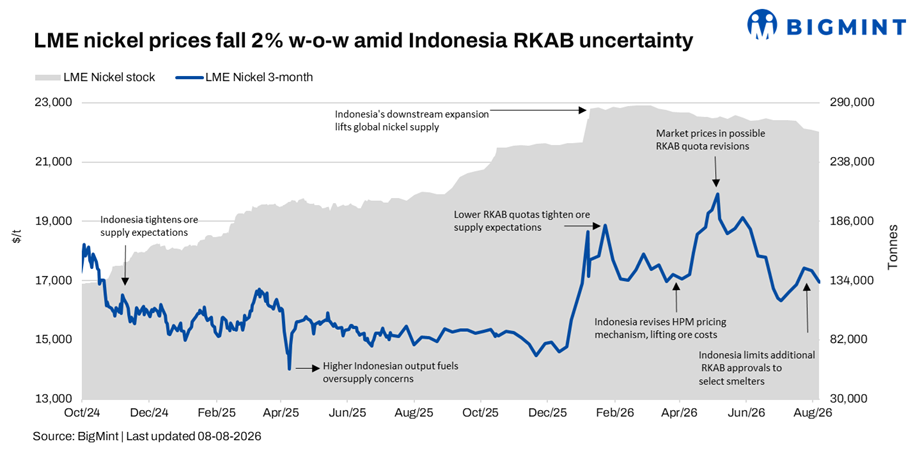
London Metal Exchange (LME) three-month nickel prices declined 2% w-o-w to $16,950/t in the week ended 7 August 2026, from $17,335/t a week earlier. The decline came as uncertainty over Indonesia’s revised nickel mining quotas raised concerns about additional supply. LME nickel inventories remained broadly stable, falling 1% to 264,444 t from 266,172 t.
Indonesia quota uncertainty weighs on sentiment
Market sentiment weakened amid reports that the revised nickel mining quota for a major Indonesian operation could be significantly higher than its initial allocation. Although the reports remain unconfirmed, expectations of additional supply have raised concerns over higher Indonesian nickel output in 2026.
Indonesia had set its 2026 nickel mining quota at 260-270 million wet metric tonnes (wmt) in February and is expected to review the allocation in Q3. Mining companies were allowed to submit revised RKAB applications until 31 July. The Energy and Mineral Resources Ministry (ESDM) has indicated that any increase is unlikely to be significant, with additional allocations primarily intended for smelters facing ore shortages.
Market participants had broadly expected a modest increase of around 10%, potentially taking the annual quota to approximately 290-300 million wmt. However, speculation over a substantially higher allocation for one mine has raised concerns that the overall revision could exceed expectations, adding pressure to nickel prices.
Weda Bay quota remains unapproved
Indonesia’s government denied reports that Weda Bay Nickel had received an additional 25 million wmt of nickel ore quota for H2CY’26. Energy Ministry official Tri Winarno confirmed that the Halmahera-based mine had applied for an additional quota but said no approval had been granted so far.
Weda Bay Nickel is a joint venture in which Tsingshan holds the majority stake, Eramet owns 37.8%, and state-run Antam holds the remaining 10%. The mine accounts for around 17% of global nickel production.
Indonesia is currently accepting revised RKAB submissions, although the government has not disclosed specific quota volumes, citing concerns over potential volatility in international commodity markets.
Royalty payments may influence allocations
Market discussions have also focused on whether additional RKAB allocations could favour companies paying higher royalties. Energy Minister Bahlil Lahadalia indicated that companies making larger royalty contributions could receive priority as the government seeks to maximise returns to the state and public.
China’s output continues to decline
China’s refined nickel production remained under pressure in July. Output from 22 producers fell 3.06% m-o-m and 14.84% y-o-y to 30,787 t. August production is estimated at 30,575 t, down 0.69% m-o-m.
Persistent losses across refining routes, driven by weak nickel prices, high raw material costs, and tight sulphur availability, have prompted several smelters to reduce operating rates.
However, production cuts have yet to translate into a meaningful reduction in domestic inventory pressure. SHFE and domestic social inventories continued to rise despite the decline in LME stocks.
Outlook
Nickel prices are likely to remain largely stable with a bearish bias in the coming weeks as uncertainty over Indonesia’s RKAB revisions persists and China’s refined nickel inventories remain elevated. Ongoing production cuts and the possibility of tighter Indonesian quota allocations could provide downside support, but expectations of additional Indonesian supply and subdued demand are likely to limit price recovery. Market participants are expected to focus on final RKAB approvals, Chinese smelter operating rates, and global inventory movements for further direction.
Leave a Reply