- Rising sulphur costs, softer US inflation data support prices
- Weak stainless steel demand, high inventories cap gains
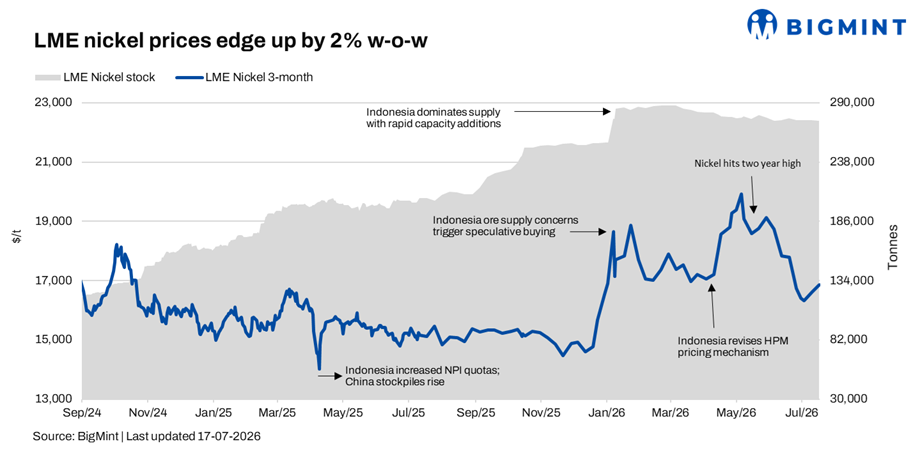
London Metal Exchange (LME) three-month nickel prices increased 2% w-o-w to $16,870/t in the week ended 17 July 2026, compared with $16,600/t a week earlier. The market found support from a global refined nickel deficit, expectations of a more accommodative US monetary policy, and continued uncertainty surrounding Indonesia’s nickel ore mining quotas. However, elevated exchange inventories and subdued stainless steel demand continued to limit stronger price gains.
LME nickel briefly climbed above the $17,000/t mark during the week, touching an intraday high of $17,370/t on 16 July before easing to close the assessment period at $16,870/t. The rally followed the release of softer-than-expected US inflation data, which reduced expectations of an imminent US Federal Reserve interest rate hike and improved sentiment across base metals.
Supply-side factors
Market sentiment was supported by tighter refined nickel fundamentals. According to the World Bureau of Metal Statistics (WBMS), the global refined nickel market recorded a 13,400-t deficit in May 2026, with demand of 314,700 t exceeding production of 301,300 t. Rising sulphur costs, linked to geopolitical tensions in the Middle East, also lifted nickel production costs and provided additional price support.
Indonesia remained the key focus for market participants. The government’s ongoing review of RKAB mining quota revisions continued to create uncertainty over future ore availability. While authorities reiterated that 2026 nickel ore production would remain within 260-270 million tonnes (mnt), mining companies have until 31 July to submit quota adjustment requests. Market participants expect any additional approvals to be limited to domestic smelters facing ore shortages rather than broad production increases.
Despite these supportive factors, LME inventories remained largely stable at 274,284 t on 17 July, compared with 274,584 t a week earlier, indicating that ample exchange stocks continue to cushion the market against significant supply disruptions.
Demand-side factors
Demand conditions remained subdued across the stainless steel and battery sectors. Stainless steel producers continued to reduce output amid seasonal weakness in China, while battery manufacturers largely restricted purchases to immediate production requirements. The combination of cautious downstream buying and adequate material availability limited the upside potential for nickel prices despite improving macroeconomic sentiment.
Market sentiment
The nickel market remained largely driven by macroeconomic developments and Indonesian policy expectations throughout the week. Softer US inflation data and expectations of lower interest rates encouraged speculative buying, while concerns over Indonesia’s mining policy and higher raw material costs supported bullish sentiment.
However, participants largely maintained a wait-and-watch approach ahead of the outcome of Indonesia’s quota review process. High LME inventories and sluggish physical demand continued to temper buying interest, keeping the market within a relatively narrow trading range despite intraday volatility.
Outlook
LME nickel prices are expected to remain volatile through the remainder of July, with Indonesia’s RKAB quota decisions likely to determine the next directional move. While the refined nickel deficit, elevated sulphur costs, and expectations of easier monetary policy provide underlying support, persistently high inventories and weak stainless steel demand are expected to limit sustained upside until clearer signs of demand recovery emerge.
Leave a Reply