- Hormuz crisis disrupts aluminium flows, raises supply-side risks
- Oil rallies above $112/bbl, heightening commodity market volatility
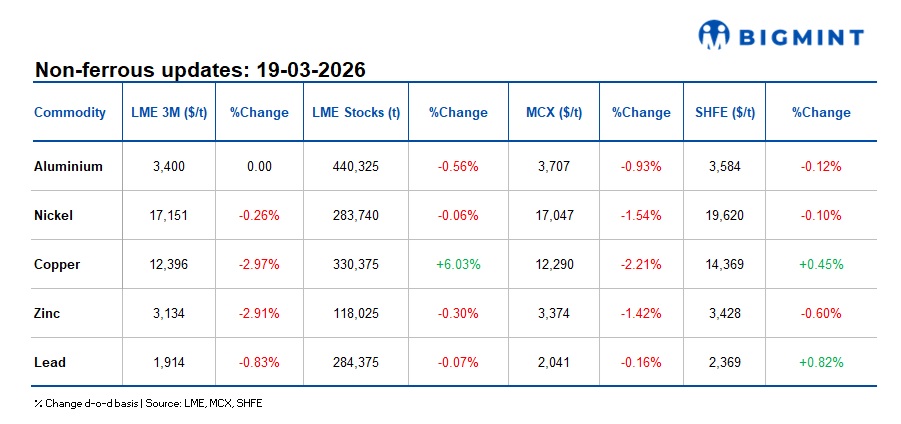
Base metals on the London Metal Exchange (LME) traded lower d-o-d on 19 March 2026, amid cautious market sentiment. Aluminium remained unchanged at $3,400/t, while zinc declined 2.91% to $3,134/t. Lead fell 0.83% to $1,914/t, whereas nickel slipped 0.26% to $17,151/t, and copper dropped 2.97% to $12,396/t.
Warehouse inventory levels were mostly lower. Aluminium stocks decreased 0.56% to 440,325 t, while zinc inventories dipped 0.30% to 118,025 t. Nickel stocks fell 0.06% to 283,740 t, and lead inventories edged down 0.07% to 284,375 t. In contrast, copper stocks rose sharply by 6.03% to 330,375 t.
Domestic market overview
Domestic non-ferrous scrap prices in India showed mixed but largely stable trends, reflecting cautious market sentiment. Aluminium tense scrap (loose), ex-Delhi, remained unchanged at INR 240,000/t, while ex-Chennai prices also held steady at INR 244,000/t.
Meanwhile, copper armature scrap (Cu 99%), ex-Delhi, declined by INR 6,000 or 0.5% to INR 1,102,000/t from INR 1,108,000/t, indicating weak buying sentiment in the market.

Other updates
Iran conflict disrupts global aluminium supply chain
The ongoing Iran conflict is disrupting the global aluminium supply chain, particularly due to restrictions around the Strait of Hormuz, a key route for raw materials and finished metal flows. The Middle East accounts for ~9% of global aluminium production, with supply disruptions impacting both exports and input availability.
Production cuts at Gulf smelters, along with rerouting challenges and logistics constraints, have tightened supply across key consuming regions. With LME inventories already low, aluminium prices have moved to multi-year highs, while physical premiums across the US, Europe, and Asia have surged.
Market participants are increasingly relying on alternative sources, including Indian-origin metal, highlighting elevated supply-side risks and volatility across the aluminium value chain.
Asia’s Russian fuel imports set to hit record high
Asia’s imports of Russian fuel oil are expected to reach a record >3 mt (~614,500 bpd) in March, driven by Middle East supply disruptions and a temporary US sanctions waiver.
With flows through the Strait of Hormuz disrupted, Asian buyers are shifting to alternative supplies. Southeast Asia imports are seen at ~1.7-1.9 mt, while China may import 1.2-1.5 mt for refining.
Higher inflows of HSFO have eased spot premiums, but global supply remains tight, sustaining volatility across energy and commodity markets.
Oil rises over 3% as Iran strikes energy facilities
Oil prices rose >3% on 19 March, with Brent above $112/bbl and WTI near $97/bbl, after Iran targeted key energy facilities across the Middle East.
Strikes on assets in Saudi Arabia, UAE, and Qatar, including damage at Ras Laffan LNG hub, have raised concerns over broader supply disruptions.
The escalation has intensified risks to flows through the Strait of Hormuz, adding a risk premium to energy markets and increasing commodity market volatility.
Iran crisis accelerates shift away from fossil fuels
The Iran conflict has triggered a global energy shock, disrupting flows through the Strait of Hormuz (~20% of global oil & LNG trade) and pushing prices above $100/bbl.
The crisis has exposed vulnerabilities in fossil fuel dependence, prompting investments in renewables, nuclear energy, and strategic reserves. Major economies including China, Japan, and the EU are reassessing supply strategies.
While the US remains relatively insulated, other regions face rising costs, supporting energy diversification and sustained commodity market volatility.
Centaurus, Glencore finalise nickel offtake deal
Centaurus Metals has finalised a nickel offtake agreement with Glencore for its Jaguar project (Brazil).
The deal includes supply of 20,000 dmt/y of ~32% nickel concentrate (~6,400 t contained Ni) for five years from 2029, covering ~one-third of planned 65,000 t/y output.
Material will be processed at Glencore’s Sudbury smelter, with pricing linked to LME nickel prices. The >$450 mn deal enhances financing visibility and supports global nickel sulphide supply.
Taiwan rejects China’s energy security offer
Taiwan has rejected China’s proposal offering energy security in exchange for reunification, reaffirming its political stance amid global energy disruptions.
With the Strait of Hormuz crisis impacting LNG flows, Taiwan has secured alternative supplies, including from the US, to meet near-term demand.
The move highlights rising geopolitical tensions and the intersection of energy security and global politics, adding further uncertainty to commodity markets.
Leave a Reply