- IEA weighs fresh stock release amid severe global oil supply shock
- Copper slips to 3-month low, signalling weak global demand outlook
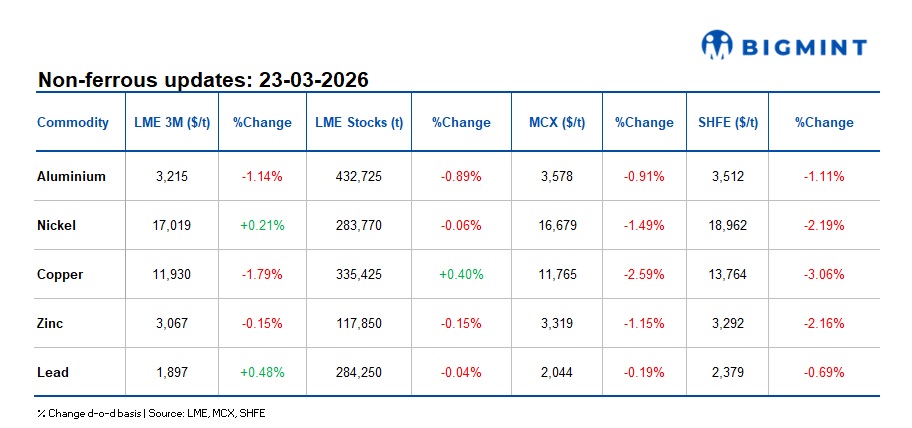
Base metals on the London Metal Exchange (LME) traded mixed but largely lower d-o-d on 20 March, amid cautious market sentiment. Aluminium declined 1.14% to $3,215/t, while zinc eased 0.15% to $3,067/t. Lead bucked the trend, rising 0.48% to $1,897/t, and nickel edged up 0.21% to $17,019/t, whereas copper dropped 1.79% to $11,930/t.
Warehouse inventory trends remained largely on the downside. Aluminium stocks fell 0.89% to 432,725 t, while zinc inventories declined 0.15% to 117,850 t. Nickel stocks edged lower by 0.06% to 283,770 t, and lead inventories dipped 0.04% to 284,250 t. In contrast, copper stocks increased 0.40% to 335,425 t.
Domestic market overview
India’s non-ferrous scrap market showed mixed trends, reflecting cautious market sentiment. Aluminium tense scrap (loose), ex-Delhi, increased by INR 2,000 or 0.8% to INR 245,000/t from INR 243,000/t, while ex-Chennai prices also rose by INR 2,000 or 0.8% to INR 247,000/t from INR 245,000/t.
Meanwhile, copper armature scrap (Cu 99%), ex-Delhi, remained unchanged at INR 1,060,000/t, indicating stable but subdued buying interest in the market.

Other updates
IEA in talks for further oil stock releases amid supply shock
The International Energy Agency (IEA) is consulting with member governments on additional oil stock releases as the Iran conflict continues to disrupt global energy supply. The crisis has removed an estimated around 11 million bpd from the market, marking one of the most severe supply shocks in decades.
The IEA had already coordinated a record release of around 400 million barrels from strategic reserves earlier in March, equivalent to around 20% of emergency stocks, to stabilise markets. However, officials indicated that further releases may be considered if disruptions persist.
Despite these measures, the agency emphasised that stock releases offer only temporary relief, with long-term stability dependent on restoring flows through the Strait of Hormuz. The ongoing disruption is expected to keep oil markets tight and volatile, with spillover effects across global commodity markets.
Copper falls to three-month low amid global growth concerns
Copper prices dropped to a three-month low, pressured by rising concerns over global economic growth and weakening demand outlook. The decline comes amid a broader risk-off sentiment across industrial metals, with investors reassessing demand prospects in light of macroeconomic uncertainty.
The downturn has been further influenced by elevated energy prices and geopolitical tensions, which are raising inflation risks and potentially dampening industrial activity. As a key barometer of economic health, copper has come under pressure alongside other base metals.
Market participants remain cautious, as slowing global growth and demand-side concerns continue to outweigh supply tightness, keeping copper prices under pressure in the near term.
Oil prices rise as US-Iran threats escalate energy supply risks
Oil prices moved higher after the United States and Iran exchanged fresh threats targeting energy infrastructure, intensifying geopolitical tensions in the Middle East. Brent crude climbed above $112/bbl on 23 March, while WTI approached $98/bbl, reflecting heightened risk premiums in global markets.
The escalation follows warnings from the US over potential strikes on Iranian energy assets, with Iran responding by threatening retaliatory attacks on regional oil and energy facilities. The situation has raised concerns over further disruption to flows through the Strait of Hormuz, which handles around 20% of global oil and LNG trade.
Market participants remain cautious as ongoing tensions and infrastructure risks continue to tighten supply expectations, supporting oil prices and increasing volatility across global energy and commodity markets.
Leave a Reply