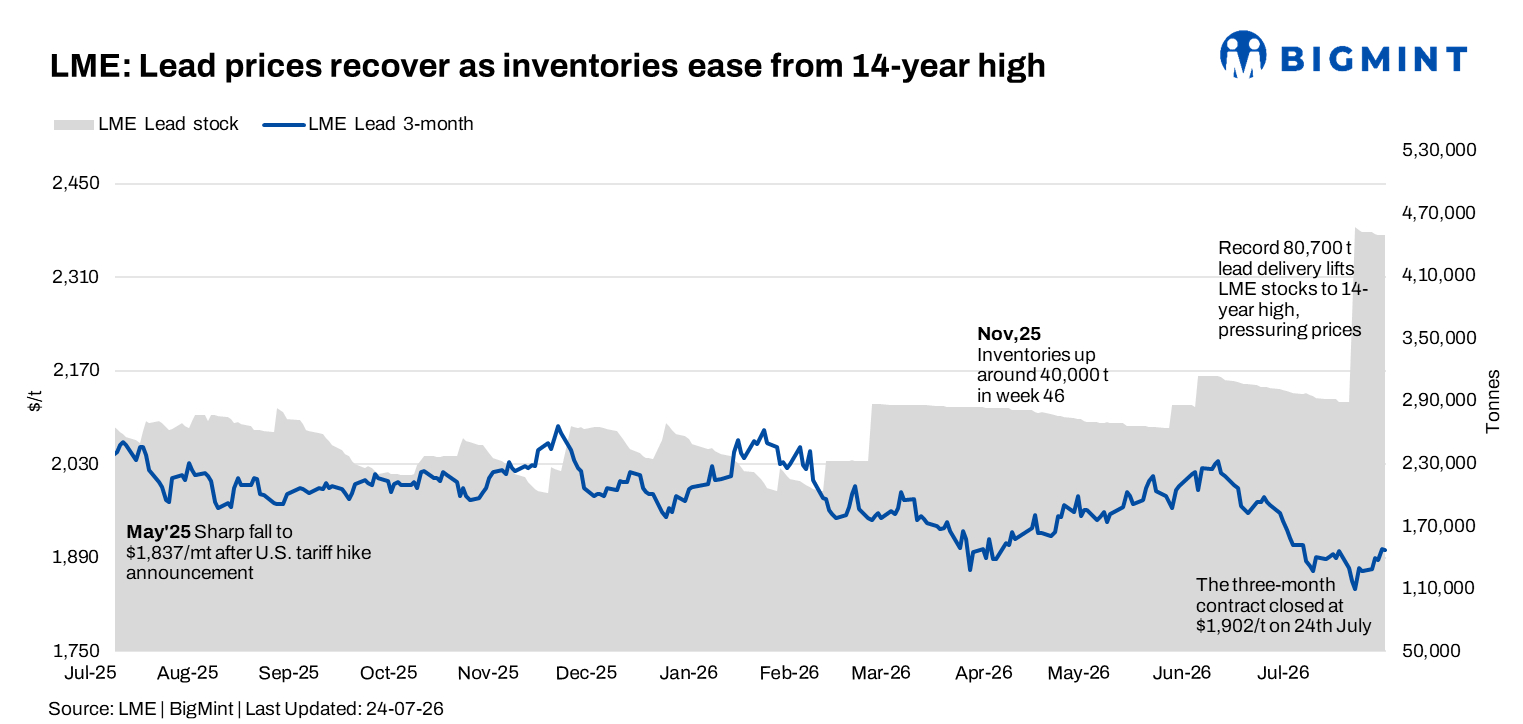
- LME lead stocks decline marginally from 14-year highs
- SHFE lead inches up but market uncertainty keeps prices volatile
Lead prices on the London Metal Exchange (LME) recovered during the week ended 24 July 2026, with prices moving back above the $1,850/t level as exchange inventories eased marginally from the previous week’s 14-year high. The recovery followed a sharp decline in the previous reporting week, when a major inflow of lead into LME warehouses significantly pressured prices.
Despite the improvement in prices, market sentiment remained cautious as LME inventories continued to stay at elevated levels. Mixed trends across the global base metals complex and subdued downstream demand also limited the strength of the recovery.
W-o-w, LME cash lead prices increased to $1,866/t on 24 July from $1,821/t on 17 July, marking a rise of $45/t, or around 2.5%. The three-month contract also strengthened, closing at $1,902/t on 24 July compared with $1,871/t in the previous week.
LME lead stocks declined by 3,225 t w-o-w during the reporting week, easing from 452,075 t on 17 July to 448,850 t on 24 July.
Price trends
LME cash lead prices opened the week at $1,830/t on 20 July and increased to $1,842/t on 21 July. Prices remained unchanged on 22 July before rising sharply to $1,875/t on 23 July. The market then corrected marginally to close at $1,866/t on 24 July.
The three-month contract followed a similar trend. Prices started the week at $1,874/t on 20 July and increased to $1,889/t on 21 July. The contract eased slightly to $1,886/t on 22 July before rising to $1,903/t on 23 July. Prices closed at $1,902/t on 24 July.
The recovery in LME lead prices during the week marked a clear improvement from the previous week’s one-year low. However, prices remained below the psychological $1,900/t level in the cash market, while the three-month contract moved above this level towards the end of the week.
The price recovery was supported by a marginal easing in exchange inventories and a correction in the sharp selling pressure seen during the previous reporting period. However, elevated stocks continued to limit bullish sentiment.
Inventory analysis
LME lead inventories remained elevated during the reporting week but declined marginally from the previous week’s 14-year high.
Exchange stocks stood at 451,775 t on 20 July, before declining to 449,750 t on 21 July and 449,325 t on 22 July. Inventories remained unchanged on 23 July before easing further to 448,850 t on 24 July.
Overall, LME lead stocks declined by 3,225 t w-o-w, or around 0.7%, from 452,075 t on 17 July to 448,850 t on 24 July.
The decline in inventories provided some support to prices after the sharp stock build seen during the previous week. However, the pace of the drawdown remained limited, with total stocks continuing to remain close to 450,000 t.
The elevated inventory levels remained a key factor limiting the recovery in lead prices. The market continued to assess whether the large inflow of metal into LME warehouses seen during the previous reporting period represented a temporary warehouse movement or a signal of weaker underlying demand and excess availability.
The stabilisation and marginal decline in stocks during the week helped improve market sentiment. However, a sustained recovery in prices is likely to require a more significant reduction in exchange inventories or clearer signs of improvement in downstream demand.
SHFE lead trends
Lead prices on the Shanghai Futures Exchange (SHFE) remained volatile during the week, initially strengthening before correcting towards the end of the reporting period.
SHFE lead prices opened at $2,183/t on 20 July and increased sharply to $2,216/t on 21 July. Prices rose further to $2,223/t on 22 July before easing to $2,219/t on 23 July. The contract closed the week at $2,199/t on 24 July.
Overall, SHFE lead prices increased by $8/t, or around 0.4%, during the week from $2,191/t on 17 July to $2,199/t on 24 July.
The initial rise reflected improved sentiment following the recovery in global lead prices. However, the subsequent correction highlighted continued uncertainty in China’s domestic market. Cautious downstream demand and mixed signals from the broader base metals complex continued to limit buying interest.
MCX lead trends (20-24 July)
On the Multi Commodity Exchange (MCX), lead futures remained comparatively resilient and recorded a weekly gain despite a late-week correction.
The July futures contract settled at INR 198,800/t on 20 July before rising to INR 199,050/t on 21 July. Prices increased further to INR 200,850/t on 22 July and remained largely stable at INR 200,900/t on 23 July. The contract then corrected to close at INR 200,150/t on 24 July.
Overall, the MCX lead contract increased by INR 1,350/t w-o-w, or around 0.7%, from INR 198,800/t on 20 July to INR 200,150/t on 24 July.
Open interest declined sharply from 479 lots on 20 July to 363 lots on 21 July and 342 lots on 22 July. It then declined further to 307 lots on 23 July and 222 lots on 24 July.
The combination of rising prices and a sharp decline in open interest suggests that the recovery was largely supported by short covering rather than aggressive fresh long additions. The sharp fall in open interest towards the end of the week also indicates that traders remained cautious despite the improvement in prices.
Trading volumes increased during the middle of the week, with activity rising alongside the recovery in prices. However, the decline in open interest indicated limited conviction in establishing fresh positions.
Market updates
Market sentiment improved during the week as LME lead prices recovered from the sharp decline recorded in the previous reporting period. Cash prices increased by $45/t w-o-w, while the three-month contract rose by $31/t.
The recovery coincided with a marginal decline in LME inventories. Stocks fell by 3,225 t during the week to 448,850 t, providing some relief after the sharp inventory build of 162,700 t recorded in the previous reporting week.
However, the decline in stocks remained limited, with inventories continuing to stay close to the 450,000-t mark. This kept the underlying supply situation a key concern for market participants.
LME cash lead prices recovered above $1,850/t during the week and briefly moved close to the $1,900/t level. The three-month contract crossed above $1,900/t on 23 July and remained marginally above this level on 24 July.
In China, SHFE lead prices increased marginally on a w-o-w basis but remained volatile, with the market correcting after reaching a weekly high of $2,223/t. Meanwhile, MCX lead futures gained around 0.7% during the week, supported by the recovery in international prices and domestic market resilience.
The sharp decline in MCX open interest suggests that the price recovery was driven largely by short covering, rather than strong fresh buying. This could limit the sustainability of the recent gains unless new long positions begin to enter the market.
Outlook
BigMint expects LME lead prices to remain volatile in the near term, with the marginal decline in exchange inventories providing some support but elevated stock levels continuing to cap the upside.
The recovery in prices above $1,850/t represents an improvement from the previous week’s one-year low. However, the market is likely to remain sensitive to further inventory movements. A sustained reduction in LME stocks could provide additional support, while any renewed inflow of metal into exchange warehouses could quickly revive selling pressure.
Immediate support is likely around $1,820-1,850/t, while resistance is expected near $1,900-1,930/t. A sustained move above $1,900/t in the cash market could improve sentiment further, although a stronger recovery would likely require a clearer reduction in exchange inventories and improvement in downstream demand.
Inventory movements, Chinese demand, broader base metals sentiment, and macroeconomic developments will remain key indicators for price direction. In India, MCX lead futures are expected to remain relatively resilient but could continue to track global cues closely. Buyers are likely to maintain a need-based procurement strategy amid elevated global inventories and cautious downstream demand.
Leave a Reply