- US tariff-driven stock movements tighten copper availability outside North America
- Negative smelter TC/RCs and mine disruptions reinforce the tighter supply outlook
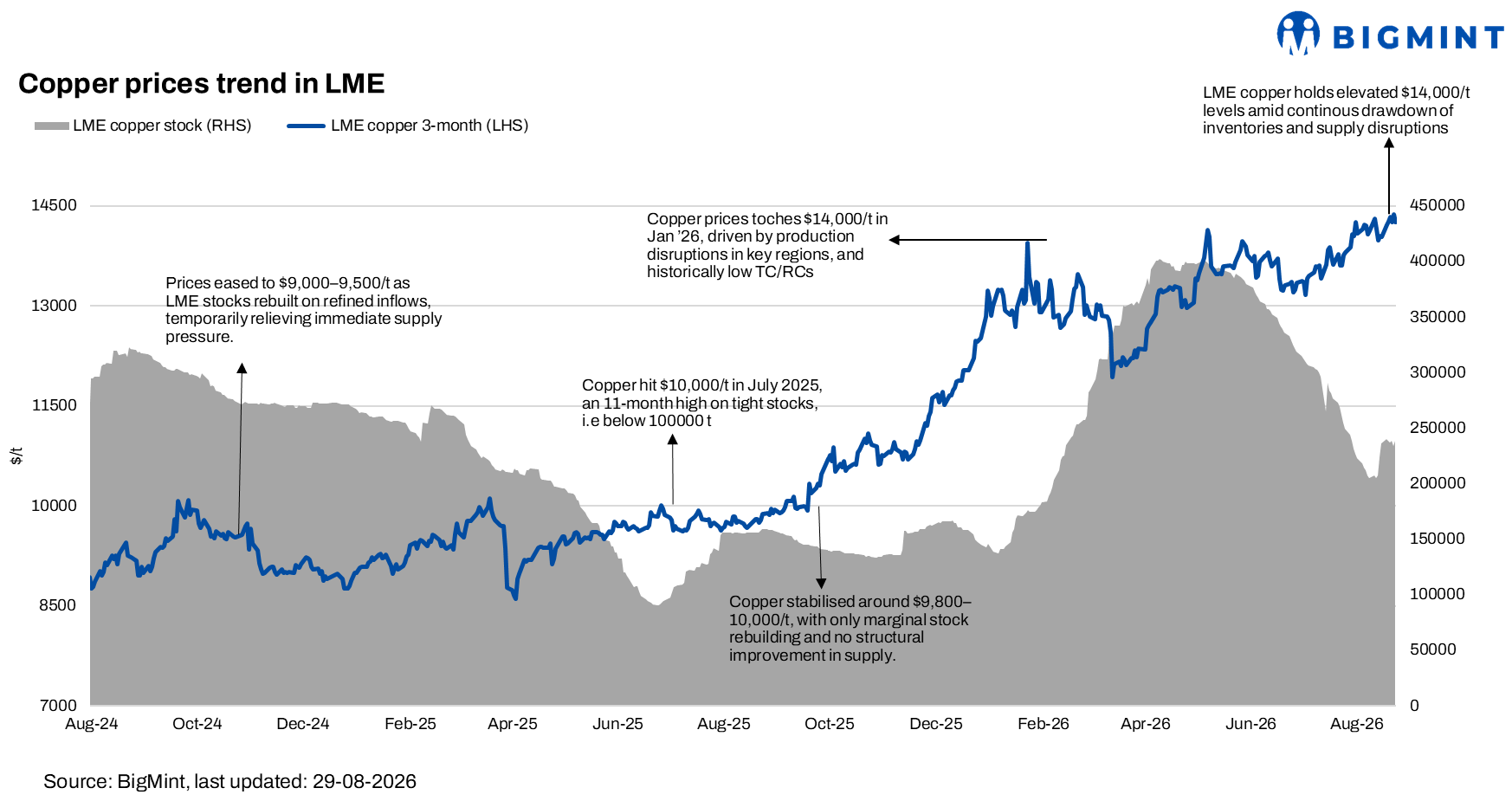
LME copper prices remained near record highs in the week ended 29 August 2026, rising from $14,037/t on 21 August to $14,253/t on 29 August. Tightening physical availability outside the US, tariff-driven trade flows and persistent concerns over mine supply continued to support the market.
Market sentiment remained broadly firm despite elevated exchange inventories. The US tariff threat has encouraged large volumes of refined copper to move into North America, with COMEX inventories reaching a record 675,185 t by late August. This has reduced metal availability in other regions and contributed to rising LME warrant cancellations, increasing the market’s sensitivity to localised physical tightness.
The concentrate market remains another key source of support. Deeply negative treatment and refining charges have pressured smelter margins, while disruptions at major mining operations have restricted feedstock availability. Copper supply has also been affected by lower output at major Chilean operations, while Kamoa-Kakula has maintained reduced 2026 production guidance following earlier operational and development challenges.
US tariff uncertainty continues to distort global copper flows as traders seek to position material ahead of potential duties on refined copper. At the same time, longer-term demand expectations remain supported by grid investment, electrification and AI-related power infrastructure.
Copper bulls regain momentum
According to the latest CME COT report, coppers long positions rose to a two-year high. A total of 10,897 lots were added in July alone, the highest monthly increase since September 2024.
The return of bulls in recent weeks was triggered by strong results from major US technology companies and their increased AI infrastructure investments. This has reinforced expectations of higher future copper demand.
Tightening ore availability is forcing smelters in China to cut output. The countrys refined copper production declined 3.7% month-on-month from its record high in July 2026.
On the other hand, the price gap between CME and LME prices continues to attract surplus copper inventories into CME warehouses, which have set a series of record highs since last year. This shift has been tightening the availability of metal elsewhere, with LME copper stocks falling 39% over the past three months.
Copper scrap prices remain firm on tight supply
India’s copper scrap market remained firm in the week ended 26 August 2026, supported by steady demand from wire rod, cable, brass and alloy manufacturers, alongside limited availability of premium-grade scrap. Tight domestic supply, elevated import costs and stronger global copper prices continued to support market sentiment despite some improvement in scrap yard inventories.
According to BigMint’s assessment, copper armature scrap, ex-Delhi, was assessed at INR 1,310,000/t (INR 1,310/kg), up from INR 1,280,000/t a week earlier. Market participants reported multiple transactions around INR 1,310/kg during the assessment period, reflecting stronger buying interest and constrained spot availability.
Government announces up to 6% stake sale in Hindustan Copper
The Indian government announced an OFS of up to 6% of Hindustan Copper, with an initial 3% stake offered at a floor price of ₹514/share, plus an option for another 3% in case of strong demand. The initial non-retail portion was fully subscribed, while HCL shares fell sharply following the announcement.
Codelco’s copper output falls 11% in H1CY’26
Chile’s state-owned Codelco reported H1 pre-tax profit of $1.97 billion, more than four times last year’s level, but its own copper production fell 11% y-o-y to 564,000 t. Lower output was linked to operational restrictions at El Teniente, weaker Chuquicamata production and lower ore grades at Ministro Hales. The company is also dealing with the aftermath of the fatal July accident at El Teniente, while its 2026 production target of 1.33–1.36 million t is becoming increasingly difficult to achieve.
Leave a Reply