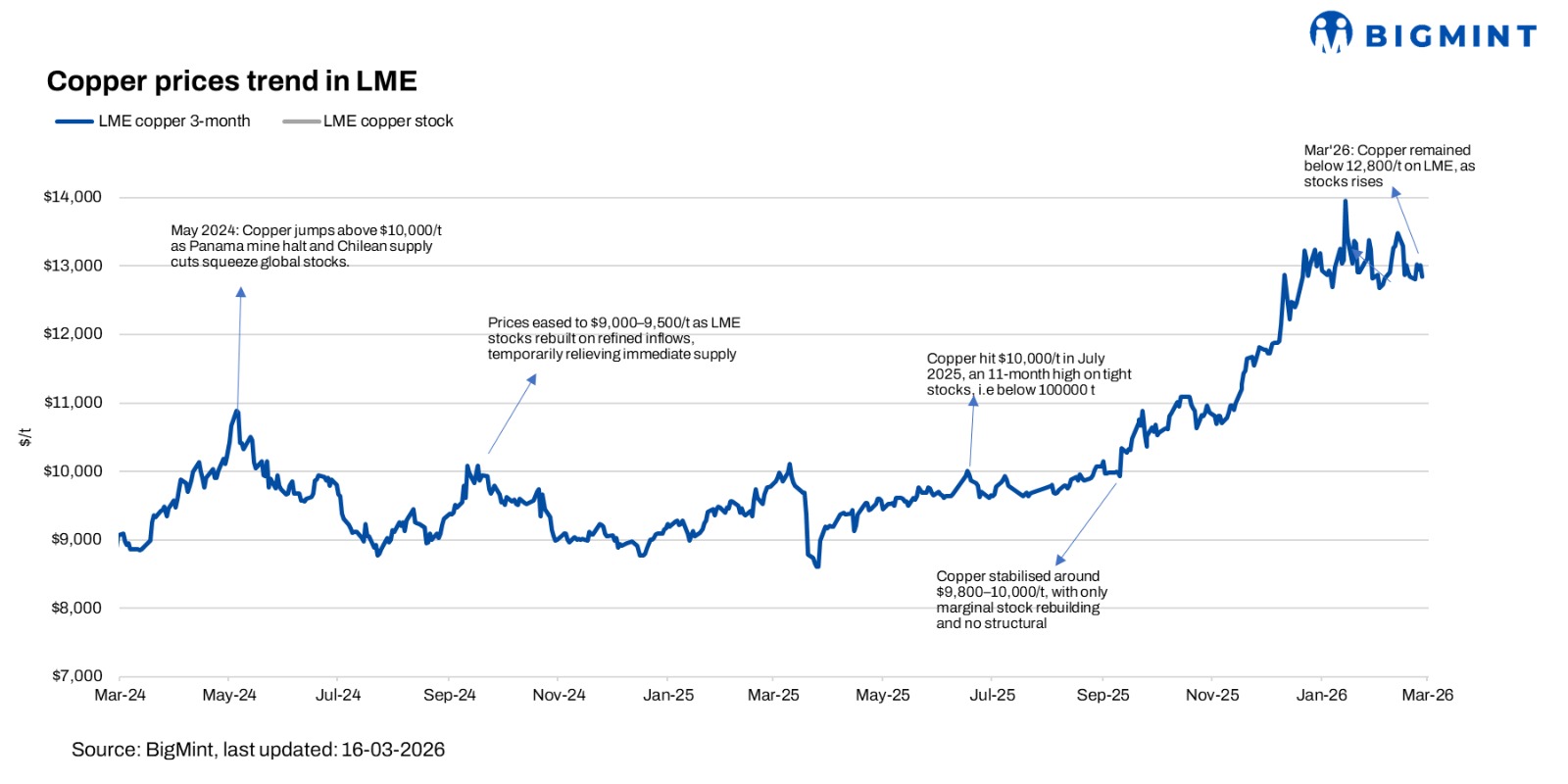
- Inventories rising to ~284,000 t weigh on LME prices
- Iran-Israel tensions have limited impact on global copper fundamentals
Copper prices on the London Metal Exchange remained largely rangebound over the past week, with the benchmark three-month contract settling at $12,780/t on 13 March, marginally lower than $12,900/t recorded on 6 March. The slight decline reflects a balanced market where improving supply indicators have offset supportive demand expectations.
One of the key factors weighing on prices has been the steady rise in exchange inventories. LME copper stocks have increased from around 253,000 t in early March to nearly 284,000 t by 13 March, indicating improved short-term metal availability in the market.
The build-up in inventories suggests that refined copper supply has become relatively comfortable, prompting buyers to adopt a cautious purchasing strategy. Higher stocks on exchange warehouses often signal weaker immediate demand or stronger inflows of refined metal, both of which can exert mild downward pressure on prices.
At the same time, geopolitical tensions between Iran and Israel have had limited direct influence on the copper market. Unlike commodities such as crude oil or aluminium, the Middle East does not play a major role in global copper production. As a result, the conflict has mainly created sentiment-driven volatility rather than any fundamental disruption to copper supply chains. However, concerns over shipping routes near the Strait of Hormuz have pushed freight rates slightly higher, making some importers cautious.
India imports
India’s copper cathode imports doubled m-o-m to 17,200 t in February from 8,600 t in January, as per data maintained by BigMint. This followed a 27% m-o-m decrease in India’s copper scrap imports in February, which hit a one-year low of 25,700 t. With scrap availability tightening, Indian buyers shifted towards sourcing refined copper cathodes, resulting in a sharp increase in imports.
Overall, the marginal w-o-w decline in copper prices reflects a largely stable market environment, where rising inventories and cautious buying sentiment have slightly outweighed geopolitical concerns. Market participants expect prices to remain rangebound in the near term, with movements likely to be influenced by inventory trends, global manufacturing activity, and developments in the broader macroeconomic environment.
Leave a Reply