- Nickel prices rise amid supportive market cues
- Supply disruptions keep metals outlook bullish
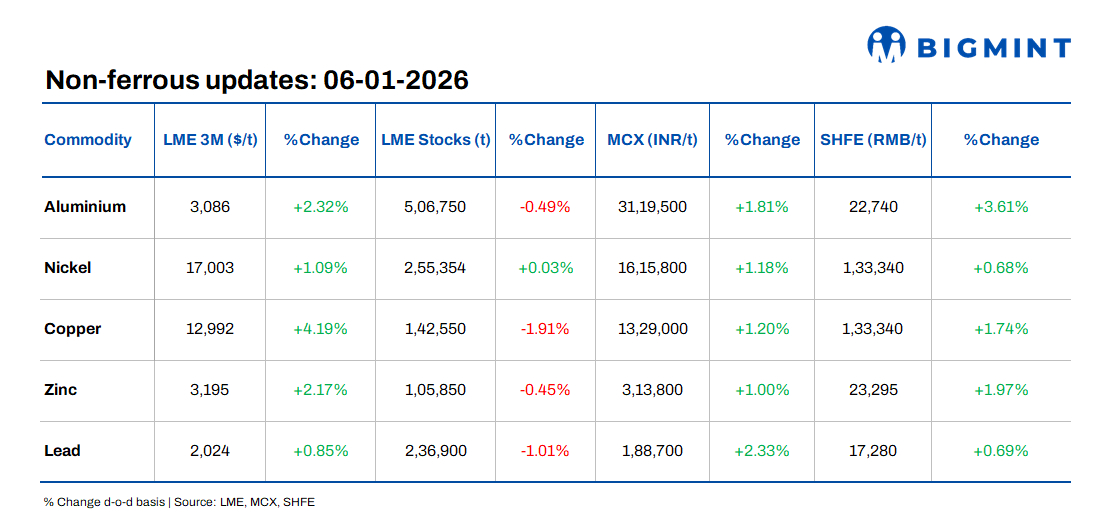
Base metals prices on the London Metal Exchange (LME) strengthened on 5 January, with broad-based gains recorded across the complex, supported by improved sentiment. Aluminium prices jumped 2.32% to $3,086/t, while nickel rose 1.09% to $17,003/t, offering firm support to the market. Copper led the rally, surging 4.19% to $12,992/t on strong buying interest. Zinc prices advanced 2.17% to $3,195/t, and lead also moved higher, gaining 0.85% to $2,024/t.
LME warehouse inventories declined across all base metals, signalling tightening supply conditions. Aluminium stocks fell 0.49% to 506,750 t, while copper inventories dropped sharply by 1.91% to 142,550 t. Zinc stocks decreased by 0.45% to 105,850 t, and lead inventories fell 1.01% to 236,900 t. In contrast, nickel stocks edged up marginally by 0.03% to 255,354 t, indicating broadly balanced availability on the exchange.
Domestic market overview
In India’s non-ferrous markets, BigMint assessed copper armature scrap to be stable at INR 1,110,000/t ex-Delhi, d-o-d. Meanwhile, aluminium Tense scrap prices remained stable at INR 204,000/t ex-Delhi and increased by INR 1500/t to INR 193,000/t ex-Chennai, respectively.

Other market updates
Copper prices hit fresh record in London
Copper prices on the London Metal Exchange surged to a new all-time high of around $13,000/t on 5 January, extending the strong rally driven by tight global supply conditions. The sharp rise reflects disruptions at key mining operations, constrained output growth, and shifting global trade flows, which have tightened availability in the physical market. Strong speculative interest further amplified the move, pushing prices well above previous highs and reinforcing the bullish sentiment across the copper complex.
Aluminium prices surge above $3,000 a tonne
Aluminium prices climbed sharply, rising above $3,000/t on 3 January on the London Metal Exchange for the first time in three years, driven by tight global supply conditions and strong market fundamentals. The move was supported by concerns over production bottlenecks, slowing inventory drawdowns on key exchanges, and renewed buying interest amid expectations of improving demand. As primary aluminium costs strengthened, both imported and domestic scrap prices also trended higher, reflecting broader bullish momentum across the aluminium complex.
Leave a Reply