- Bahrain force majeure lifts aluminium prices
- Hydro begins Qatalum production shutdown
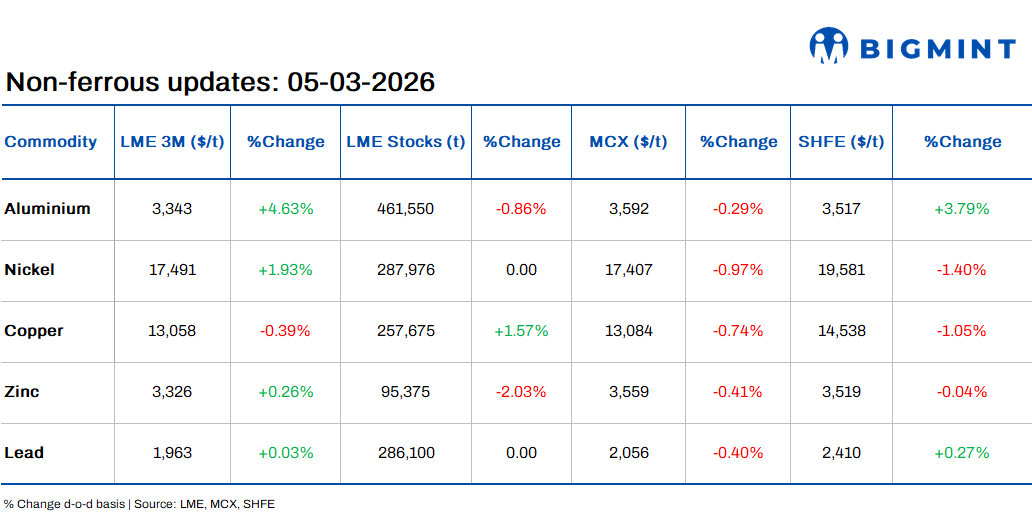
Base metal prices on the London Metal Exchange (LME) closed mostly higher on 4 March 2026, supported by strong gains in aluminium and nickel, while copper recorded a marginal decline. Aluminium surged 4.63% to $3,343/t, with inventories declining 0.86% to 461,550 t, indicating continued stock drawdowns. Nickel gained 1.93% to $17,491/t, while stocks remained unchanged at 287,976 t.
Copper slipped 0.39% to $13,058/t, despite inventories rising 1.57% to 257,675 t. Zinc edged up 0.26% to $3,326/t, even as stocks fell 2.03% to 95,375 t, reflecting relatively tighter availability. Meanwhile, lead inched up 0.03% to $1,963/t, with inventories steady at 286,100 t.

Domestic market overview
Domestic non-ferrous scrap prices in India strengthened d-o-d. Aluminium tense scrap (solid, loose), ex-Delhi, remained unchanged at INR 223,000/t, while aluminium tense scrap (solid, loose), ex-Chennai, rose by INR 1,500/t or 0.7% to INR 228,500/t from INR 227,000/t.
Meanwhile, copper armature scrap (Cu 99%), ex-Delhi, declined by INR 2,000/t or 0.2% to INR 1,145,000/t from INR 1,147,000/t d-o-d.
Other market updates
Bahrain force majeure pushes aluminium higher amid supply fears
Aluminium prices rose sharply after Aluminium Bahrain declared force majeure on supply contracts due to shipping disruptions through the Strait of Hormuz, even as production continues but shipments remain blocked. On 4 March, SHFE aluminium 2604 closed at RMB 25,145/t, up 1.41%, while LME aluminium touched $3,418/t — its highest since April 2022 — before settling at $3,335.5/t, with inventories falling by 425 t. Escalating Middle East tensions, potential smelter suspensions in Qatar and Mozambique, and ongoing inventory drawdowns have widened global supply gap expectations, supporting prices. Domestically, however, rising post-holiday inventories and moderate demand recovery may limit upside, though short-term sentiment remains firm on geopolitical risk.
EBRD backs aluminium expansion in Egypt
The European Bank for Reconstruction and Development (EBRD) is extending a loan of EUR 13.7 million to Alumil Misr, the Egyptian subsidiary of Greece’s ALUMIL, to support the installation of a new aluminium extrusion line at its facility in Cairo’s Polaris Industrial Zone. The expansion will raise production capacity, improve efficiency, and strengthen the company’s vertical integration strategy. Strategically located near the Suez Canal, the upgraded plant is expected to serve as an export hub for aluminium systems across Africa and the Middle East, reinforcing regional manufacturing competitiveness.
Hydro begins Qatalum shutdown after LNG halt
Norway’s Hydro has initiated a controlled shutdown of its Qatar-based joint venture Qatalum after Qatar Energy halted LNG production at Ras Laffan following a drone attack linked to the Israel/US-Iran conflict. The shutdown is expected to conclude by end-March, with a potential 6-12 month restart timeline if fully closed, and a force majeure notice has been issued to customers. Qatalum has a primary aluminium capacity of 636,000 t per year, with rising concerns over Strait of Hormuz disruptions supporting demand for value-added aluminium products in Asia.
Oil prices extend rally as Iran conflict disrupts supply
Oil prices rose for a fifth straight session on 5 March 2026 as the escalating US-Israel conflict with Iran heightened supply concerns. Markets remain tense as traffic through the Strait of Hormuz has nearly halted, leaving around 300 tankers stranded amid rising security risks and reported strikes near vessels, while Iraq has cut output by nearly 1.5 million barrels per day due to storage and export constraints and Qatar declared force majeure on LNG exports. European diesel futures hit their highest level since October 2022, and China has reportedly asked major refiners to suspend fuel exports, further tightening global supply as geopolitical risks continue to drive volatility across energy markets.
Leave a Reply