- Nickel posts steepest decline on LME
- Policy, ESG updates shape broader metals outlook
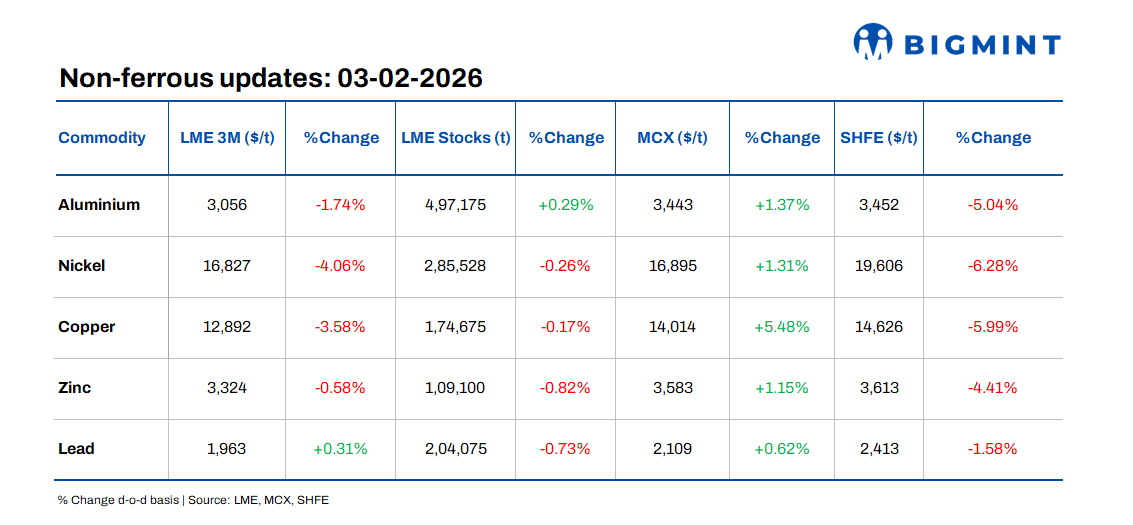
Base metals prices on the London Metal Exchange (LME) traded broadly lower on 2 February, reflecting a continued risk-off tone across the complex. Nickel posted the steepest decline, sliding 4.06% to $16,827/t, while copper fell 3.58% to $12,892/t. Aluminium prices eased 1.74% to $3,056/t, zinc edged down 0.58% to $3,324/t, while lead bucked the broader trend, inching up 0.31% to $1,963/t, offering limited support to overall market sentiment.
LME warehouse inventories showed mixed trends, highlighting uneven supply dynamics. Aluminium stocks rose marginally by 0.29% to 497,175 t, pointing to slightly improved availability. Copper inventories slipped 0.17% to 174,675 t, while nickel stocks declined 0.26% to 285,528 t, suggesting mild tightening. Zinc stocks fell a sharper 0.82% to 109,100 t, and lead inventories dropped 0.73% to 204,075 t, indicating tightening supply conditions across parts of the complex.
Domestic market overview
In India’s non-ferrous scrap market, aluminium Tense scrap prices declined d-o-d across key regions. Ex-Delhi assessments decreased by INR 1,000/t (0.5%) to INR 211,000/t, while ex-Chennai prices decreased by INR 2,000/t (0.9%) to INR 213,000/t. Meanwhile, Copper armature scrap prices, ex-Delhi, also declined sharply by INR 85,000/t (0.2%) to INR 1,131,000/t.

Domestic market overview
MPE supports CBAM extension to downstream aluminium and steel products from 2028
Metal Packaging Europe (MPE) has backed the European Commission’s proposal to extend the Carbon Border Adjustment Mechanism (CBAM) to downstream iron, steel and aluminium products from 1 January 2028, arguing it will close loopholes, curb carbon leakage and ensure fair competition. MPE said the current focus on primary metals leaves many semi-finished and finished products unregulated, weakening climate objectives, and welcomed the plan to include around 180 additional downstream products such as automotive components, machinery, construction goods and can ends. The extension would apply across six carbon-intensive sectors, while small importers below 50 tonnes remain exempt, and MPE stressed that clear benchmarks and transparent rules are crucial to protect downstream value chains, support recycling and avoid penalising low-carbon manufacturers as CBAM enters its definitive phase in 2026.
Hindustan Zinc wins ICAI award for best large-cap manufacturing BRSR report
Hindustan Zinc Limited has won the ‘Best BRSR Report – Manufacturing (Large Cap)’ award at the 4th ICAI Sustainability Reporting Awards, recognising the strength, transparency and decision-useful quality of its FY 2024-25 sustainability disclosures. The Institute of Chartered Accountants of India (ICAI) cited the company’s governance-led, data-driven reporting across key ESG indicators such as emissions, energy, water, biodiversity, occupational safety, community impact and business conduct, aligned with global benchmarks. Hindustan Zinc was an early adopter of BRSR ahead of SEBI’s mandate and has built a robust reporting framework spanning GRI, IFRS S2, TNFD and other voluntary disclosures, while advancing its decarbonisation agenda through higher renewable energy use, SBTi-aligned targets and a net-zero ambition by 2050, reinforcing its position as one of India’s most sustainable and forward-looking metals companies.
Leave a Reply