- Iran conflict impacts oil demand, long-term outlook firm
- Rising crude oil prices increase inflation pressure in India
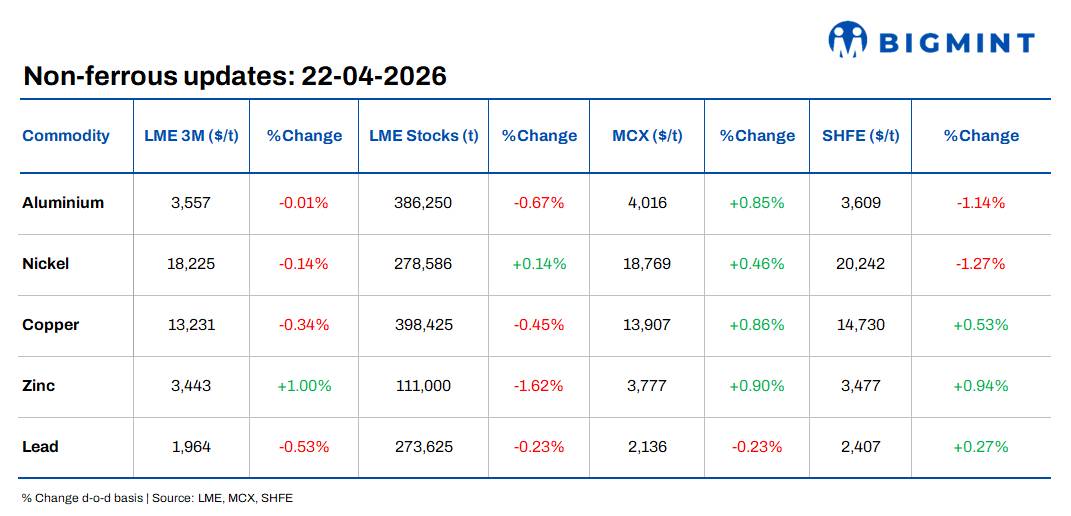
Base metals on the London Metal Exchange traded on the downside d-o-d on 21 April 2026, with most metals posting declines while zinc remained the only gainer. Lead recorded the sharpest fall, declining 0.53% to $1,964/t, followed by copper, which slipped 0.34% to $13,231/t. Nickel eased 0.14% to $18,225/t, while aluminium remained largely flat with a marginal dip of 0.01% to $3,557/t. In contrast, zinc rose 1.00% to $3,443/t.
On the inventory front, stocks continued to decline across most metals, indicating tightening supply conditions. Zinc inventories registered the steepest drop, down 1.62% to 111,000 t, followed by aluminium, which fell 0.67% to 386,250 t. Copper stocks decreased 0.45% to 398,425 t, while lead inventories edged lower by 0.23% to 273,625 t. Meanwhile, nickel stocks increased slightly by 0.14% to 278,586 t, suggesting relatively stable availability compared to other metals.
Domestic market overview
India’s non-ferrous scrap market witnessed a mixed-to-weak trend on a d-o-d basis. Aluminium tense scrap (loose), ex-Delhi, remained stable at INR 287,000/t. However, ex-Chennai prices declined by INR 2,000/t or 0.7% to INR 303,000/t, reflecting a mild correction in southern markets.
In the copper segment, sentiment remained subdued. Copper armature scrap (Cu 99%), ex-Delhi, fell by INR 5,000/t or 0.4% to INR 1,130,000/t, indicating continued demand weakness.

Other market updates
Rio Tinto strengthens copper focus amid rising demand outlook
Rio Tinto reported a 9% increase in Q1CY’26 copper output, reinforcing its strategic pivot toward copper as a key growth driver aligned with energy transition demand. The miner continues to prioritise copper investments and project pipeline expansion, positioning itself to benefit from tightening supply and structurally strong demand fundamentals.
The move highlights growing industry-wide focus on copper as a critical metal for electrification, supporting a bullish long-term outlook.
Iran war may weigh on near-term oil demand
The ongoing Iran conflict is expected to sharply reduce oil demand in the short term due to severe supply disruptions and economic slowdown, with global demand projected to contract by nearly 80,000 bpd in 2026.
The closure of the Strait of Hormuz has removed nearly 13 million barrels per day of supply, triggering refinery shutdowns and demand destruction, particularly across Asia.
However, over the longer term, the crisis could drive higher oil demand through increased investment in energy security, domestic production, and infrastructure, supporting a structurally bullish outlook.
Hormuz reopening hopes fade; aluminium & copper find support
Hopes of a sustained reopening of the Strait of Hormuz have weakened, but base metals — particularly aluminium and copper — continue to find support from underlying supply-side constraints and cost pressures.
Aluminium prices rebounded after a brief dip, supported by lower Gulf output in March, which remained around 6% lower m-o-m, and a sharp 87% surge in China’s alumina imports to nearly 340,000 t, tightening global availability.
Copper fundamentals also remain firm despite record Chinese refined output of around 1.33 mnt in March, as deteriorating TC/RCs at negative 66.1 levels and sulphuric acid export restrictions continued to squeeze smelter margins and support prices.
Overall, fading optimism around Hormuz reopening, coupled with persistent supply disruptions and cost-side pressures, is sustaining a supportive outlook for industrial metals.
Indian bond yields rise as oil near $100/bbl amid geopolitical tensions
Indian government bond yields moved higher as global crude oil prices hovered near $100 per barrel, driven by escalating geopolitical tensions in West Asia.
Rising oil prices have heightened inflation concerns for India, increasing input costs and pressuring macroeconomic stability, prompting investors to demand higher yields on government securities.
As a major crude importer, India remains highly sensitive to oil price volatility, with sustained elevated prices posing risks to inflation outlook and bond market stability.
Trump considers extending Jones Act waiver to support oil flows
The US administration is evaluating an extension of the temporary Jones Act waiver to facilitate domestic oil shipments and ease fuel price pressures amid ongoing Iran-related disruptions.
The waiver, initially implemented for 60 days from mid-March, allows foreign-flagged vessels to transport fuel between US ports, improving logistical flexibility and boosting shipping capacity.
The move is aimed at stabilising domestic energy markets, as supply chain disruptions and elevated freight constraints continue to impact fuel distribution across regions
Leave a Reply