- Aluminium up 0.8% as inventories decline on LME
- India scrap strengthens; geopolitics and demand concerns weigh
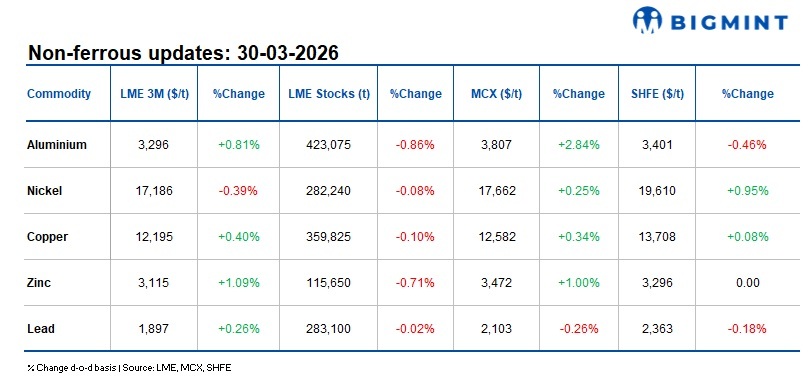
Base metals on the London Metal Exchange (LME) showed mixed trends d-o-d as of close of trading on 27 Mar’26 reflecting divergent trends across the complex. Aluminium increased 0.81% to $3,296/t, while zinc rose 1.09% to $3,115/t and copper gained 0.40% to $12,195/t. Lead also edged up 0.26% to $1,897/t. In contrast, nickel declined 0.39% to $17,186/t, indicating selective weakness.
On the inventory side, stocks declined across most base metals, pointing to tightening availability. Aluminium inventories fell 0.86% to 423,075 t, while zinc stocks dropped 0.71% to 115,650 t. Copper inventories eased 0.10% to 359,825 t, nickel stocks edged down 0.08% to 282,240 t, and lead inventories declined 0.02% to 283,100 t, indicating a broad-based drawdown in exchange stocks.
Domestic market overview
India’s non-ferrous scrap market remained positive, indicating improving domestic buying sentiment. Aluminium tense scrap (loose), ex-Delhi, increased by INR 7,000/t or 2.8% to INR 261,000/t from INR 254,000/t, while ex-Chennai prices also strengthened by INR 5,000/t or 2% to INR 257,000/t from INR 252,000/t.
Similarly, prices of copper armature scrap (Cu 99%), ex-Delhi, rose by INR 20,000/t or 1.8% to INR 1,135,000/t from INR 1,115,000/t, reflecting steady demand and firm market fundamentals.

Other updates
Vedanta to demerge into five entities to unlock value
Vedanta Ltd. is set to undergo a major corporate restructuring, with plans to demerge into five independently listed entities by mid-2026, following regulatory approval.
Post-restructuring, Vedanta Ltd. will continue as the base metals-focused entity, while four verticals-Vedanta Aluminium, Talwandi Sabo Power, Vedanta Iron and Steel, and Malco Energy-will be carved out and listed separately, enabling segment-wise valuation and operational independence.
The company is expected to retain around 50% stake in each entity, ensuring strategic control while enhancing capital allocation efficiency and business focus. The combined valuation of the demerged entities could exceed the group’s current around $27 billion market cap.
Despite earlier concerns from the Indian government regarding debt recovery implications, the restructuring has progressed post tribunal approval, with listings targeted before mid-May.
Iran strikes aluminium facilities in UAE, Bahrain
Iranian strikes targeting key aluminium facilities in the UAE and Bahrain have heightened concerns over disruptions to global supply chains, particularly from the Gulf region, a critical aluminium-producing hub.
Major producers, including Emirates Global Aluminium (EGA) and Aluminium Bahrain (Alba), reported damage and operational disruptions, with some capacity already impacted amid ongoing logistics constraints.
The escalation has also disrupted shipping routes through the Strait of Hormuz, affecting both raw material inflows and finished metal exports, further tightening near-term supply conditions.
Market sentiment remains volatile, with supply risks rising amid continued geopolitical tensions and uncertainty around production and trade flows in the region
Aluminium prices rise up to 6% on Iran strikes disrupting supply
LME aluminium prices rose up to 6% to ~$3,492/t on 30 March 2026, following Iran’s strikes on aluminium facilities in the UAE and Bahrain, heightening concerns over supply disruptions.
The rally was driven by potential disruptions at key producers, including Emirates Global Aluminium (EGA) and Aluminium Bahrain (Alba), alongside risks to shipments through the Strait of Hormuz, a critical trade route.
Market sentiment remains firm but volatile, with ongoing geopolitical tensions likely to sustain supply risks and price fluctuations in the near term.
India economy shows early signs of slowdown amid West Asia crisis
India’s economy has begun showing early signs of moderation in March, as external shocks from the West Asia conflict and rising crude oil prices start to impact domestic activity.
According to the Finance Ministry’s monthly review, the slowdown is being driven by higher input costs, supply disruptions, and emerging pressure across key sectors, indicating the first sequential signs of easing economic momentum after a strong start to the year.
Despite this, economic activity remained resilient until February, supported by robust domestic demand, infrastructure spending, and stable consumption trends, suggesting that the slowdown is gradual rather than structural at this stage.
Leave a Reply