- Oil prices rally as Iran denies US talks; India weighs costly Iranian supply
- Strategic trade deals drive focus on minerals, energy supply resilience
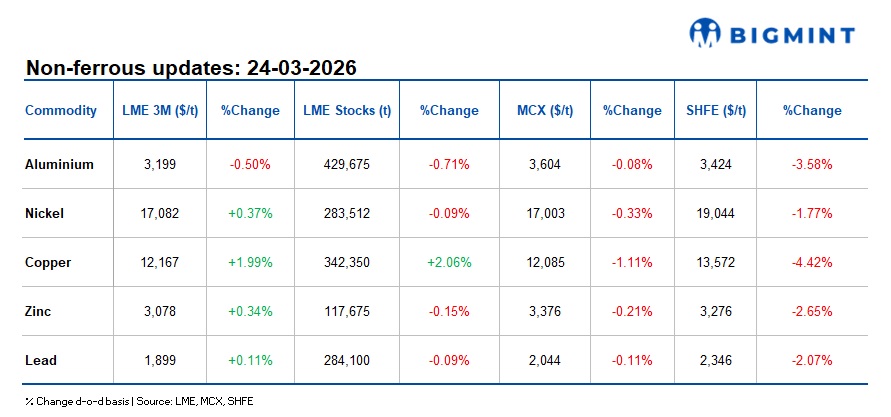
Base metals on the London Metal Exchange (LME) traded higher d-o-d as of close on 23 March, supported by improved market sentiment. Aluminium, however, declined 0.50% to $3,199/t, while zinc rose 0.34% to $3,067/t. Lead edged up 0.11% to $1,899/t, and nickel gained 0.37% to $17,082/t, whereas copper advanced 1.99% to $12,167/t.
Warehouse inventory trends remained largely on the downside. Aluminium stocks decreased 0.71% to 429,675 t, while zinc inventories fell 0.15% to 117,675 t. Nickel stocks edged down 0.09% to 283,512 t, and lead inventories declined 0.09% to 284,100 t. In contrast, copper stocks increased 2.06% to 342,350 t.
Domestic market overview
India’s non-ferrous scrap market remained largely stable, reflecting cautious market sentiment. Aluminium tense scrap (loose), ex-Delhi, increased by INR 2,000/t or 0.8% to INR 247,000/t from INR 245,000/t, while ex-Chennai prices held steady at INR 247,000/t.
Meanwhile, copper armature scrap (Cu 99%), ex-Delhi, remained unchanged at INR 1,060,000/t, indicating subdued buying activity in the market.

Other updates
Oil edges higher as Iran denies US talks, supply risks persist
Oil prices moved higher as markets reassessed supply risks after Iran denied holding talks with the United States, contradicting earlier claims of potential de-escalation. Brent crude rebounded to around $101-104/bbl, while WTI rose toward $89-92/bbl, recovering after a sharp decline in the previous session.
The denial has renewed concerns over prolonged disruptions in the Middle East, particularly around the Strait of Hormuz, a key route handling around 20% of global oil and LNG flows. Ongoing attacks on energy infrastructure and constrained tanker movement continue to tighten supply expectations.
Market sentiment remains cautious, with analysts warning that prices could retest $110/bbl or higher if disruptions persist, keeping energy markets volatile with spillover effects across commodities
Iranian oil offered to India at premium amid supply disruptions
Iranian crude is being offered to Indian refiners at a premium of $6-8/bbl over Intercontinental Exchange (ICE) Brent, following a temporary US sanctions waiver aimed at easing the ongoing energy crisis.
India, which has not imported Iranian oil since 2019, is now facing supply constraints due to disruptions in shipments through the Strait of Hormuz. Refiners have a limited window to secure crude and LPG cargoes from Iran, given geographical proximity and tightening global supply.
However, buying interest remains cautious due to payment challenges, sanctions risks, and Iran’s exclusion from SWIFT, even as some suppliers show flexibility on currency settlement. The development highlights tightening supply conditions and rising cost pressures in global energy markets.
EU-Australia trade deal advances amid tariff risks, geopolitical tensions
The European Union and Australia have finalised a long-pending free trade agreement (FTA), aimed at strengthening economic ties and reducing reliance on China and volatile global trade routes. The deal removes tariffs on most goods, including critical minerals, industrial products, and key exports, while improving market access across sectors.
The agreement comes against the backdrop of rising protectionism and tariff risks linked to US trade policies, particularly under renewed pressure from potential Trump-era tariffs, prompting countries to diversify trade partnerships.
Beyond trade, the pact also includes strategic cooperation on critical minerals and supply chains, reinforcing efforts to secure resources such as lithium and rare earths. The move highlights a broader shift toward economic resilience and supply chain diversification, as global markets navigate geopolitical tensions and trade uncertainties.
Vietnam, Russia sign nuclear power deal amid energy pressures
Vietnam and Russia have signed an agreement to develop Vietnam’s first nuclear power plant, marking a major step to strengthen long-term energy security amid rising demand. The project will involve the construction of two nuclear reactors with a combined capacity of around 2,400 MW, led by Russia’s state nuclear firm Rosatom.
The move comes as Vietnam faces frequent power shortages, driven by rapid industrial growth, rising electricity demand, and weather-related disruptions. The project revives earlier nuclear plans that were suspended in 2016 due to cost and safety concerns and later restarted in 2024.
The agreement highlights Vietnam’s strategy to diversify its energy mix beyond fossil fuels, while deepening energy cooperation with Russia. The development is expected to support long-term power stability, with broader implications for regional energy markets and infrastructure investment.
Leave a Reply