- Oil jumps 5% on Middle East tension
- Copper demand rise drives BHP investment
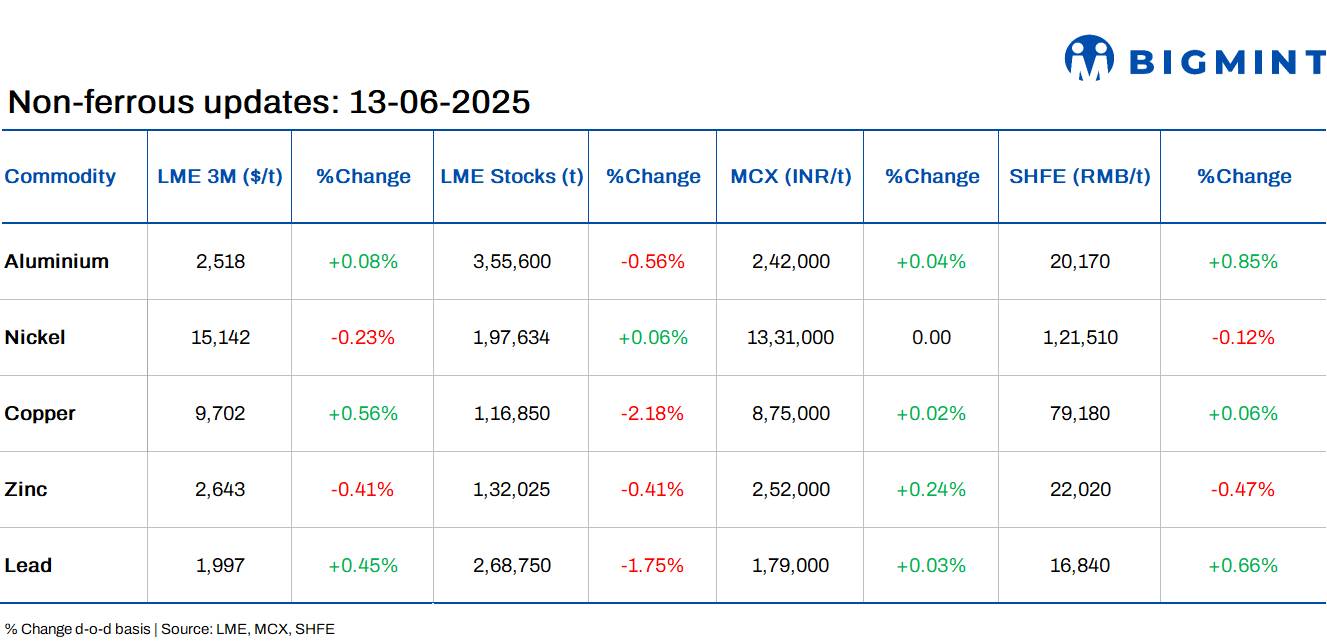
Base metals prices on the London Metal Exchange (LME) remained range-bound d-o-d, with copper increasing by 0.56% to $9,702/tonne (t). Meanwhile, inventories at LME-registered warehouses dropped d-o-d, with copper recording the highest fall of 2.18%.
Indian market overview
In India’s non-ferrous metals markets, BigMint assessed domestic copper armature scrap at INR 805,000/t ex-Delhi, stable d-o-d. Aluminium Tense scrap prices remained steady d-o-d, with ex-Delhi at INR 196,000/t and ex-Chennai at INR 197,000/t.
Additionally, in FY’25, India imported 239,000 t of copper cathode, 34% less than 363,000 t in the previous financial year. Amid sharp drop in imports between December 2024 to February 2025, two trade associations filed a petition against the Union Mines Ministry, which issued a Quality Control Order (QCO) in 2023 which came into force last year regulating the use of copper products, alleging that stringent quality norms have caused acute shortages in supply.
Futures, index updates (d-o-d)

Market updates
UK economy shrinks in April
Britain’s GDP fell by 0.3% in April, the steepest monthly drop since October 2023. Production was hit hard, led by a 0.4% decline in services, especially real estate and legal sectors, following the end of a property tax break. Car production and exports also dipped as a fallout of US tariffs.
BHP poised for copper growth with Vicuna stake
BHP has reaffirmed its copper ambitions with a $2 billion acquisition of a 50% stake in Argentina’s Vicuna project. Backed by strong financials, including $25.8 billion EBITDA and low debt, BHP is set to invest $8.5 billion over a decade. JPMorgan maintains an Overweight rating, citing major development phases and long-term copper output potential from Josemaria and Filo del Sol.
Oil prices surge amid escalating Israel-Iran conflict
Oil prices spiked more than 5% to a two-month high after Israel launched strikes on Iran, triggering fears of broader conflict in the Middle East that could threaten regional oil infrastructure and supply chains, with concerns that any escalation involving Iranian retaliation particularly targeting oil assets or disrupting the Strait of Hormuz-could significantly impact up to 20 million barrels per day of global oil flow.
Leave a Reply