- Australia secures Tomago Aluminium smelter and jobs
- Novelis invests €43 million in rail logistics
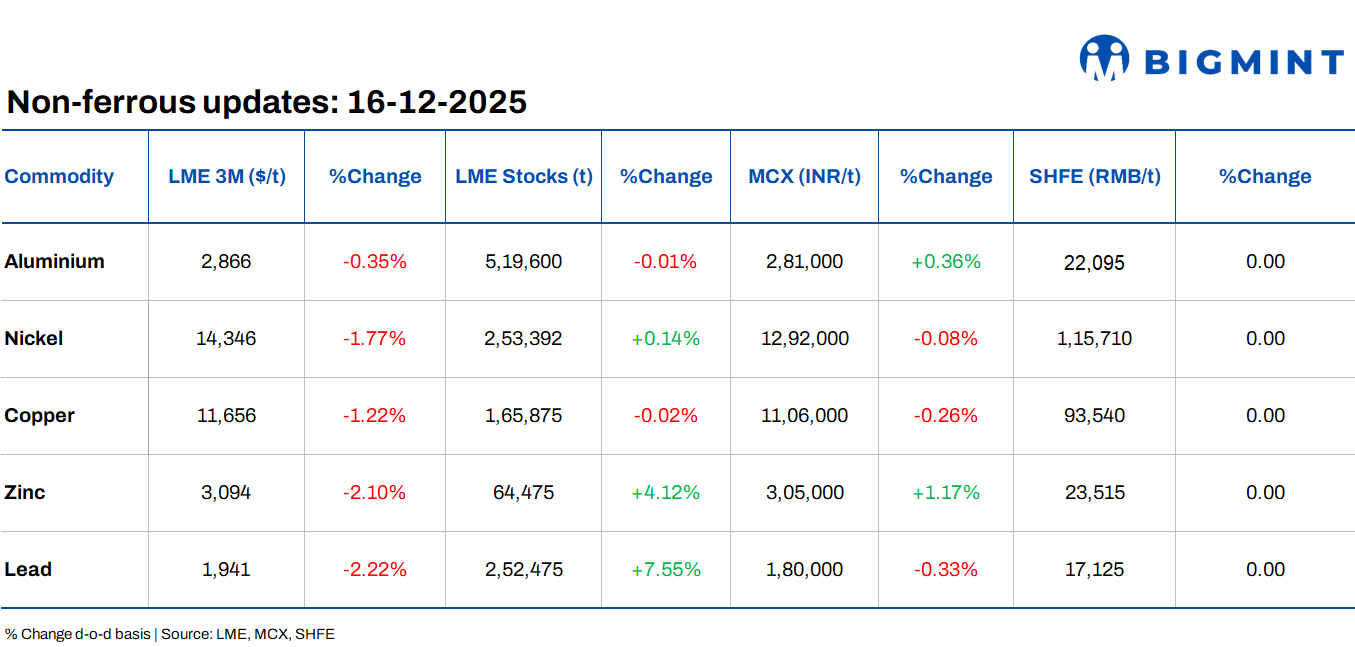
Base metals prices on the London Metal Exchange posted broad declines, with zinc and lead leading the losses. Zinc fell 2.10% to $3,094/t and lead dropped 2.22% to $1,941/t, while copper slipped 1.22% to $11,656/t. Nickel declined 1.77% to $14,346/t, and aluminium eased 0.35% to $2,866/t.
LME warehouse stocks showed mixed movements, with zinc inventories rising sharply by 4.12% to 64,475 t and lead stocks jumping 7.55% to 252,475 t, while aluminium stocks edged down 0.01% to 519,600 t, and copper inventories dipped 0.02% to 165,875 t. Nickel stocks increased slightly by 0.14% to 253,392 t.
Domestic market overview
In Indias non-ferrous markets, BigMint assessed copper armature scrap at INR 1005,000/t ex-Delhi, stable d-o-d. Aluminium Tense scrap prices remained stable w-o-w, stood at INR 194,000/t ex-Delhi and INR 187,000/t ex-Chennai, stable d-o-d.

Other market updates
Novelis invests €43 million in rail logistics to cut emissions
Novelis Inc. is investing around €43 million to expand its European rail logistics network by purchasing 220 new Shimmns railcars, reinforcing its “rail instead of road” sustainability strategy. The move will increase rail transport of aluminum between plants, particularly shifting ingot shipments from trucks to trains, which is expected to remove about 2,000 truck trips annually and reduce CO₂e emissions on those routes by roughly 78%, with full delivery of the new fleet due by September 2026.
Government steps in to secure Tomago aluminium smelter and 1,000 Jobs
The Australian government has intervened to prevent the closure of the Tomago Aluminium smelter, the country’s largest, ensuring the preservation of over 1,000 jobs. In a deal between the federal and NSW state governments and the plant’s owners, including Rio Tinto, the smelter will continue operating beyond 2028 with access to secure, clean energy. Prime Minister Anthony Albanese emphasized the deal’s significance for national manufacturing and job security.
Japan PMI signals slower manufacturing contraction
Japan’s manufacturing sector continued to contract in December but at a slower pace, with the PMI rising to 49.7 from 48.7 in November, while growth in the services sector moderated, according to private surveys. Although demand for goods declined at the slowest rate in 18 months, overall manufacturing activity remained weak, and business confidence eased amid concerns over global economic conditions, rising costs and demographic challenges as the economy closed out 2025.
Oil prices ease on Russia-Ukraine peace hopes and china demand concerns
Oil prices extended losses as signs of progress toward a potential Russia-Ukraine peace deal boosted expectations that sanctions on Russian oil could eventually be eased, adding to global supply. At the same time, weaker-than-expected Chinese economic data, including slowing factory output and retail sales, heightened concerns about demand growth in the world’s largest oil importer, pushing Brent crude toward $60 a barrel and US WTI closer to $56.50.
Leave a Reply