- Nickel remains up ~3.7% YTD, supported by tight supply despite volatility
- Iranian strikes disrupt EGA and Alba operations, tightening global aluminium supply
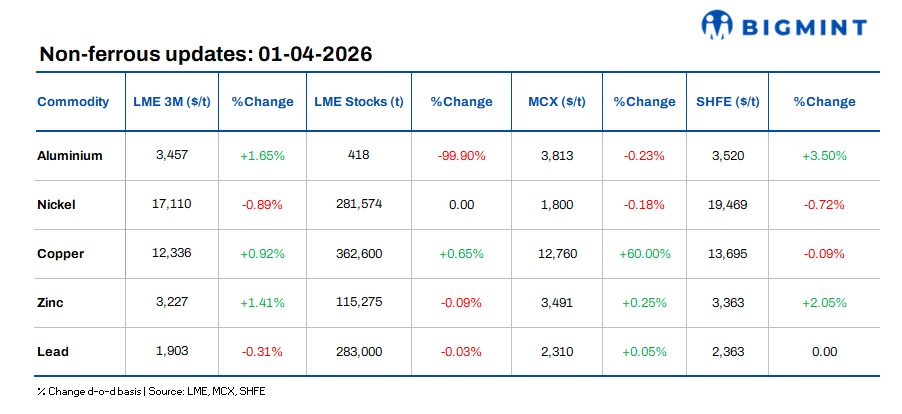
Base metals on the London Metal Exchange (LME) traded mixed d-o-d as of close on 31 Mar’26, reflecting divergent trends across the complex. Aluminium increased 1.94% to $3,467/t, while zinc rose 1.40% to $3,227/t and copper gained 0.91% to $12,336/t. In contrast, nickel declined 0.89% to $17,110/t and lead edged down 0.31% to $1,903/t.
On the inventory side, stocks were largely on the downside, indicating tightening availability. Aluminium inventories fell 0.52% to 418,675 t, while zinc declined 0.09% to 115,275 t and lead edged down 0.03% to 283,000 t. Nickel stocks remained stable at 281,574 t, while copper inventories saw an increase of 0.65% to 362,600 t.
Domestic market overview
India’s non-ferrous scrap market remained firm, reflecting improved domestic buying sentiment. Aluminium tense scrap (loose), ex-Delhi, increased by INR 7,000/t or 2.6% to INR 272,000/t from INR 265,000/t, while ex-Chennai prices rose by INR 5,000/t or 1.9% to INR 269,000/t from INR 264,000/t.
In contrast, copper armature scrap (Cu 99%), ex-Delhi, remained stable at INR 1,126,000/t with no change d-o-d, indicating steady demand conditions.

Other updates
Brent extends gains after record March surge; Middle East disruptions keep prices elevated
Front-month Brent crude futures extended gains, rising around 1.4% to $105.37/bbl, following a record around 64% surge in March-the largest monthly increase since 1988-driven by ongoing Middle East conflict.
Supply concerns remain elevated amid disruptions to oil flows through the Strait of Hormuz and damage to energy infrastructure, with OPEC output also impacted, tightening global availability.
Despite signs of potential de-escalation, continued risks to shipping and production are expected to keep prices supported and market volatility elevated in the near term.
LME aluminium surges above $3,400/t on Middle East conflict; supply risks intensify
LME aluminium prices surged 3.19% to $3,401/t on 30 March 2026, after hitting an intraday high of $3,492/t, driven by escalating Middle East conflict and attacks on key smelting facilities in the UAE and Bahrain.
The affected region accounts for around 9% of global aluminium supply, raising concerns over production losses and tightening inventories. Y-t-d, prices have risen around 13.5%, supported by persistent supply-side risks.
Rising oil prices and higher shipping costs have further increased smelting costs-energy accounting for around 40% of production-adding upward pressure on prices. Market participants are now watching whether aluminium prices test the previous record high of $4,073/t.
LME nickel rises above $17,200/t on dovish Fed outlook; gains capped by strong dollar
LME nickel prices rebounded to $17,263/t on 30 March 2026, supported by a softer US monetary outlook after Federal Reserve signals of stable long-term inflation eased rate hike expectations, boosting base metals sentiment.
However, upside remained limited due to a stronger US dollar, while nickel prices were still down 3.26% m-o-m despite gaining around 3.7% y-t-d, indicating underlying volatility.
Fundamentally, the market reflects tight ore supply conditions, though weak demand from China’s real estate sector continues to weigh on consumption. LME inventories remained stable at 281,574 t, suggesting a balanced near-term supply scenario.
Market participants expect prices to remain firm but volatile, with elevated production costs providing a price floor amid mixed demand signals
Iranian strikes hit key Gulf smelters; EGA and Alba operations disrupted, supply risks escalate
Iranian missile and drone attacks targeted major aluminium producers Emirates Global Aluminium and Aluminium Bahrain, causing significant structural damage and disrupting operations at key facilities.
At EGA’s Al Taweelah complex, critical areas including the power plant, carbon section, and aluminium handling units were severely impacted, with operations temporarily halted. Meanwhile, both companies are assessing damage while prioritising worker safety.
Initial reports indicate injuries to multiple employees-two at Alba and six at EGA-highlighting the severity of the incident.
The attacks have intensified concerns over global aluminium supply, as the Middle East accounts for a significant share of exports, with ongoing disruptions likely to tighten availability and support elevated price levels.
Leave a Reply