- Oil rises on US market optimism, demand recovery
- Indian copper armature scrap prices edge down d-o-d
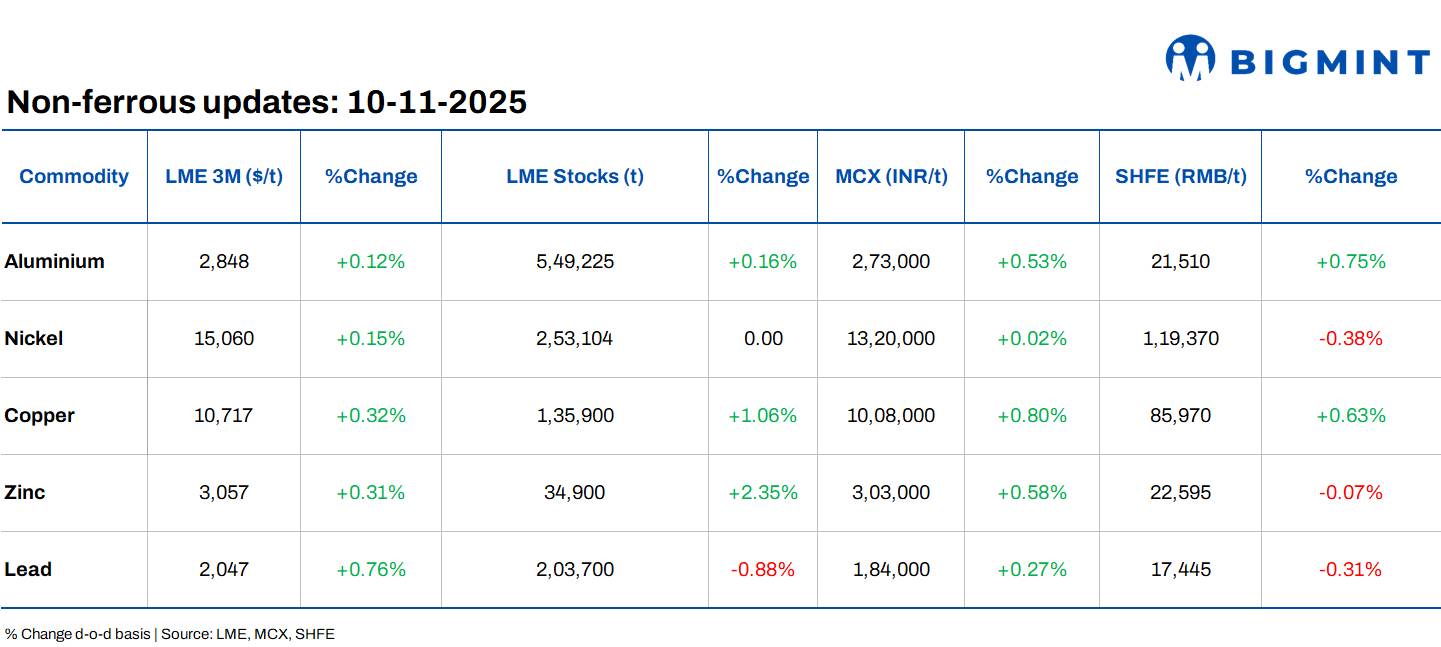
Base metals prices on the London Metal Exchange (LME) remained range-bound d-o-d, with lead increasing by 0.57% to $2,032/tonne (t). Meanwhile, inventories at LME-registered warehouses witnessed mixed movements, with lead recording the highest decline of 1.49%.
Domestic market overview
In India’s non-ferrous metals markets, BigMint assessed copper armature scrap at INR 877,000/t ex-Delhi, down by INR 4,000/t d-o-d. Aluminium Tense scrap prices were assessed at INR 19o,000/t ex-Delhi and at INR 185,000/t ex-Chennai, both stable d-o-d.

Other market updates
Aluminium prices dip to 2-week low on weak global sentiment
Aluminium prices on the LME slipped to a two-week low of $2,831.50/t on 7 November, as global equity weakness dampened sentiment across base metals. Despite steady demand prospects in China, prices reversed early gains following a Wall Street sell-off.
Analysts cited uncertainty over a possible US government shutdown and limited economic data as reasons for trader caution ahead of the Federal Reserve’s December rate decision.
Earlier this week, aluminium had touched a 29-month high of $2,920/t, supported by tight Chinese supply and increased investor interest, while European premiums rose to their highest since February amid supply constraints and higher CBAM-related costs.
Oil prices climb up on US market optimism, demand recovery
Oil prices rose on Monday as optimism grew over a potential end to the prolonged US government shutdown and improving domestic demand. Analysts said the likely restoration of government operations would revive federal spending and boost consumer confidence.
Analysts noted that this could lift WTI prices toward $62 per barrel. Despite last week’s 2% decline due to oversupply concerns, sentiment improved as OPEC+ paused further output hikes. However, rising US inventories and growing oil storage in Asia continue to cap gains.
Leave a Reply