- Japan’s factory activity shrinks to 19-month low in Oct
- Glencore mulls closure of Canada’s top copper smelter
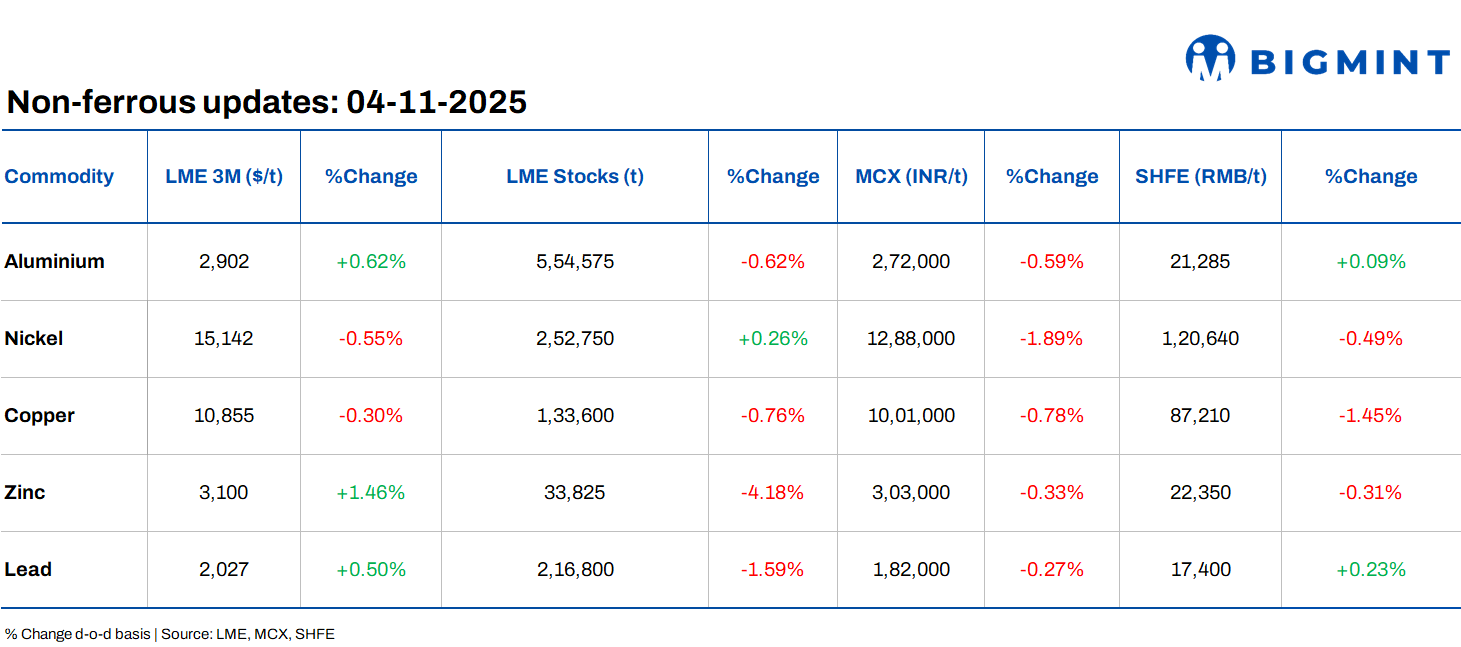
Base metals prices on the London Metal Exchange (LME) inched up d-o-d, with zinc increasing by 1.46% to $3,100/tonne (t). Meanwhile, inventories at LME-registered warehouses registered negative movements, with zinc recording the highest decline of 4.18%.
Domestic market overview
In India’s non-ferrous metals markets, BigMint assessed copper armature scrap at INR 898,000/t ex-Delhi, stable d-o-d. Aluminium Tense scrap prices were assessed at INR 19o,000/t ex-Delhi, down by INR 1,000/t d-o-d, and at INR 186,000/t ex-Chennai, stable d-o-d.

Japan’s manufacturing slowdown deepens in October
Japan’s manufacturing sector shrank in October at its fastest pace in 19 months, hit by weak demand in the automotive and semiconductor sectors. The S&P Global Japan Manufacturing PMI fell to 48.2 from 48.5 in September, staying below the 50 mark for the fourth straight month. New orders dropped sharply, while export demand remained subdued across Asia, Europe, and the US. Rising labour, material, and transport costs pushed input inflation to a four-month high, prompting firms to raise prices. Despite the slowdown, manufacturers remained cautiously optimistic, expecting recovery driven by new product launches, AI adoption, and improving global trade.
Aluminium industry seeks higher import duty, stricter scrap norms
The Aluminium Association of India (AAI) has urged the government to impose a uniform 15% duty on aluminium imports and tighten quality standards for scrap to curb dumping and protect domestic producers. The industry warned that without tariff support, India could face increased dumping risks amid global supply shifts. AAI said stricter BIS norms, similar to those in the EU and China, are essential to ensure high-quality scrap imports and strengthen India’s aluminium sector.
Glencore may close Canada’s largest copper smelter amid high costs, environmental concerns
Glencore is reportedly considering the closure of its Horne smelter in Quebec, Canada’s largest copper-producing facility, due to rising environmental costs and the heavy investment required for modernisation. The smelter, which produces over 300,000 t of copper annually and employs more than 1,000 workers, could need over $200 million in upgrades. While Glencore stated it is “not currently considering closure,” the company acknowledged facing significant financial and regulatory pressures. The miner is also contesting a class-action lawsuit over arsenic emissions from the Horne site. A shutdown could further tighten global copper supplies, as Canada supplies around 17% of US copper imports.
Leave a Reply