- China PMI rebounds, signalling industrial recovery
- Hydro secures renewable supply to support green aluminium
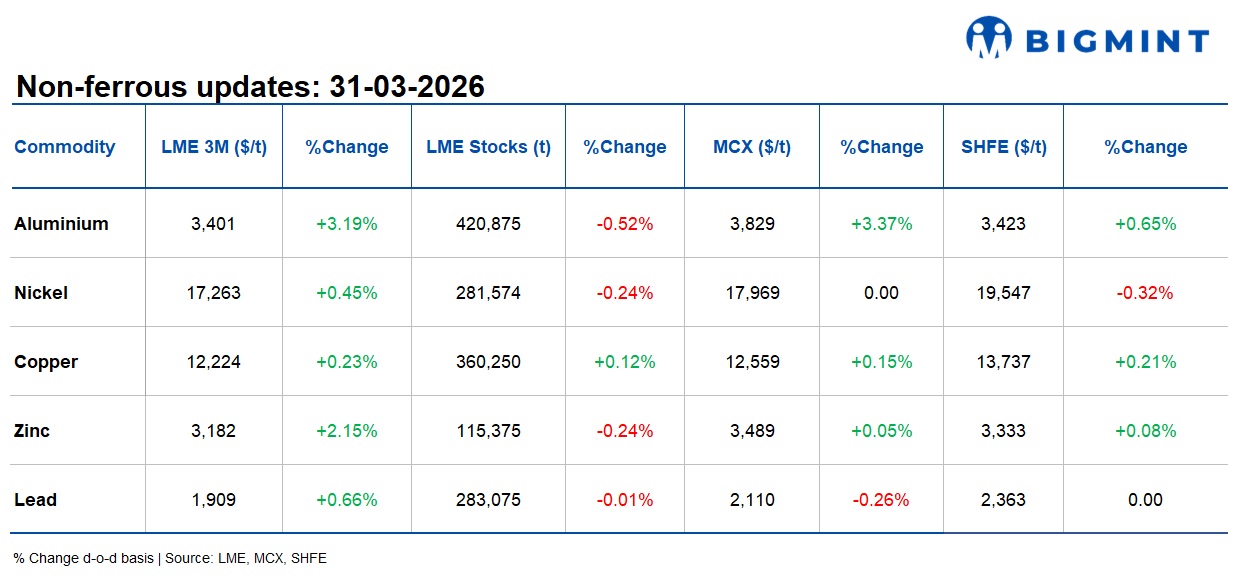
Base metals on the London Metal Exchange (LME) traded mostly higher d-o-d as of close on 30 March 2026, indicating a broadly positive trend across the complex. Aluminium rose 3.19% to $3,401/t, while zinc gained 2.15% to $3,182/t and copper edged up 0.23% to $12,224/t. Lead increased 0.66% to $1,909/t, and nickel rose 0.45% to $17,263/t.
On the inventory side, stocks declined across most base metals, indicating tightening availability. Aluminium inventories fell 0.52% to 420,875 t, while nickel stocks dropped 0.24% to 281,574 t and zinc declined 0.24% to 115,375 t. Lead inventories remained largely stable, down 0.01% to 283,075 t. Copper was the only exception, with stocks rising marginally by 0.12% to 360,250 t.
Domestic market overview
India’s non-ferrous scrap market remained firm, reflecting improved domestic buying sentiment. Aluminium tense scrap (loose), ex-Delhi, increased by INR 4,000/t or 1.5% to INR 265,000/t from INR 261,000/t, while ex-Chennai prices rose by INR 7,000/t or 2.7% to INR 264,000/t from INR 257,000/t.
Similarly, copper armature scrap (Cu 99%), ex-Delhi, edged up by INR 20,000/t or 1.8% to INR 1,135,000/t from INR 1,115,000/t, indicating steady demand and firm market fundamentals.

Other updates
Aluminium nears $3,500/t, set for ~10% m-o-m surge
LME aluminium prices approached $3,500/t, on track for a ~10% m-o-m rise in March 2026-the strongest in nearly two years-driven by supply disruptions linked to the Iran war.
The Middle East, accounting for around 9% of global output, has seen production and exports impacted due to smelter damage and disruptions in the Strait of Hormuz, tightening global availability.
Key outages, including at Emirates Global Aluminium’s Al Taweelah plant (around 1.6 mnt/year), could shift the market from around 200,000 t surplus to around 1.3 mnt deficit in 2026, supporting firm prices and higher regional premiums.
China’s manufacturing PMI rises to 50.4 in Mar’26
China’s official manufacturing PMI rose to 50.4 in March from 49.0 in February, marking a return to expansion and the highest level in a year.
The recovery was driven by improved production and new orders following the Lunar New Year, indicating a rebound in factory activity. However, export orders remained weak and below the 50 threshold.
Despite the uptick, rising input costs and ongoing geopolitical risks, particularly from Middle East tensions, continue to pose challenges to manufacturing momentum and near-term outlook.
Norsk Hydro ASA secures 1.75 TWh renewable power deal
Norsk Hydro ASA, through its unit Hydro Energi, signed a long-term power purchase agreement (PPA) with Alpiq, securing 219 GWh/year of renewable power for 2031–2038, totalling 1.75 TWh supply in Norway’s NO3 price area.
The agreement supports Hydro’s low-carbon aluminium production, which has a carbon footprint around 75% below the global average, and aligns with its strategy to combine PPAs, renewable investments, and asset upgrades to achieve net-zero emissions by 2050.
India’s industrial output rises 5.2% y-o-y in Feb’26
India’s industrial output (IIP) grew 5.2% y-o-y in February 2026, up from 5.1% in January, supported by a recovery in the manufacturing sector.
Manufacturing output expanded around 6%, led by strong performance in metals, automobiles, and machinery, while mining and electricity recorded moderate growth.
Despite the improvement, uneven consumption trends and ongoing geopolitical risks, particularly from West Asia tensions, may weigh on near-term industrial momentum.
Japan to strengthen energy coordination with Indonesia
Japan has agreed to enhance energy cooperation with Indonesia as the ongoing Iran war disrupts oil and gas flows, particularly through the Strait of Hormuz, a key supply route for Asia.
The move comes as Japan seeks to secure alternative energy sources, given its heavy dependence on Middle Eastern imports. Indonesia, a major exporter of thermal coal and LNG, plays a strategic role, supplying a significant share of Japan’s energy needs.
To mitigate supply risks, Japan is ramping up coal-fired power generation, releasing strategic oil reserves, and introducing fuel subsidies, while also exploring diversified sourcing beyond the Middle East.
The development highlights growing energy security concerns across Asia, as geopolitical disruptions tighten global supply chains and increase volatility in energy markets.

Leave a Reply