- China’s smelting expansion reshaping global aluminium dynamics
- Temporary easing in Gulf tensions drags energy prices lower
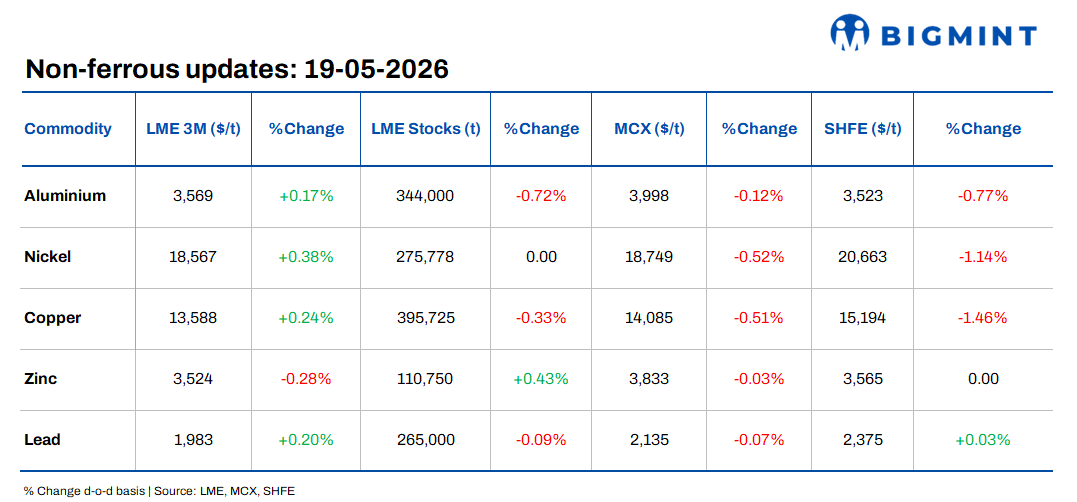
Base metals prices on the London Metal Exchange (LME) witnessed a largely positive trend on 18 May 2026, with gains in aluminium, nickel, copper and lead, while zinc edged marginally lower. Nickel recorded the strongest gain among major metals, rising 0.38% to $18,567/t, followed by copper, which increased 0.24% to $13,588/t. Lead and aluminium also edged higher by 0.20% and 0.17% to settle at $1,983/t and $3,569/t, respectively, while zinc declined marginally by 0.28% to $3,524/t. The broader non-ferrous complex reflected cautious but relatively stable market sentiment.
On the inventory side, LME stocks showed a mixed trend across major metals, indicating continued drawdowns in exchange inventories. Aluminium inventories fell 0.72% to 344,000 t, while copper stocks declined 0.33% to 395,725 t. Lead inventories edged lower by 0.09% to 265,000 t, while nickel inventories remained stable at 275,778 t. Meanwhile, zinc inventories increased 0.43% to 110,750 t, reflecting relatively balanced near-term supply conditions across the complex.
Domestic market overview
India’s non-ferrous scrap market remained largely stable d-o-d. Aluminium Tense scrap (loose) prices were unchanged, with ex-Delhi prices steady at INR 304,000/t and ex-Chennai prices stable at INR 312,000/t amid balanced domestic market activity.
Meanwhile, copper armature scrap (Cu 99%), ex-Delhi, increased by INR 4,000/t or 0.3% d-o-d to INR 1,196,000/t from INR 1,192,000/t, supported by relatively firmer global copper sentiment and steady replacement costs.

Other market updates
China aluminium output surge tests demand, capacity limits
China’s aluminium output continued rising toward capacity limits, with daily production reaching a record 129,000 t last month amid strong smelting margins and ongoing global supply disruptions linked to the Iran conflict. However, growing domestic inventories and slowing downstream demand are beginning to test the market’s absorption capacity.
Market participants noted that elevated Chinese output and potential export growth could increase pressure on global aluminium prices in the near term, although tight ex-China supply conditions and continued Middle East disruptions are likely to keep broader market sentiment supported.
Oil prices fall after Trump pauses planned Iran strike
Global oil prices fell more than 2% on 19 May after US President Donald Trump announced he would hold off on a scheduled military strike against Iran, easing immediate concerns over potential supply disruptions across the Middle East. Brent crude declined toward $110/bbl, while WTI slipped near $103/bbl following the announcement.
Market sentiment remained cautious as the Strait of Hormuz continued facing logistical uncertainty amid ongoing US-Iran tensions and stalled diplomatic negotiations. Analysts noted that despite the temporary correction, geopolitical risks and tight global oil supply conditions are likely to keep crude price volatility elevated in the near term
India refiners seen weathering Russian oil waiver expiry
India’s oil refiners are expected to manage near-term supply disruptions despite the expiry of the US waiver on Russian crude purchases, supported by weaker domestic demand, higher floating Russian crude availability and alternative spot supplies from the US and Middle East. Russian crude imports into India are still expected to remain near peak levels at around 1.9 million bpd in May, according to Kpler data.
Market participants noted that maintenance-related lower refinery runs at Reliance Industries and Nayara Energy have increased floating Russian crude storage above 7 million barrels globally, improving short-term supply flexibility for Indian refiners. Continued geopolitical uncertainty and uneven Middle East oil flows are, however, expected to keep overall crude market volatility elevated.
Leave a Reply