- Nickel leads LME drop as India scrap shows resilience
- US–Iran conflict and Suez shipping halt amplify supply risk premium
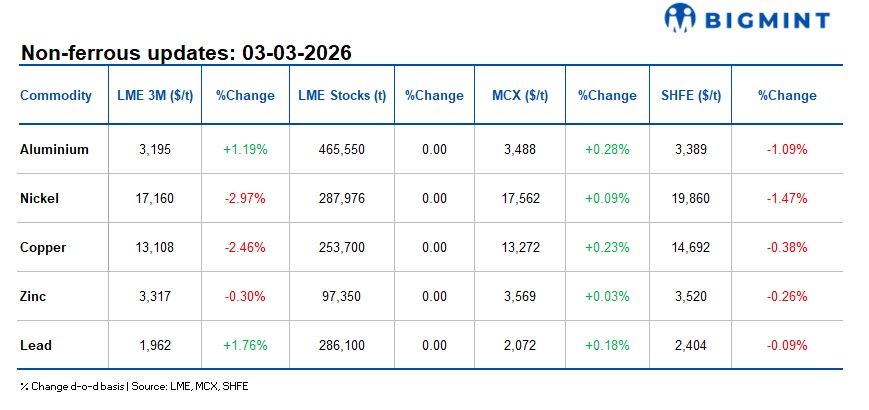
Base metal prices on the London Metal Exchange (LME) mostly weakened at the close on 02 March 2026, despite selective gains. Aluminium advanced 1.19% to $3,195/t, with inventories steady at 465,550 t. Nickel declined 2.97% to $17,160/t, while stocks remained unchanged at 287,976 t.
Copper fell 2.46% to $13,108/t, with inventories stable at 253,700 t. Zinc eased 0.30% to $3,317/t, as stocks held steady at 97,350 t. Meanwhile, lead rose 1.76% to $1,962/t, with inventories largely unchanged at 286,100 t..
Domestic market overview
Domestic non-ferrous scrap prices in India strengthened, supported by active restocking and firm downstream demand from cable, automotive and fabrication segments. Aluminium tense scrap (loose), ex-Delhi, rose by INR 3,000/t or 1.4% to INR 223,000/t from INR 220,000/t. Similarly, aluminium tense scrap (loose), ex-Chennai, increased by INR 2,000/t or 0.9% to INR 227,000/t from INR 225,000/t.
Meanwhile, copper armature scrap (Cu 99%), ex-Delhi, climbed by INR 11,000/t or 1% to INR 1,147,000/t from INR 1,136,000/t, reflecting stronger procurement activity amid firm refined copper prices and improved trade sentiment.

Other market updates
Maersk suspends Suez transit, amplifying supply-chain risks
Maersk has halted sailings through the Suez Canal and Bab el-Mandeb Strait amid escalating Middle East tensions, disrupting one of the world’s most critical maritime trade routes. The Red Sea corridor handles a significant share of Europe–Asia container traffic, and rerouting vessels around the Cape of Good Hope increases transit time and freight costs.
The disruption heightens logistics and supply-chain risks, potentially tightening physical availability and adding inflationary pressure across commodities — reinforcing supportive sentiment for energy and industrial metals markets.
Alba moves to acquire Europe’s largest smelter
Bahrain-based aluminium producer Aluminium Bahrain (Alba) has entered exclusive talks to acquire Aluminium Dunkerque, the European Union’s largest primary aluminium smelter with around 300,000 t annual capacity. The transaction, valued at around $1.17 billion and expected to close in 2026, would bring the French facility under Alba’s ownership while preserving jobs and strengthening low-carbon production commitments.
This strategic consolidation highlights producers’ focus on geographic diversification, operational resilience and sustainable capacity expansion, which could influence regional supply dynamics and add a supportive narrative to aluminium market sentiment.
Iran tensions lift aluminium on supply risk
Aluminium prices surged as escalating Iran-linked tensions threatened Middle East supply routes, with nearly 150 vessels stranded near key chokepoints. The region accounts for about 9% of global aluminium capacity, raising concerns over exports to the US and Europe and tightening near-term availability.
LME spreads moved into backwardation, signalling immediate supply stress, while Rio Tinto suspended Q2 talks with Japanese buyers after offering a US $250/t premium over LME, the highest since at least 2015. Rising energy and freight costs further reinforced the risk premium across aluminium markets.
Leave a Reply