- Producers face rising input costs as LNG supplies cut to 80%
- Processors’ shift to alternative fuels could lift prices by 20-25%
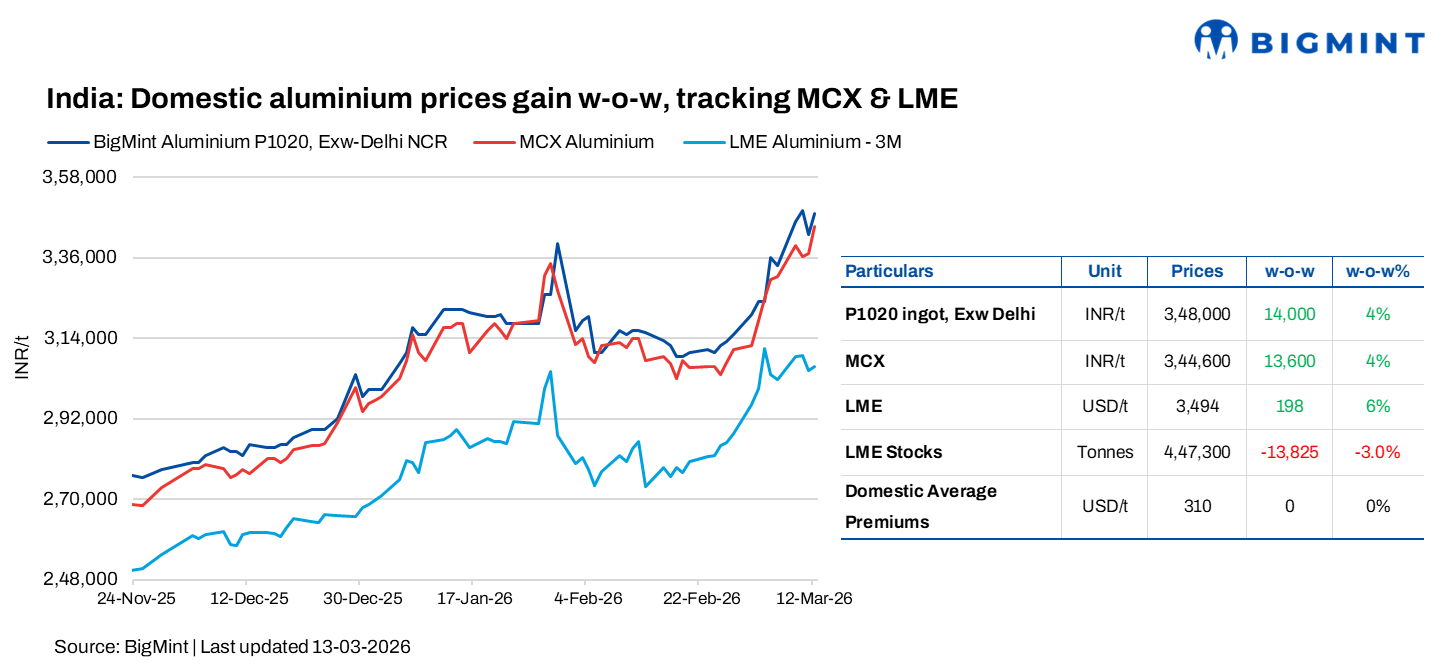
Domestic aluminium prices in India increased w-o-w on 13 March 2026, tracking gains in aluminium futures on the London Metal Exchange (LME) and Multi Commodity Exchange of India (MCX), supported by continued global supply concerns and ongoing geopolitical tensions.
As per BigMint’s assessment, domestic aluminium P1020 ingot prices in Delhi NCR increased by INR 12,000/t, or around 3.6%, w-o-w to INR 348,000/t. Similarly, Mumbai prices rose by INR 17,000/t, or about 5%, w-o-w to INR 355,000/t as of 13 March 2026, compared to INR 336,000/t and INR 338,000/t, respectively, in the previous week.
How did Indian and global exchanges perform?
Domestic aluminium futures on the MCX increased by INR 13,600/t, or 4%, w-o-w to INR 344,600/t, indicating improved market sentiment.
In the global market, 3-month aluminium prices on the London Metal Exchange (LME) also rose by $198/t, or 6%, w-o-w to $3,494/t. Meanwhile, stocks at LME-registered warehouses declined by 13,825 t or 3% w-o-w, with total inventories standing at 447,300 t.
Meanwhile, aluminium prices on the LME climbed to nearly a four-year high on 9 March 2026, with the benchmark three-month contract touching $3,544/t amid rising global supply concerns. The rally was driven by escalating Middle East tensions disrupting shipments through the Strait of Hormuz, a key trade route for Gulf producers, which collectively account for about 9% of global aluminium output. Supply worries intensified after Qatalum began shutting down production and Aluminium Bahrain declared force majeure on shipments, tightening global availability.
Meanwhile, commodity trader Mercuria plans to withdraw nearly 100,000 t of aluminium from LME warehouses after cancelling warrants in Port Klang, Malaysia, as supply disruptions from the Middle East continue. The move comes amid surging aluminium premiums in the United States and Europe due to tightening supply, while major regional producers such as Emirates Global Aluminium, Aluminium Bahrain, and Qatalum face operational challenges that could keep additional metal off the market.
Market insights
Primary aluminium producers in India are likely to face limited direct impact from the US-Iran conflict, as most smelters rely on domestic power and source key raw materials outside the GCC. Strong domestic demand and potential reductions in imports from the Middle East — which accounts for nearly 30% of India’s aluminium ingot imports — could support local producers.
However, indirect cost pressures may emerge due to possible industrial gas supply curbs, higher coal prices amid freight constraints, and potential tightening of pet coke availability. Meanwhile, India’s domestic aluminium premiums have remained stable at around $300-$320/t above LME cash.
Reflecting the firm market trend, NALCO increased its primary aluminium ingot (P1020, 99.7%) prices by INR 11,500/t to INR 358,700/t ($3,904/t) on 11 March 2026 from INR 347,200/t ($3,779/t) on 6 March 2026.
BALCO increased its P1020 ingot prices by INR 23,000/t from INR 366,250/t on 7 March to INR 389,250/t on 13 March. Similarly, Hindalco raised prices by INR 19,250/t from INR 368,000/t on 7 March to INR 387,250/t on 13 March.
The current market situation is putting increasing pressure on downstream aluminium producers. Over the past 10 days, IE07 aluminium ingot prices have risen by around INR 32,000/t, significantly increasing input costs for manufacturers.
At the same time, Indian gas suppliers have indicated possible curbs on industrial gas supplies. Aluminium processors that rely on LNG are currently receiving only about 80% of their contracted volumes, forcing some producers to consider switching to alternative fuels such as furnace oil (FO), which could raise operating expenses.
Industry participants believe that this shift in fuel usage could increase finished product costs by roughly 20-25%. In addition, export operations are facing disruptions, as the closure of a major UAE port has affected shipments to the Middle East — a key market where nearly 70% of exports from some producers are currently impacted.
Outlook
Domestic aluminium prices in India are expected to remain firm in the near term, supported by strong trends on the London Metal Exchange (LME), declining global inventories, and ongoing geopolitical tensions affecting Middle East supply. However, volatility may persist as higher input costs, potential gas supply curbs, and export disruptions continue to pressure downstream producers and influence market sentiment.
Leave a Reply