- India services PMI hits 58.5
- Oil gains on US-Iran tensions
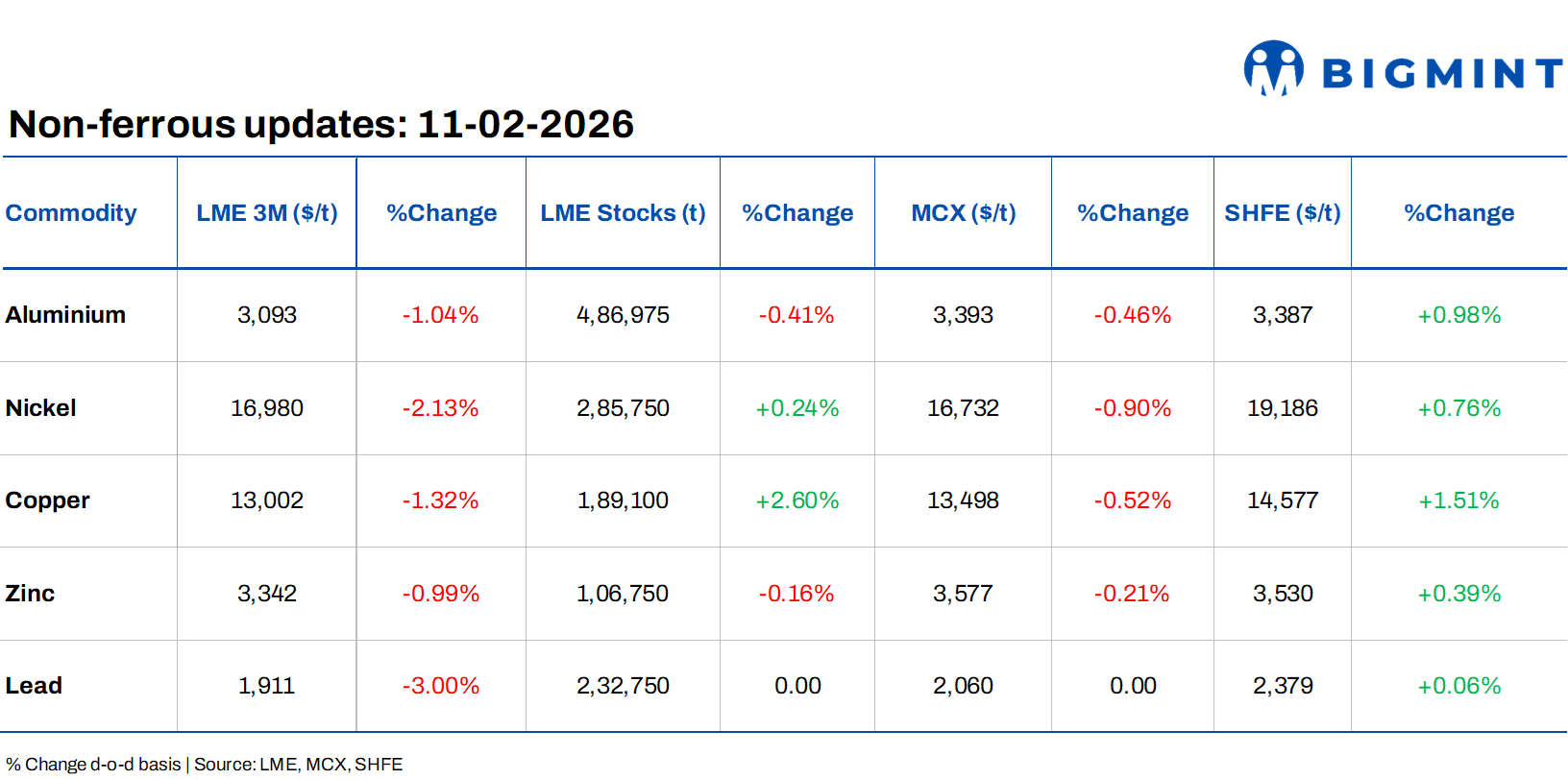
Base metals prices on the London Metal Exchange (LME) traded lower on 11 February 2026, weighed down by cautious market sentiment and profit-booking across the complex. Lead recorded the steepest decline, falling 3.00% to $1,911/t, followed by nickel, which dropped 2.13% to $16,980/t. Copper prices slipped 1.32% to $13,002/t, while aluminium eased 1.04% to $3,093/t. Zinc also edged down 0.99% to $3,342/t, reflecting broad-based weakness across the metals pack.
LME warehouse inventories displayed mixed trends, indicating varied supply dynamics. Aluminium stocks declined 0.41% to 486,975 t, while zinc inventories dipped 0.16% to 106,750 t. In contrast, nickel stocks rose 0.24% to 285,750 t, and copper inventories saw a sharper increase of 2.60% to 189,100 t, suggesting relatively comfortable near-term availability. Lead inventories remained unchanged at 232,750 t, pointing to stable supply conditions.
Domestic market overview
In India’s non-ferrous scrap market, aluminium Tense scrap prices showed a mixed trend d-o-d across key regions. Ex-Delhi assessments remained unchanged at INR 213,000/t, reflecting stable spot activity. In contrast, ex-Chennai prices moved up by INR 1,000/t (0.5%) to INR 218,000/t, indicating improved buying interest in the southern market.
Meanwhile, copper armature scrap (Cu 99%), ex-Delhi, held steady at INR 1,152,000/t, with no change recorded on the day, pointing to balanced demand-supply conditions.

Other updates
Global PMI lifts higher at start of 2026 amid shifting regional growth trends
Global economic activity strengthened at the beginning of 2026, with the J.P. Morgan Global Composite PMI rising to 52.5 in January from a six-month low in December, signalling continued expansion despite muted business confidence and persistent geopolitical uncertainties. Growth remained broad-based but uneven across regions, as developed economies such as Australia, the UK and Japan led the upturn, while several emerging markets recorded relatively softer momentum, highlighting shifting regional growth dynamics early in the year.
Oil prices rise on US-Iran tensions and stronger India demand
Oil prices climbed on Wednesday, supported by heightened geopolitical risk as US-Iran talks remain fragile and by signs of stronger demand, particularly from India. Brent crude rose about 0.8% to around $69.37 a barrel, while US crude gained roughly 0.9% to near $64.52. The market was underpinned by ongoing sanctions tensions and the possibility of increased U.S. naval presence in the Middle East, keeping a risk premium on crude. Additionally, demand from Indian refiners, who are stepping up purchases of non-Russian oil, helped absorb surplus barrels. Traders were also awaiting weekly U.S. inventory data for further direction.
India’s services PMI rises to two-month high in January as demand improves
India’s services sector continued to show strong momentum in January, with the HSBC India Services PMI climbing to 58.5 from 58.0 in December, marking a two-month high and signalling robust expansion in activity. The upturn was driven by stronger demand, higher new orders and improved business confidence, as firms also noted a rebound in hiring and a steady influx of international and domestic business. A PMI reading above 50 indicates expansion, underscoring sustained growth in the services industry at the start of 2026.
Leave a Reply