- Rio Tinto expands low-carbon aluminium capacity in Quebec
- Oil prices retreat as US-Iran tensions ease
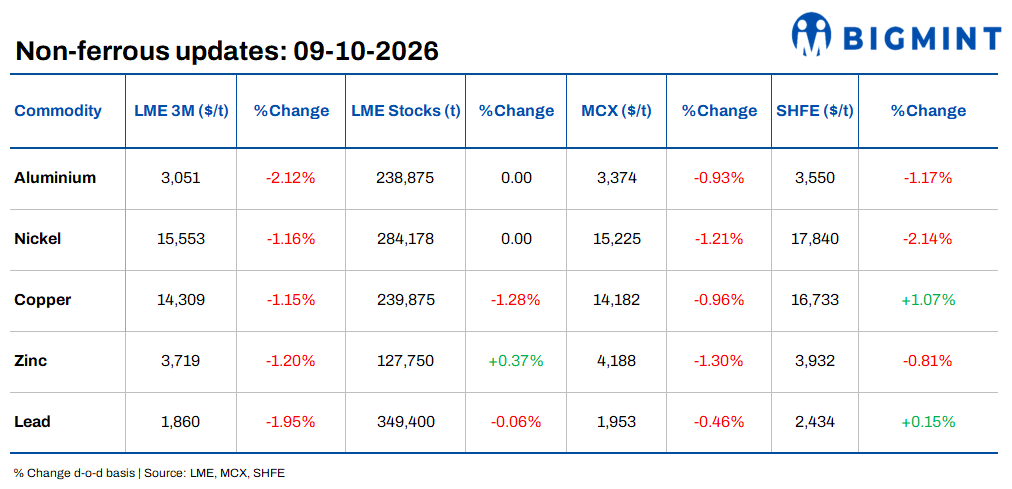
LME base metals traded lower on 8 October, with all five major metals recording declines. Aluminium recorded the sharpest fall, down 2.12% d-o-d to $3,051/t, followed by lead, which slipped 1.95% to $1,860/t. Zinc declined 1.20% to $3,719/t, while nickel fell 1.16% to $15,553/t and copper eased 1.15% to $14,309/t.
LME base metals faced pressure from a stronger US dollar and elevated Treasury yields, with the US 10-year yield moving above 5.30%. China’s National Day holiday from 1–7 October also reduced domestic trading activity, while improved supply prospects in the Middle East and higher Indonesian shipments pressured aluminium. However, copper remained relatively resilient, supported by tight inventories, Chinese restocking expectations and mine supply risks.
LME inventories recorded mixed trends on 8 October. Copper stocks registered the steepest decline, falling 1.28% d-o-d to 239,875 t, while lead inventories slipped 0.06% to 349,400 t. Meanwhile, zinc stocks rose 0.37% to 127,750 t, and aluminium and nickel inventories remained unchanged at 238,875 t and 284,178 t, respectively.
Domestic Market Overview
India’s domestic non-ferrous market remained largely stable on 8 October, with aluminium prices unchanged across the reported grades, while copper armature scrap edged higher.
Aluminium tense scrap remained unchanged at INR 244,000/t ex-Delhi and INR 246,000/t ex-Chennai. Meanwhile, aluminium P1020 prices held steady at INR 344,000/t. MCX aluminium stood at $3,374/t, down 0.93% d-o-d, reflecting weakness in the futures market alongside stable domestic prices.
Meanwhile, copper armature scrap (Cu 99%) rose by INR 4,000/t, or 0.30%, to INR 1,353,000/t from INR 1,349,000/t. MCX copper stood at $14,182/t, down 0.96% d-o-d. The divergence between weaker futures and higher domestic copper scrap prices indicates that the domestic market did not fully mirror the day’s international price direction.

Other Updates
Oil prices fall as US-Iran talks ease supply concerns
Oil prices declined on 9 October after US President Donald Trump reported productive discussions with Iran. He also said Washington would not attack Iran before the 3 November midterm elections. Consequently, Brent crude fell 1.3% to $102.94 a barrel. Hopes of reduced disruption around the Strait of Hormuz eased immediate supply concerns.
Ivanhoe Mines reports higher copper and zinc production
Ivanhoe Mines’ copper output at its Kamoa-Kakula complex in the Democratic Republic of Congo rose 18.8% quarter-on-quarter to 76,401 tonnes in Q3 2026. Higher mining rates and improved processing supported the recovery. Meanwhile, its Kipushi mine produced a quarterly record of 77,147 tonnes of zinc in concentrate, up around 10%. Consequently, higher output could improve concentrate availability and ease supply constraints. However, Ivanhoe retained its 2026 copper production guidance of 290,000–310,000 tonnes, with output trending towards the lower end.
Rio Tinto expands low-carbon aluminium capacity in Quebec
Rio Tinto’s US$1.5 billion AP60 smelter expansion in Quebec will add around 160,000 tonnes of annual aluminium capacity. The project uses efficient smelting technology powered by hydropower. Commissioning began in March 2026, while all 96 new pots are expected to operate by year-end. As a result, the expansion could strengthen supplies of lower-carbon aluminium. However, its immediate impact on global prices is likely to remain limited given the scale of worldwide production.
Poland advances procurement for its first AP1000 nuclear plant
Poland has begun procuring long-lead components for its first nuclear power plant. The project will feature three Westinghouse AP1000 reactors with a combined planned capacity of 3.75 GW. Early procurement aims to secure manufacturing capacity and reduce construction delays. Meanwhile, first concrete is targeted for late 2028. The project could support longer-term demand for copper wiring, electrical equipment and aluminium infrastructure. However, its immediate impact on non-ferrous metals demand is likely to remain limited.
Leave a Reply