- Vale-Glencore eye JV to boost copper output
- Oil prices soften on peace-talk uncertainty
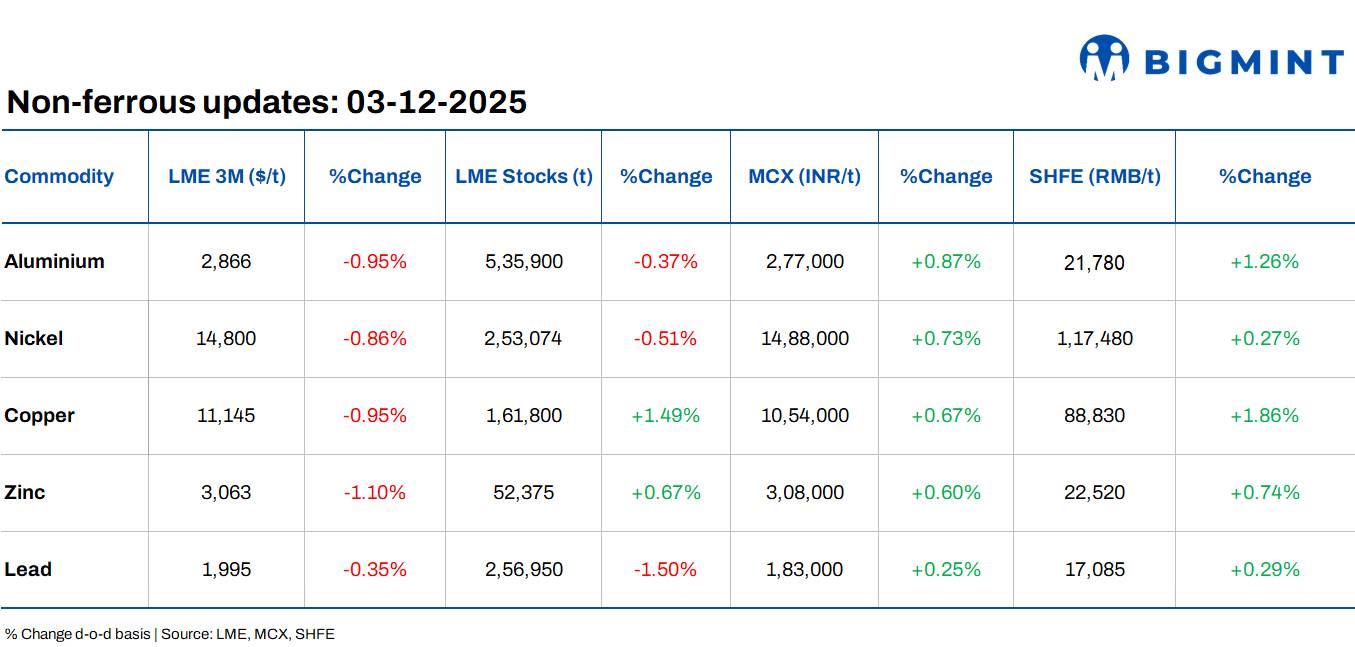
Base metals prices on the LME inched lower on 2 December, with benchmark copper prices slipping about 0.95% to $11,145/t as inventories rose, while aluminium fell around 0.95% to $2,866/t. Zinc led the declines, dropping 1.1% to $3,063/t amid mixed movements across LME-registered stocks.
Meanwhile, inventories at LME-registered warehouses witnessed mixed movements, with copper recording the highest gain of 1.49%.
Domestic market overview
In India’s non-ferrous metals markets, BigMint assessed copper armature scrap at INR 945,000/t ex-Delhi, stable d-o-d. Aluminium Tense scrap prices were assessed at INR 188,000/t ex-Delhi, and at INR 184,000/t ex-Chennai, both are stable d-o-d.

Other updates
India’s services PMI rises to 59.8 in November on strong demand
India’s services sector regained momentum in November, with the HSBC India Services PMI — released on Tuesday, — rising to 59.8 from 58.9 in October, signalling an expansion in activity, driven by robust new orders and easing input cost pressures.
Export growth, however, softened amid tough global competition, and job creation remained modest as firms reported limited capacity strain. The composite PMI came in slightly lower at 59.7, while manufacturing activity slowed to a nine-month low of 56.6.
Vale and Glencore explore Canada copper JV to lift supply
Vale and Glencore are considering a joint copper project in Canada’s Sudbury basin, targeting a $1.6-$2 billion development that could produce 880,000 tonnes over 21 years. As demand surges with electrification and AI-related infrastructure, the partnership would help both miners manage rising costs and declining ore grades. The plan involves combining underground operations and transitioning to an equal joint venture, with engineering and permitting work set for next year and a final decision expected in 2027.
Rupee slides past 90 as outflows deepen pressure
The rupee fell to a record 90.14 on 3 December, compared with 89.94 on Tuesday, as persistent trade and portfolio outflows overshadowed strong growth data. With widening deficits, weak FDI, and nearly $17 billion in equity outflows this year, the rupee remains Asia’s worst performer. RBI intervention stayed limited and staggered, prompting analysts to warn of further weakness if U.S. tariff pressures continue.
Oil prices dip as peace-talk uncertainty fuels surplus worries
Oil prices eased for a second straight session as markets monitored Russia-Ukraine peace efforts that could influence supply flows, while rising U.S. inventories deepened concerns about a potential surplus. Brent and WTI held largely steady through midday, but analysts noted Brent is hovering near its lowest since October. With talks showing no breakthrough and geopolitical risks still elevated, traders remain cautious, focusing on both the possibility of restricted Russian supply and mounting worries over weak demand and growing stockpiles.
Leave a Reply