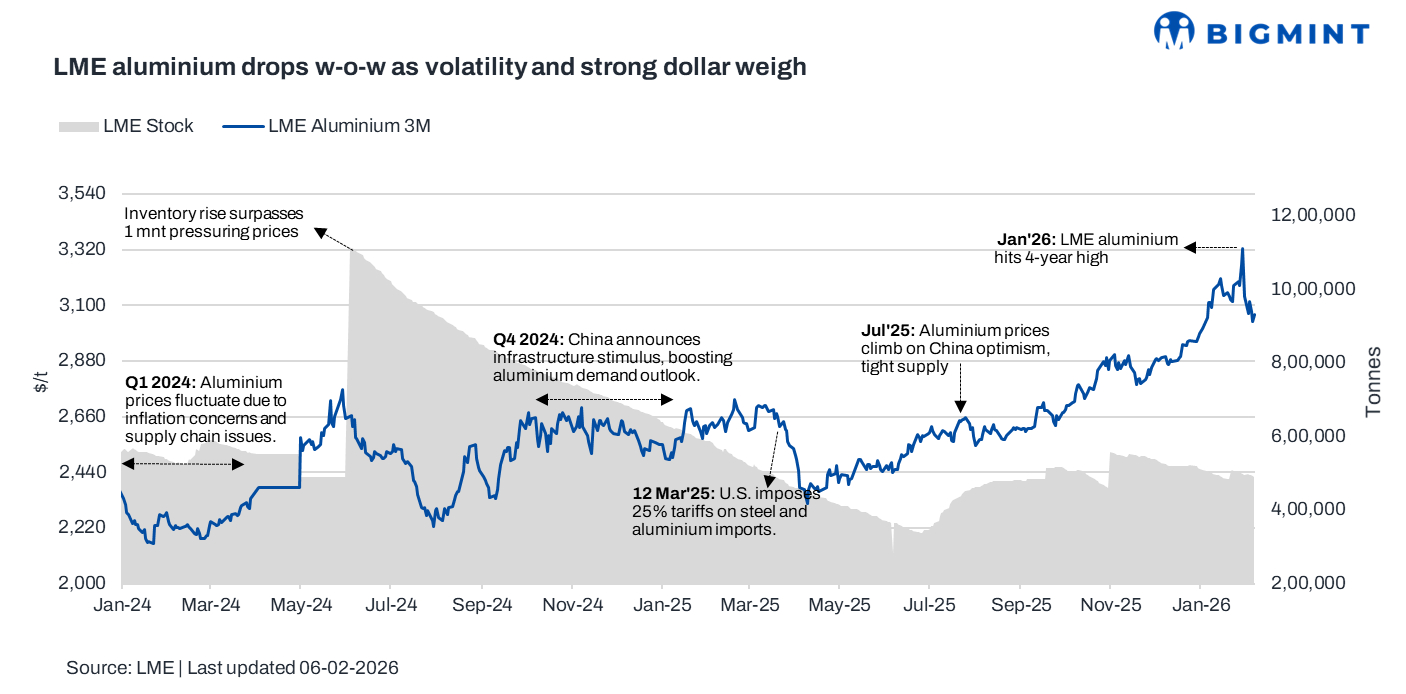
- LME aluminium prices fell 4.6% w-o-w
- Near-term prices likely to remain rangebound
Benchmark aluminium prices on the LME fell 4.6% in the week ended 06 February 2026. Post hitting a four-year high LME aluminium fell w-o-w amid heightened market volatility and risk-off sentiment, driven by fading expectations of near-term rate cuts, panic selling, and a stronger US dollar, pressuring both futures and physical markets.
Pricing, inventory trends
LME aluminium prices averaged $3,071/t in the week ended 06 February, down $148/t or 4.6% w-o-w. Prices opened the week at around $3,066/t and strengthened mid-week, reaching $3,076/t, and closed the week at $3,063/t.
Meanwhile, LME aluminium inventories fell 1.2%, reaching at 494,295 t w-o-w from 500,190 t in the week.
Factors impacting prices
LME aluminium prices fell w-o-w as market volatility intensified and risk-off sentiment spread across global commodities. Investors reacted cautiously amid broad-based declines in precious metals, as expectations for near-term interest-rate cuts by major central banks continued to fade. This shift triggered a wave of panic selling, which weighed heavily on the non-ferrous metals complex, including aluminium.
The downward pressure was further exacerbated by a roughly 1% single-day surge in the US dollar index, strengthening headwinds for dollar-denominated commodities. As aluminium is priced in US dollars, a stronger dollar makes it more expensive for holders of other currencies, reducing global buying interest. This combination of macroeconomic uncertainty, currency appreciation, and risk aversion contributed to a significant pullback in LME aluminium, reinforcing the negative sentiment in both physical and futures markets.
Outlook
In the near term, LME aluminium is likely to remain rangebound, oscillating between $3,000-$3,100/t, as markets balance elevated macroeconomic uncertainty, persistent US dollar strength, and ongoing risk-off sentiment against supportive factors like tight downstream demand and moderate inventory drawdowns. Traders may adopt a cautious stance, with price swings driven by short-term macro and currency fluctuations.
Leave a Reply