- LME aluminium near 4-year high on Middle East supply concerns
- Qatalum curbs output; Alba declares force majeure
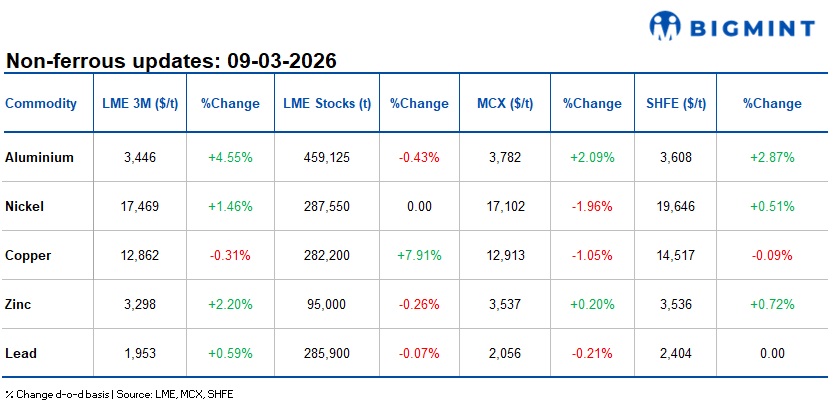
Base metals on the London Metal Exchange (LME) traded mostly higher d-o-d on 9 March 2026, supported by firm market sentiment amid ongoing supply concerns and geopolitical tensions. Aluminium surged 4.55% to $3,446/t, zinc gained 2.20% to $3,298/t, lead edged up 0.59% to $1,953/t, and nickel advanced 1.46% to $17,469/t. In contrast, copper slipped marginally by 0.31% to $12,862/t.
Warehouse inventory trends were mixed but largely lower. Aluminium stocks declined 0.43% to 459,125 t, while zinc inventories fell 0.26% to 95,000 t. Nickel inventories remained unchanged at 287,550 t. Meanwhile, copper stocks rose sharply by 7.91% to 282,200 t, whereas lead inventories edged down 0.07% to 285,900 t.
Domestic market overview
Domestic non-ferrous scrap prices in India remained largely stable across key markets, indicating balanced demand conditions and cautious trading activity. Aluminium tense scrap (loose), ex-Delhi, was stable at INR 224,000/t, while aluminium tense scrap (loose), ex-Chennai, also remained unchanged at INR 230,000/t.
In contrast, copper armature scrap (Cu 99%), ex-Delhi, declined by INR 5,000 or 0.4% to INR 1,140,000/t from INR 1,145,000/t, reflecting mild selling pressure amid fluctuating refined copper prices and cautious procurement by downstream buyers.

Other market updates
Supply fears lift LME aluminium to near 4-year high
LME aluminium surged to a near four-year high, with benchmark three-month prices touching $3,544/t, the strongest level since March 2022, before easing to $3,446/t, up 4.5% d-o-d.
The rally was driven by escalating Middle East tensions disrupting shipping through the Strait of Hormuz, a key trade route for the Gulf region that accounts for about 9% of global aluminium production.
Supply concerns intensified after Qatar’s Qatalum smelter began curbing output and Aluminium Bahrain (Alba) declared force majeure on shipments, raising fears of tighter global availability. Analysts noted that prolonged disruption could restrict both alumina inflows and aluminium exports from Middle Eastern smelters, reinforcing bullish sentiment in the aluminium market.
Alba declares force majeure amid Hormuz disruption
Aluminium Bahrain (Alba) declared force majeure on metal deliveries due to severe shipping disruptions through the Strait of Hormuz, affecting aluminium exports from the Gulf region. The company clarified that the declaration relates to transit delays rather than operational damage at its smelting facilities.
The development has heightened concerns over global supply-chain disruptions, particularly for manufacturers dependent on just-in-time inventories. Following the announcement, LME aluminium prices jumped 5.1%, marking the largest rise since November 2024, and pushing prices to levels last seen in 2022.
South Korea to cap fuel prices
South Korea plans to cap domestic fuel prices for the first time in nearly 30 years to shield its economy from the ongoing global energy shock triggered by the Middle East conflict and surging crude prices.
The government intends to introduce a maximum price system on petroleum products to curb excessive price increases and stabilize domestic fuel markets. As a major energy importer, South Korea faces rising supply risks and inflationary pressures from higher oil prices.
Authorities are also exploring alternative crude sourcing beyond the Strait of Hormuz and may expand the country’s 100 trillion won ($67 billion) market stabilization programme if the energy crisis deepens.
Leave a Reply