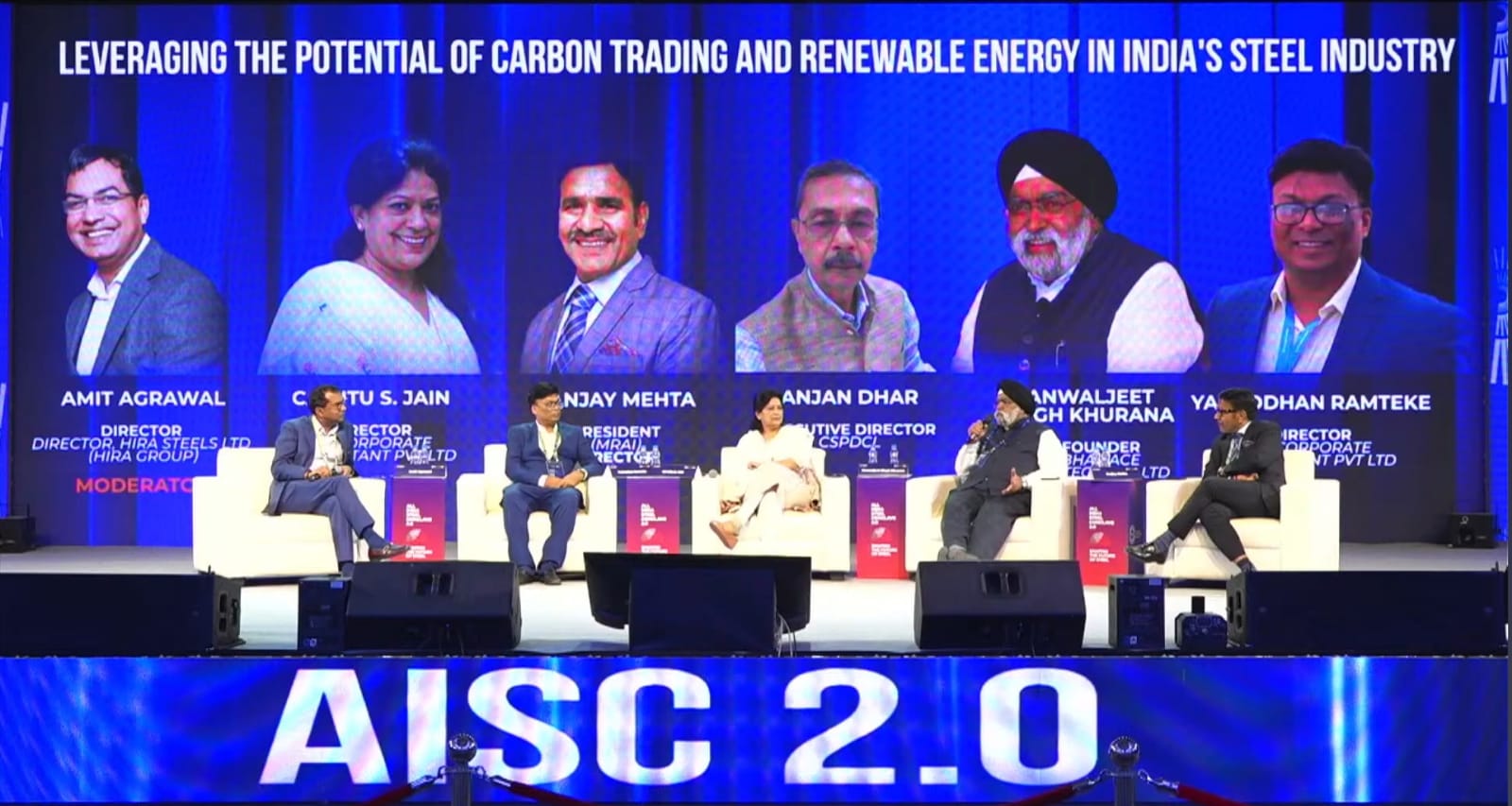
The All India Steel Conclave held in Raipur from 10-11 January, 2025 featured many interesting sessions one of which was on the role of renewable energy and the evolving carbon market in India’s transition to a low-carbon economy. The session titled ‘Leveraging the potential of Carbon trading & renewable Energy in Steel Industry’ was helmed by an array of experts and industry leaders: Sanjay Mehta, President-Material Recycling Association of India (MRAI), Director-MTC Group; Kanwaljeet Singh Khurana, Co-Founder, Sadbhav Ace Renewtech Pvt. Ltd. CA Ritu S. Jain, Director, S R Corporate Consultant Pvt Ltd; and Yashodhan Ramteke, Assistant Vice President, Meta Materials Circular Markets.
Key takeaways from the session:
Green steel & carbon markets
*India first country in the world to formulate green steel taxonomy. Any steel with embedded emissions of 2.2 tCO2/tcs is defined as ‘green steel’ in the star-rating system.
*The rating system is set to get tougher with time: Saudi Arabia’s Neom megacity, which focuses on sustainable construction, has set a benchmark of 0.7 tCO2/tcs for any steel used in construction.
*India’s 500 GW renewable energy target by 2030 is complemented by an energy storage target of over 51 GW by the turn of the current decade.
*In view of generating more domestic scrap for the steel sector, the EPR mandate has fixed at 8% for the automobile companies. EPR existed in plastic and battery recycling, but now it has been formally notified for the ELV sector under the Environment protection rules. Between 2025 and 2030, ELV recycling facilities have been given a target to produce 3-3.5 mnt of steel scrap.
*Chhattisgarh currently has only 2 RVSFs, while around 1,000 such facilities are expected to come up across the country over the next few years.
*India’s emerging carbon market, the Carbon Credit Trading scheme (CCTS), is a continuation of the PAT cycle and e-certs will be transformed into carbon credits. Notified in 2023, the domestic carbon market is set to become operational by 2026.
*This compliance carbon market will allow the steel industry to buy carbon credits and tackle the challenge of Scope III emissions and other emissions in the value chain which producers are unable to control directly.
*Under Article 6 of the Paris Agreement Crediting Mechanism, the developing countries are set to receive around $300 billion in climate funding over the next few years. India is set to receive around $15 billion in the next five years.
Renewable energy
*In Chhattisgarh, the total solar installed capacity is just 1.6 GW, while India’s cumulative capacity is touching 100 GW.
*Chhattisgarh accounts for only 1% of India’s installed renewable energy capacity.\
*The December 2023 amendment to India’s solar policy puts a cap at 500 MW for incentives in transmission and open access charges. This means that charges will include through to 2027 – the lifetime of the existing policy.
*The amendment goes against the state’s objective of generating over 14,000 MW of renewable power by 2030 as against just 1,600 MW currently.
*India’s solar module manufacturing capacity is current at 65 GW. It is expected to increase to 120 GW by December 2025 and 170 GW by December 2026
*India’s solar cell production capacity is just 8 GW and the country is highly import-dependent. Last year imports were around 16 GW, while exports of modules to the EU, US and many African countries were around 5 GW.
*Government’s PLI schemes and imposition of basic customs duty on imports of modules, as well as the proactive policies of different state governments such as Gujarat, Rajasthan, Telangana, Himachal Pradesh, etc. are set to boost domestic manufacturing capacity.
Leave a Reply