- Automobile production jumped 36% between CY’21 and CY’25
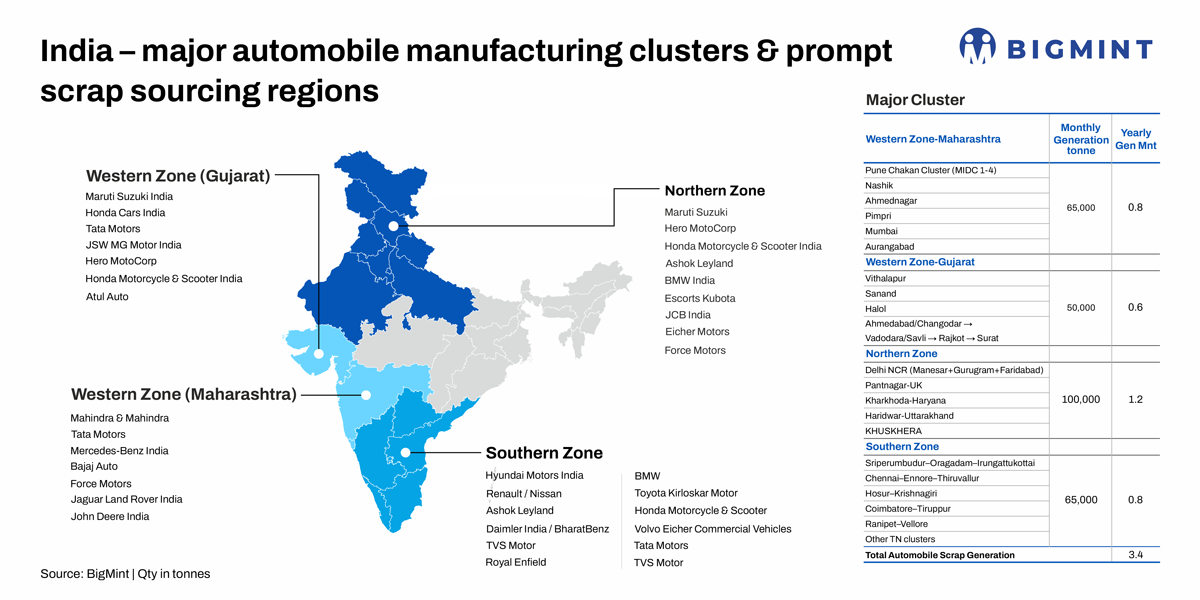
- Key hubs account for 3.36 mnt/y of auto prompt scrap generation
- Buyers source through direct contracts, e-auctions, and aggregators
Data Deep Dive: India’s automobile industry has expanded steadily in recent years, creating a growing pool of prompt scrap generated during vehicle production. According to BigMint’s compilation of SIAM data, automobile production increased from 24.1 million units in 2021 to 32.7 million units in 2025, up around 36%. Production remained strong in 2026, reaching 21.6 million units through July.

Higher vehicle production means greater manufacturing activity across stamping, blanking, cutting, trimming and fabrication, generating steel off-cuts and other residues commonly known as prompt scrap. As production expands, the addressable pool of automobile manufacturing scrap is also increasing, particularly across India’s major OEM and Tier-1 manufacturing clusters.
For scrap buyers, this expanding manufacturing base creates opportunities to build direct sourcing networks and access recurring volumes from OEMs, component manufacturers, stamping units and other industrial suppliers.
Higher automobile production does not translate into a one-to-one increase in scrap generation. Actual prompt scrap intensity depends on vehicle weight, steel consumption, material thickness, blank utilisation, stamping efficiency, manufacturing technology and vehicle mix. Nevertheless, the sustained expansion in vehicle manufacturing is structurally increasing the potential supply pool of automobile prompt scrap.
India’s prompt scrap ecosystem

India’s prompt scrap value chain begins with steel producers supplying HRC, CRC and coated steel to service centres, automobile OEMs and engineering industries. During slitting, blanking, stamping, trimming and fabrication, these industries generate edge trims, offcuts, punching, busheling, skeletons and component rejects. Automotive OEMs and their extensive Tier-1, Tier-2 and Tier-3 supplier networks form a major generation base, while engineering and equipment manufacturers also contribute significant fabrication scrap.
The generated material then moves through approved scrap contractors, aggregators, dealers, balers, shearing units and shredders, which collect, segregate and process the material into consumer-specific grades. The final destination is generally EAF/IF steel mills, rerolling mills and foundries, where processed prompt scrap is re-melted.
Automotive prompt scrap: Major grades and characteristics

Automobile manufacturing generates several grades of prompt scrap, with value determined by cleanliness, chemistry, size, density, processing requirements and furnace suitability.
CRCA stamping scrap: Clean prompt scrap generated from cold-rolled sheets during automotive panel and component stamping. Its relatively low contamination and consistent chemistry make it a premium feedstock for steelmakers.
Buyer consideration: Check coating, contamination, thickness and whether the material is supplied loose or baled.
HRC stamping scrap: Generated from hot-rolled sheets used in automotive chassis, structural and heavier components. The material generally has clean steel chemistry but may contain mill scale.
Buyer consideration: Mill scale and oxidation can influence yield and effective recovery.
Press-shop offcuts: Large and irregular sheet remnants generated during blanking and cutting operations.
Buyer consideration: Although chemically clean, low packing efficiency can increase transportation and handling costs. Shearing or baling may improve economics.
Punching scrap: Dense metal slugs generated during punching and hole-making operations.
Buyer consideration: High bulk density generally makes punching scrap efficient to handle and charge into furnaces.
Sheet skeletons: Perforated sheet frames remaining after multiple components are blanked from a sheet.
Buyer consideration: Low bulk density and large surface area can increase handling and oxidation losses. Baling or shredding may be required.
Busheling: Clean new-generation sheet steel scrap consisting of clippings, stampings and production offcuts.
Buyer consideration: Its predictable chemistry, low contamination and good furnace yield make it one of the most sought-after prompt scrap grades.
Trimming scrap: Narrow strips generated during coil-edge trimming and slitting.
Buyer consideration: Tangling and low handling efficiency can make chopping, compacting or baling necessary before transportation and melting.
Where is India’s automobile prompt scrap generated?
India’s automobile prompt scrap generation is concentrated across four major manufacturing regions.
The northern zone is estimated to be the largest hub, generating around 100,000 t/month or 1.2 mnt/year. The southern zone follows at around 65,000 t/month or 0.78 mnt/year, supported by a strong automotive manufacturing base in Tamil Nadu and Karnataka. Maharashtra contributes around 65,000 t/month or 0.78 mnt/year, while Gujarat contributes approximately 50,000 t/month or 0.60 mnt/year.
Based on BigMint’s estimates, these four regions together represent approximately 280,000 t/month or 3.36 mnt/year of automobile prompt scrap generation.
This concentration makes north India, south India and the Maharashtra-Gujarat belt important sourcing corridors for steel mills, foundries, re-rollers, scrap processors and aggregators seeking consistent supplies of automobile prompt scrap.

Northern zone — India’s largest prompt scrap generation hub
The northern region is estimated to generate around 100,000 t/month or 1.20 mnt/y, making it the largest automobile prompt scrap generating region in India.
Supply is heavily concentrated in the Delhi NCR-Gurugram-Manesar-Faridabad belt, which accounts for an estimated 35,000 t/month. Other important locations include Pantnagar at 10,000 t/month, Kharkhoda at 8,000 t/month, Haridwar at 5,000 t/month and Khushkhera at 2,000 t/month.
Major manufacturers and industrial companies operating across the wider region include Maruti Suzuki, BMW, Escorts, Ashok Leyland, JCB, Force Motors, Eicher Motors and Honda Motorcycle and Scooter India, supported by a dense Tier-1 and vendor ecosystem.
The region generates a broad range of material, including CRCA stamping scrap, punching, trimming, busheling and heavier fabrication scrap.
Buyer opportunity: The NCR ecosystem offers both large OEM-generated lots and fragmented supplier-level volumes. Buyers looking for recurring supply should target OEM and Tier-1 supplier networks, while smaller buyers can explore approved contractors, dealers and aggregators. The market is relatively fragmented, making a combination of direct procurement, e-auctions and local sourcing networks important for securing regular volumes.
Southern zone — Chennai automotive scrap powerhouse
The southern zone represents one of India’s most important automobile manufacturing and prompt scrap sourcing regions, supported by major clusters across Tamil Nadu and Karnataka.
In Tamil Nadu, the largest concentration is around the Sriperumbudur-Oragadam-Irungattukottai belt, which accounts for an estimated 15,000 t, followed by Chennai-Ennore-Thiruvallur at 5000 t, Hosur-Krishnagiri at 4,000 t, Coimbatore-Tiruppur at 4,000 t and Ranipet-Vellore and other clusters account for around 18,000 t.
Important automobile manufacturers and component ecosystems include Hyundai, Toyota, Nissan, Kia, Honda, TVS and Datsun, alongside a large network of Tier-1 and Tier-2 component manufacturers.
Karnataka also provides significant sourcing opportunities around Bengaluru, Bidadi, Jigani, Narsapura-Kolar and Mysuru, supported by OEM and component manufacturing activity.
Key Karnataka sourcing corridors are Bengaluru, Bidadi, Ramanagara, Bommasandra, Jigani–Hosur, Hoskote-Narsapura-Kolar, Doddaballapura, Nelamangala, Mysuru, and Dharwad-Hubballi.
Buyer opportunity: Southern India is particularly relevant for buyers seeking recurring OEM and Tier-1 generated scrap, supported by an integrated automotive component ecosystem and significant export-oriented manufacturing activity.
The Chennai-Sriperumbudur-Oragadam corridor can be prioritised for OEM and component supplier sourcing, while Hosur-Bengaluru provides access to another major automotive and engineering manufacturing base.
Western zone — Pune-Chakan core hub
Maharashtra is estimated to generate around 65,000 t/month or 780,000 t/y of automobile prompt scrap. Approximately 50,000 t/month is concentrated in the Pune-Chakan MIDC 1-4 cluster. Other important locations include Aurangabad, Mumbai, Nashik, Ahmednagar and Pimpri. The region has a diversified OEM and industrial base including Mahindra & Mahindra, Tata Motors, Mercedes-Benz India, Jaguar Land Rover, Force Motors, John Deere and Bajaj Auto.
Pune-Chakan is arguably one of India’s deepest prompt-scrap ecosystems because it combines passenger vehicles, commercial vehicles, two-wheelers, tractors, engineering equipment and a large Tier-1/Tier-2 supplier base.
The diversity of the manufacturing base means buyers are not dependent on a single OEM. Prompt scrap is generated across a large number of vehicle, component and engineering manufacturing facilities.
Buyer opportunity: Pune-Chakan is particularly attractive for buyers looking for diversified and recurring sources of automotive and engineering prompt scrap. Buyers can combine OEM e-auctions, direct procurement, approved dealers, scrap contractors and aggregators to build supply.
For smaller buyers, Tier-1/Tier-2 suppliers and local aggregators can provide an entry point into the market without the volume and vendor requirements associated with direct OEM procurement.
Western zone — Gujarat: Emerging high-growth prompt scrap hub
Gujarat is estimated to generate around 50,000 t/month or 600,000 t/y of automobile prompt scrap. The largest concentration is around Vithalapur at approximately 20,000 t/month, followed by Sanand at 15,000 t/month and Halol at 5,000 t/month. Other volumes are generated across Ahmedabad/Changodar, Vadodara/Savli, Rajkot and Surat.
The region has developed into an important automotive manufacturing corridor, supported by manufacturers such as Maruti Suzuki, Tata Motors, JSW MG Motor India, Hero MotoCorp, Honda Motorcycle and Scooter India and Atul Auto.
Buyer opportunity: Gujarat is particularly important from a future-growth perspective. Expansion of OEM capacity and increasing localisation of Tier-1 and Tier-2 suppliers can progressively enlarge the regional prompt-scrap pool.
For buyers looking for long-term sourcing relationships, Sanand-Hansalpur-Halol and surrounding vendor clusters should be monitored for new generation capacity and supplier additions.
Eastern India has a relatively limited prompt scrap generation base, owing to its smaller automotive manufacturing footprint. Scrap generated from the region is primarily consumed by nearby secondary steelmakers and rerolling units.
How to secure auto prompt scrap?
Buyers need to adopt a cluster-based sourcing strategy, combining OEM e-auctions, direct sourcing, approved contractors, dealers and aggregators. The preferred route varies by region and supplier network.
Recommended sourcing strategy by location
North: Key clusters include Gurugram-Manesar-Faridabad, Kharkhoda, Pantnagar, Haridwar and Khushkhera-Bhiwadi. Buyers should monitor OEM e-auctions and direct sourcing from Maruti, Honda, BMW, Hero, Tata Motors, Ashok Leyland and their Tier-1 suppliers.
West – Maharashtra: Focus on Pune-Chakan-Ranjangaon, Nashik-Ahmednagar, Chhatrapati Sambhajinagar, Pimpri and Mumbai. Buyers should combine e-auctions, direct sourcing and approved dealers/aggregators, targeting OEMs, Tier-1 suppliers and engineering units.
West – Gujarat: Key clusters include Sanand-Ahmedabad, Vithalapur, Halol-Vadodara, Savli, Rajkot and Surat. Direct engagement with OEMs, component suppliers, approved contractors and aggregators can help secure recurring volumes.
South – Tamil Nadu: Major hubs are Sriperumbudur-Oragadam, Chennai-Ennore-Thiruvallur, Hosur-Krishnagiri, Coimbatore-Tiruppur and Ranipet-Vellore. Buyers should use a mix of e-auctions, direct sourcing, dealers and aggregators across OEM and Tier-1 networks.
South – Andhra Pradesh & Karnataka: Penukonda-Anantapur can be explored through direct and e-auction channels, while Bidadi-Bengaluru offers opportunities through Toyota and its component supplier network.
Overall, buyers should map the local scrap-generating units, identify their disposal channel and compare material price, processing and freight costs before finalising a source.
Leave a Reply