- Imports reach 67,900 t during Jan-May’26; kidney beans, dry peas account for bulk of shipments
- Kenya’s pulse exports forecast to decline to 55,000 t in 2026 due to below-average rainfall
Acc to USDA Kenya’s pulse production is set to fall further in 2026 as below-average rainfall and prolonged dry conditions weigh on yields across key growing regions. Dry bean production, the country’s largest pulse crop, is forecast to decline to 630,000 tonnes (t) in 2026 from 666,000 t in 2025, while mung bean, pigeon pea, cowpea, and dry pea output are also expected to fall.
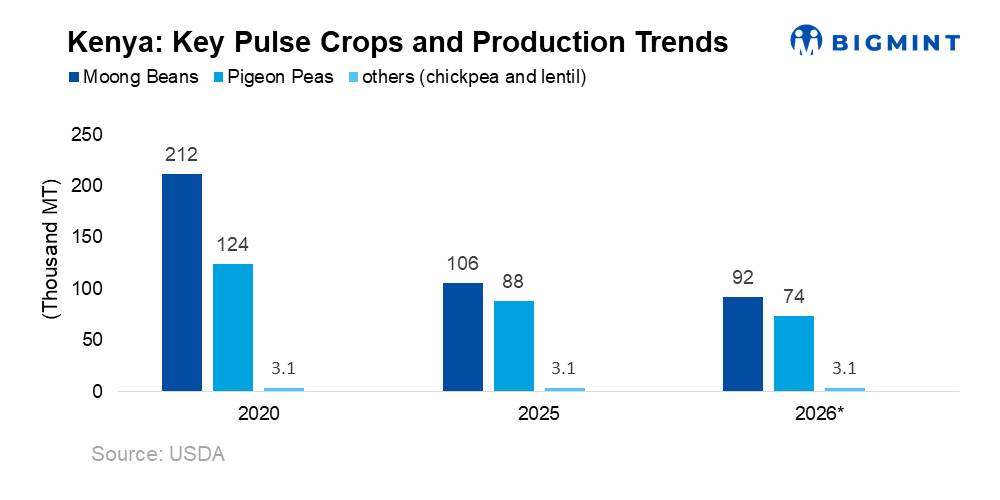
The decline will add to a multi-year contraction in several of Kenya’s key pulses. Mung bean production is forecast at 92,000 t in 2026, down from 106,000 t in 2025 and about 212,000 t in 2020, while pigeon pea output is projected at 74,000 t, against 88,000 t in 2025 and 124,000 t in 2020. Cowpea production is also expected to fall to about 65,000 t in 2026 from 87,500 t in 2025, while dry pea production is forecast at 45,000 t, down from around 85,000 t.
Production weakens after a strong 2023
Kenya’s pulse sector has seen large year-to-year swings because production is predominantly rainfed and concentrated in highland and semi-arid areas. Dry bean production reached a record 1.09 million tonnes (mnt) in 2023, before falling to 904,000 t in 2024 and 666,000 t in 2025 as rainfall became less favourable in parts of the country. The 2026 forecast of 630,000 t points to another decline, although it is considerably smaller than the fall recorded over the previous two years.
Other major pulses have followed a similar pattern. Mung bean output has almost halved since its 2020 peak, while pigeon pea production has fallen by nearly one-third over the same period. Cowpea production has also dropped sharply from more than 264,000 t in 2020 to about 87,500 t in 2025. These declines reflect the sensitivity of rainfed crops to changes in rainfall, with farmers also facing pest and disease pressure, limited access to improved seed, and weak irrigation coverage.
The contraction has not been uniform across the sector. Dry pea production increased from about 33,000 t in 2021 to around 85,000 t in 2025 as demand from domestic processors and institutional buyers encouraged cultivation in the Rift Valley and central highlands. However, production is forecast to fall to about 45,000 t in 2026 because of lower expected acreage and unfavourable weather.
Rainfall to remain main constraint in 2026
Weather conditions are expected to be the main driver of the 2026 decline. Kenya’s pulse production depends heavily on its two seasonal rainfall periods, leaving crops exposed to delayed or inadequate rains and prolonged dry spells. The latest FAS assessment expects lower rainfall and drought conditions to reduce output in major producing areas, particularly in the northern Rift Valley.
The impact is likely to be most visible in crops that are already under pressure. Mung bean production is forecast to fall by about 13% y-o-y to 92,000 t, while pigeon pea output is expected to decline by nearly 16% to 74,000 t. Dry pea production could fall by almost 47% to 45,000 t, showing that the weather-related impact is likely to extend beyond Kenya’s traditional pulse crops.
Production constraints extend beyond rainfall. The FAS assessment identifies recurrent drought, pests and diseases, limited access to quality seed, restricted irrigation, post-harvest losses, and inadequate storage as factors limiting productivity. This means that even when rainfall improves, the sector may struggle to recover quickly without higher yields and better farm-level infrastructure.
Imports set to rise; exports to decline
Lower domestic production is likely to increase Kenya’s dependence on imports, particularly for pulses that have a persistent domestic supply deficit. Total pulse imports increased from 95,200 t in 2021 to 157,900 t in 2023, before falling to 90,600 t in 2024 and recovering to 99,400 t in 2025. Imports already reached 67,900 t during January-May 2026, indicating that external supplies will remain important as domestic availability tightens.
Kenya’s import basket is supported by both regional and international suppliers. Tanzania remained the largest supplier in 2025, shipping 52,060 t, or 52% of Kenya’s total pulse imports. Canada supplied 17,527 t, Ukraine 13,427 t, the United States 7,697 t, and Ethiopia 6,560 t. The supplier mix gives Kenya some flexibility in replacing domestic shortfalls, particularly for dry beans, dry peas, lentils, and chickpeas.
The trade balance is also likely to shift further towards imports as export availability falls. Kenya’s pulse exports dropped from 97,700 t in 2021 to 46,900 t in 2022, before recovering to 54,100 t in 2023 and reaching a five-year high of 129,400 t in 2024. Exports then declined to 76,700 t in 2025, with FAS forecasting a further fall to 55,000 t in 2026 because of lower rainfall and reduced production.
The composition of trade is important. Kenya imports pulses such as dry beans, dry peas, chickpeas, and lentils to supplement domestic consumption, while it exports mung beans, pigeon peas, cowpeas, and other speciality pulses. This means weaker production does not simply reduce total exports. It also increases competition between domestic consumption and export-oriented crops for available supplies.
Outlook
Kenya’s pulse market is likely to remain dependent on imports through 2026 as domestic production falls and consumption continues to rise. The immediate supply gap is likely to be most visible in dry beans and the export-oriented pulses. With Kenya also facing limited domestic production of chickpeas and lentils, imports are likely to remain the key mechanism for balancing the market.
Leave a Reply