- Flat steel share rises to 61% as product mix shifts towards value-added grades
- Angul blast furnace ramp-up and slurry pipeline support operational efficiency
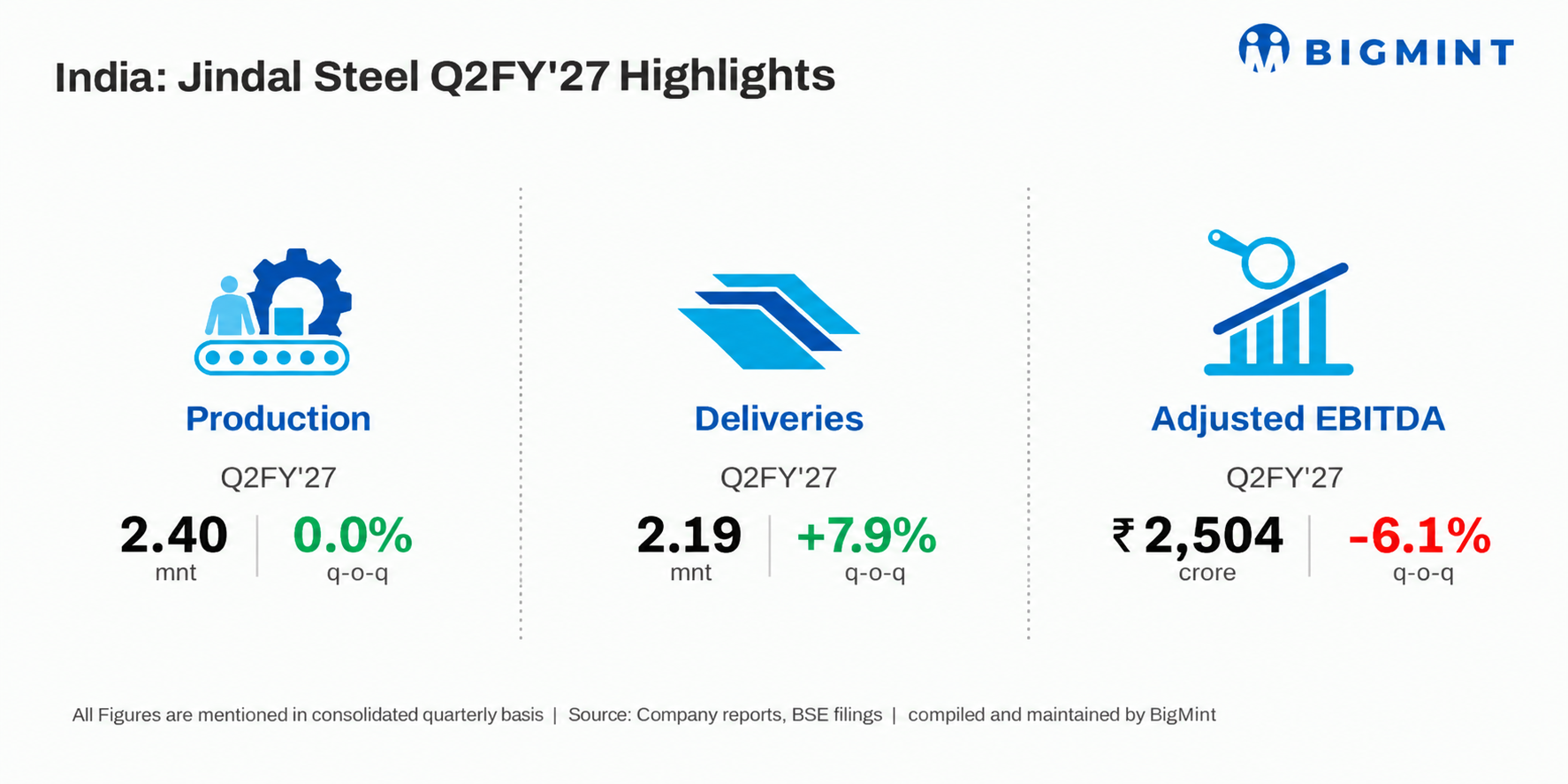
Jindal Steel Ltd reported its highest-ever quarterly steel sales of 2.19 million tonnes (mnt) in Q2 FY’27, up 29% year-on-year (y-o-y) and 8% quarter-on-quarter (q-o-q), supported by higher domestic sales volumes and improved realisations from a richer flat steel product mix. Flat products accounted for 61% of sales, compared with 53% in Q1 FY’27 and 50% in Q2 FY’26.
Adjusted EBITDA increased 34% y-o-y to INR 2,504 crore but declined 6% q-o-q from INR 2,667 crore, reflecting higher raw material, power, fuel and freight costs. Profit after tax (PAT) rose 21% y-o-y to INR 771 crore but fell 9% q-o-q from INR 844 crore. Crude steel production stood at 2.40 mnt, up 20% y-o-y and unchanged q-o-q.
Flat steel strategy reshapes product mix and capacity allocation
Flat products contributed 61% of sales in Q2 FY’27, up 11 percentage points y-o-y and 8 percentage points q-o-q. Jindal Steel is targeting a product mix of 65% flat products, including plates, and 35% long products.
As part of this shift, the company has reduced monthly TMT production from around 220,000 t to 120,000 t, directing more capacity towards plates and hot-rolled coil (HRC). Domestic sales increased 29% y-o-y and 8% q-o-q to 2.19 mnt, while exports declined 10% q-o-q to 0.19 mnt, although they remained 6% higher y-o-y.
The strategy supports the company’s focus on flat steel products used in infrastructure, defence, shipbuilding and wind energy.
Angul blast furnace ramp-up supports higher steel output
Crude steel production reached 4.79 mnt in H1 FY’27, up by 17% from 4.09 mnt in H1 FY’26. Quarterly production stood at 2.40 mnt in Q2 FY’27 remaining unchanged from Q1 FY’26.
The company is targeting quarterly production of around 3 mnt in H2 FY’27 as operations at its new blast furnace in Angul ramp up. The blast furnace is operating at around 10,500 t per day, with production targeted to increase to 11,000 t per day in November and 12,000 t per day in December.
Earlier, monsoon-related flooding at Odisha mines and rail disruptions affected raw material supplies. Supplies from Odisha Mining Corporation (OMC) and NMDC improved as the disruptions eased.
Slurry pipeline to reduce iron ore transportation costs
Jindal Steel has commissioned its 192-km Barbil-Angul iron ore slurry pipeline, with an annual capacity of 18 mnt. The company estimates that the pipeline could reduce iron ore transportation costs by around INR 700/t at a flow rate of 20,000 t per day.
The pipeline is expected to improve raw material logistics between the mining region and the Angul plant. Water recovery and recycling at Angul will also help reduce freshwater consumption.
Capex continues alongside debt reduction
Jindal Steel spent INR 3,187 crore on capital expenditure in H1 FY’27, including INR 1,228 crore in Q2. Its capital expenditure guidance for FY’27 stands at INR 7,500-10,000 crore, with growth projects expected to be funded primarily through internal cash generation.
Consolidated net debt declined 7% q-o-q to INR 14,786 crore at the end of September 2026 from INR 15,927 crore at the end of June. However, it remained 4% higher y-o-y than INR 14,156 crore at the end of September 2025. The net debt-to-EBITDA ratio improved to 1.51x from 1.71x in Q1 FY’27 but was marginally higher than 1.48x in Q2 FY’26.
The company expects its growth projects to deliver a pre-tax return on capital employed (ROCE) of 18-20% once fully operational, compared with around 8% currently.
Outlook
Jindal Steel is targeting quarterly steel production of around 3 mnt in H2 FY’27, supported by the ramp-up of its Angul blast furnace. The planned increase in flat steel’s share to 65% is expected to further shift its product mix towards plates and HRC. The Barbil-Angul slurry pipeline is expected to support logistics cost savings, while higher coking coal costs remain a concern, with the company anticipating a further increase of $20-25/t in Q3 FY’27.
Leave a Reply