- Crude steel output remains broadly stable, limiting export supply
- Vietnam remains leading buyer even as shipments decline 10% y-o-y
- EAF investments to increasingly divert scrap towards domestic market
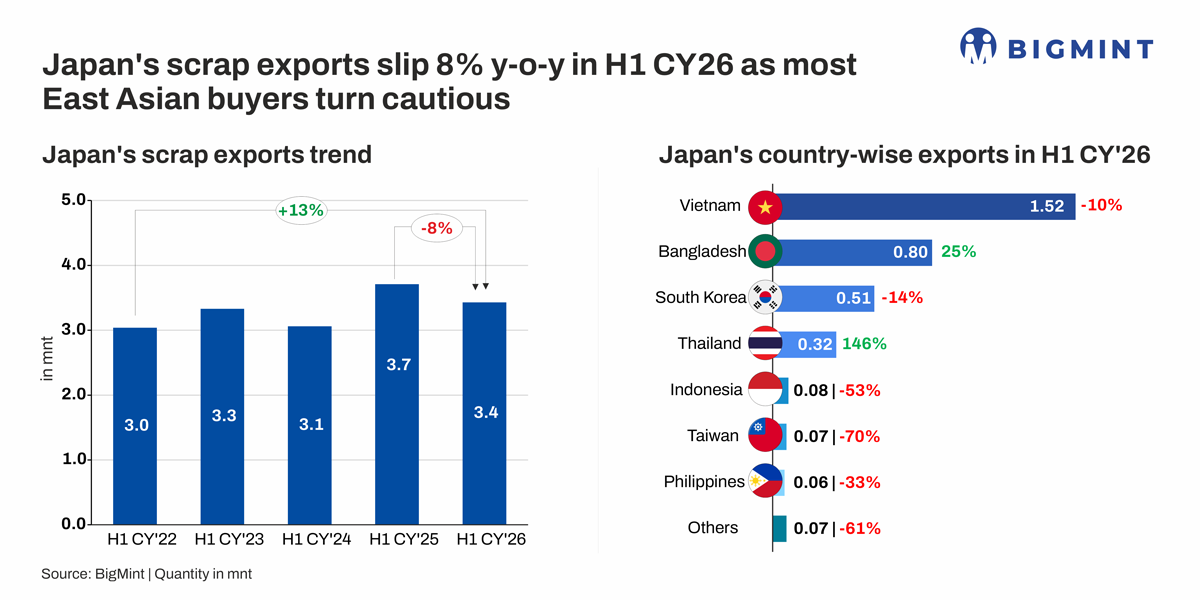
Morning Brief: Japan’s ferrous scrap exports declined 8% y-o-y to 3.43 million tonnes (mnt) during H1CY26, compared with 3.71 mnt in the corresponding period last year, according to customs data compiled by BigMint.
Although June exports rose 6% y-o-y to 0.57 mnt, overseas shipments remained under pressure throughout H1CY’26 amid cautious procurement by East Asian mills.
Moreover, Japan’s crude steel production remained broadly stable, limiting scrap availability for exports. Steady domestic scrap consumption, alongside continued investment in EAF steelmaking, suggests that an increasing share of Japan’s scrap is likely to be absorbed domestically to support the country’s decarbonisation goals.
Notably, in CY’25, Japan’s ferrous scrap exports had increased 19% y-o-y to a five-year peak of 7.5 mnt, as crude steel production fell for the fourth consecutive year, reaching a 57-year low last seen in 1968. Lower domestic scrap consumption forced recyclers to redirect supply towards faster-growing Southeast Asian and Bangladeshi markets.
Japan’s crude steel production stood at 40.44 mnt, marginally down 0.3% y-o-y from 40.55 mnt in the corresponding period last year, indicating stable steelmaking activity.
Hot metal production also remained largely unchanged at 29.25 mnt, while scrap consumption edged down just 0.3% y-o-y to 14.92 mnt, compared with 14.96 mnt in H1CY’25.
The marginal decline suggests that domestic steelmakers maintained relatively steady scrap procurement despite subdued construction activity.
Blast furnace (BOF) production continued to benefit from healthy demand from the automotive and shipbuilding sectors, while electric arc furnace (EAF) production remained under pressure due to slower construction activity, labour shortages, and elevated material costs.
Domestic vehicle sales improved following the suspension of the environmental vehicle tax, supporting higher steel demand. However, overseas vehicle production remained under pressure due to weaker demand in China and the Middle East.
The shipbuilding sector also continued to prop up steel demand. Although new export ship orders were broadly stable during H1CY’26, export deliveries increased modestly, helping sustain demand for heavy plate and structural steel products.

While Vietnam retained its position as Japan’s largest ferrous scrap buyer, its imports fell 10% y-o-y to 1.52 mnt during H1CY’26.
Vietnamese mills increasingly relied on domestic and competitively priced deep-sea scrap. Japanese scrap lost competitiveness in Vietnam as overseas scrap prices softened while Japanese domestic mill prices remained relatively firm.
Consequently, price-sensitive Vietnamese mills switched to US bulk cargoes during April-May. Interest in containerised scrap also increased as mills sought to optimise delivered costs. This shift was reinforced by weaker finished steel demand and seasonal rains, which reduced the urgency to replenish inventories.
Bangladesh emerged as the strongest-performing market, with imports increasing 25% to 0.80 mnt. Improved availability of letters of credit (LCs), tight availability from alternative origins, periodic inventory replenishment, and stable construction activity supported imports despite sluggish finished steel demand and tight mill margins.
South Korea imported 0.51 mnt, down 14%, reflecting slower manufacturing activity and cautious raw material procurement.
Among other markets, Thailand recorded the strongest growth, with imports surging 150% to 0.32 mnt against 0.13 mnt in H1CY’25, supported by tight domestic scrap availability, improving construction activity, and increased demand from local EAF mills.
Meanwhile, exports to Indonesia (-53%), Taiwan (-70%), Philippines (-33%), and India (-100%) declined sharply, reflecting weaker steel production, improved domestic scrap availability, and subdued import appetite across the region.

Green steel transition reshapes long-term scrap fundamentals
Japan’s long-term scrap demand outlook remains robust as major steelmakers accelerate EAF investments.
Nippon Steel has committed to three EAF projects in Japan with combined production capacity of about 2.9 mnt/year. The projects comprise a 2 mnt/year EAF at Kyushu Works, a 0.5 mnt/year expansion at Setouchi Works, and the restart of a 0.4 mnt/year EAF at Yamaguchi Works. Production is scheduled to begin between the second half of fiscal 2028 and the second half of fiscal 2029. Additionally, JFE Steel is developing a large EAF, adding to the industry’s future scrap requirement.
These investments are expected to significantly increase domestic scrap demand over the coming decade, potentially reducing export availability. The Japan Iron and Steel Federation targets an additional 6.9 mnt of domestic scrap circulation by 2030 to support decarbonisation.
The government has also planned to commit nearly JPY 1 trillion ($6.3 billion) in public and private investment by 2030 to expand recycling infrastructure and produce high-grade scrap for low-carbon steelmaking.
Japan H2 scrap prices rise sharply in H1CY26
Japan’s H2 export FOB prices averaged JPY 49,686/t($313/t) in H1CY26, up 19% y-o-y, with the increase accelerating in Q2 as domestic replacement costs strengthened. The Kanto Tetsugen FAS tender averaged JPY 51,402/t ($324/t), up 18.5% y-o-y, while Kanto domestic delivered scrap averaged JPY 48,583/t ($306/t), up 20.2%. In Vietnam, H2-linked prices averaged around $365/t CFR, up 13% y-o-y, reaching $397/t in May before easing to $385/t in June. Bangladesh prices averaged around $381/t CFR, up 6% y-o-y, peaking at $407/t in May.
The sharp rise in Japanese scrap values also weighed on buying interest from major importers, as higher replacement costs reduced buyer margins and widened the gap between Japanese suppliers’ offers and workable levels in key markets. This price sensitivity contributed to slower Japanese scrap bookings despite relatively firm underlying scrap fundamentals.

BigMint expects Japan’s ferrous scrap exports to remain subdued in H2CY26 as weak Asian steel demand, continued Chinese steel export pressure and cautious procurement limit fresh overseas bookings. Export prices have already softened through July, with Japanese H2 offers to Vietnam declining from around $370/t CFR in early July to nearly $362/t CFR by late July. Deep-sea HMS 80:20 prices also eased as Vietnamese mills maintained sufficient inventories and increasingly shifted towards competitively priced containerised cargoes.
Japan’s August Kanto scrap export tender averaged JPY 49,086/t FAS ($309.87/t), down JPY 3,422/t ($21.5/t) m-o-m and falling below JPY 50,000/t for the first time since February. The decline reversed the gains recorded during April-July and could improve Japan’s competitiveness against US deep-sea scrap and other origins. However, any recovery in exports is likely to remain gradual, with Vietnam and Bangladesh entering their seasonal rainy periods and steel demand expected to remain softer.
Meanwhile, higher domestic steel production could limit the volume of scrap available for export. METI expects Japan’s crude steel production to reach 21.2 mnt in Q3CY26, up 6.4% y-o-y and 4.2% q-o-q. However, EAF producers may continue to operate cautiously as construction activity faces persistent labour shortages, project delays and bottlenecks. This could temper the increase in near-term scrap consumption despite higher crude steel output.
Over the medium to long term, Japan’s scrap fundamentals remain constructive. Expanding EAF capacity, government-backed recycling initiatives and increasingly stringent carbon-reduction targets are expected to raise domestic scrap requirements. As Japan advances its green steel transition, a greater share of available scrap is likely to be absorbed domestically, gradually reducing exportable surplus. Thus, while near-term export demand remains under pressure, Japan’s scrap market is likely to transition progressively from an export-oriented market towards a strategically important domestic raw material base for low-carbon steelmaking.

Leave a Reply