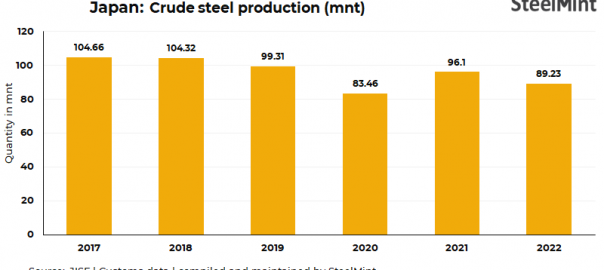
Japan’s crude steel output stood at 89.23 million tonnes (mnt) in calendar year (CY) 2022, down 7.4% y-o-y, according to data released by the Japan Iron & Steel Federation (JISF) on 23 January, 2023.
In December, crude steel output stood at 6.89 mnt, down 13% as against 7.9 mnt in the same month of the previous year. Daily production was 223,000 tonnes (t), down 16,000 t from November. Moreover, during October-December, production was recorded at 21.42 mnt.
The decline in production was due to sluggish demand in Japan and overseas markets. In addition, demand for automobiles was sluggish against the backdrop of semiconductor shortage.
Converter furnace (CF) mills produced 65.403 mnt, down 9.1% y-o-y, while electric-arc-furnace (EAF) mills’ steel output stood at 23.832 mnt, down 2.3% y-o-y. Both declined for the first time in two years. The decline in converter furnaces was sharper than that of electric furnaces. As a result, the share of electric furnace to crude steel production was 26.7%, up from 25.3% in 2021.
The production volume of hot-rolled steel products fell by 6.9% to 78.63 mnt, the first decline in two years. Of this, ordinary steel sales fell by 6.3% to 61.75 mnt, with a significant decrease in steel sheets such as hot-rolled coils and galvanised steel sheets.
Crude steel production in CY10-18 had exceeded 100 mnt for nine consecutive years. Later, it continued to decline due to the intensification of trade friction and the impact of the new coronavirus. This is the fourth consecutive year it has fallen below 100 mnt, including below 90 mnt in FY20 and FY22.
In addition to the decline in domestic demand for automobiles and other applications, sluggish export growth also affected production.
Note: This article has been written in accordance with an article exchange agreement between Japan Metal Daily and SteelMint.

Leave a Reply