- Carbon footprint of products necessary for downstream sectors
- Steel products with reduced emissions securing new markets
Japan Metal Daily: The Japan Iron and Steel Federation (JISF) will formulate guidelines for the version of steel products with a carbon footprint (CFP) that displays carbon dioxide (CO2) emissions by product. This is in response to the growing demand for CFP disclosure of steel products in demand industries such as auto and construction.
The guidelines are intended to include CFP calculation rules. The contents of the guidelines are currently being finalised, and are scheduled to be formulated and announced later this year.
Product carbon footprint
With regard to CFP, there is a growing movement mainly in the automotive and construction industries to demand the disclosure of CFP for materials and parts used. Although there are already eco-labels and EPDs (Environmental Product Declaration certifications) for the environmental performance of steel products, the JISF deems it necessary to standardise the calculation rules for CFPs for each product.
CFPs typically show CO2 emissions over a product’s entire lifecycle assessment (LCA). In accordance with the guidelines for steel products, in addition to the calculation of LCA as a whole, the guidelines for calculating CFP at the factory stage are also set in line with the needs of the demand industry.
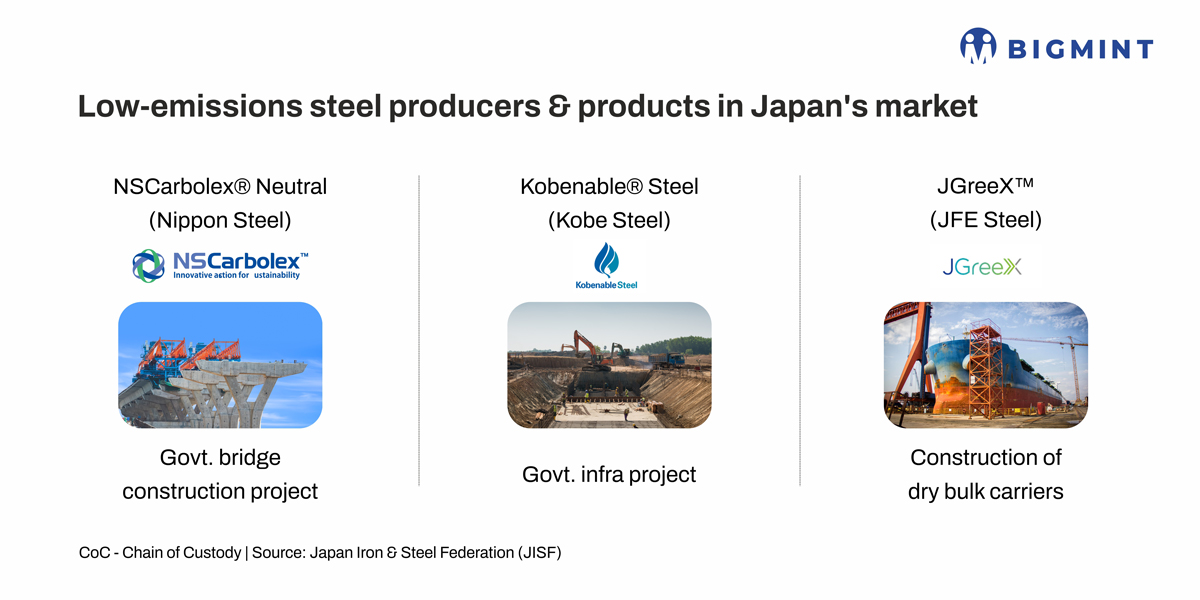
In the steel industry, the supply of low-emissions steel, or ‘green steel’, is expanding, mainly by the blast furnace manufacturers. Currently, the mainstream method for green steel certification is the ‘mass balance method’, which allocates CO2 reduction results to arbitrary steel products.
Reduced Emission of Products (REPs)
The Japanese government seeks to reduce emissions in order to make the green transition, and has proposed a new indicator – REPs. Creating a market for products with REPs has become a pillar of Japan’s decarbonisation policy.
According to the JISF, the reality is that only a limited number of steel companies in the world are able to manufacture steel products with significantly reduced GHG emissions in the near future, and it is predicted that near-zero emission steel will not be widely available until around 2040.
During the transition period, the provision of green steel, which embeds the value of REPs, will be the only way to meet customers needs for green steel.
By issuing certificates of REPs based on the results of a company’s emission reductions and selling them together with steel products, it has been possible to supply customers with green steel products that have substantially reduced their embedded emissions, as per JISF.
Customers can reduce their Scope 3 emissions by using REP certificates. By a premium paid for green steel, steel companies can raise funds for their next decarbonisation investment.
Focus on EAFs
In the future, CFP disclosure is expected to be required for green steel. In conjunction with the formulation of the CPF guidelines, JISF plans to incorporate the concept of CFP calculation into the current mass balance guidelines.
In addition, JISF is responding to the growing movement to supply low-CO2 steel materials through the use of renewable energy, especially by electric arc furnace manufacturers.
Guidelines for the use of renewable energy will also be formulated separately. The use of renewable energy has been studied by the Ordinary Steel Electric Furnace Manufacturers Association, but at the beginning of this fiscal year, the discussion was moved to the JISF.
Note: This article has been written in accordance with an article exchange agreement between Japan Metal Daily and BigMint.
Leave a Reply