- Kanto tender bids decline by $7/t m-o-m
- Baosteel, CSC keep prices firm for May’25
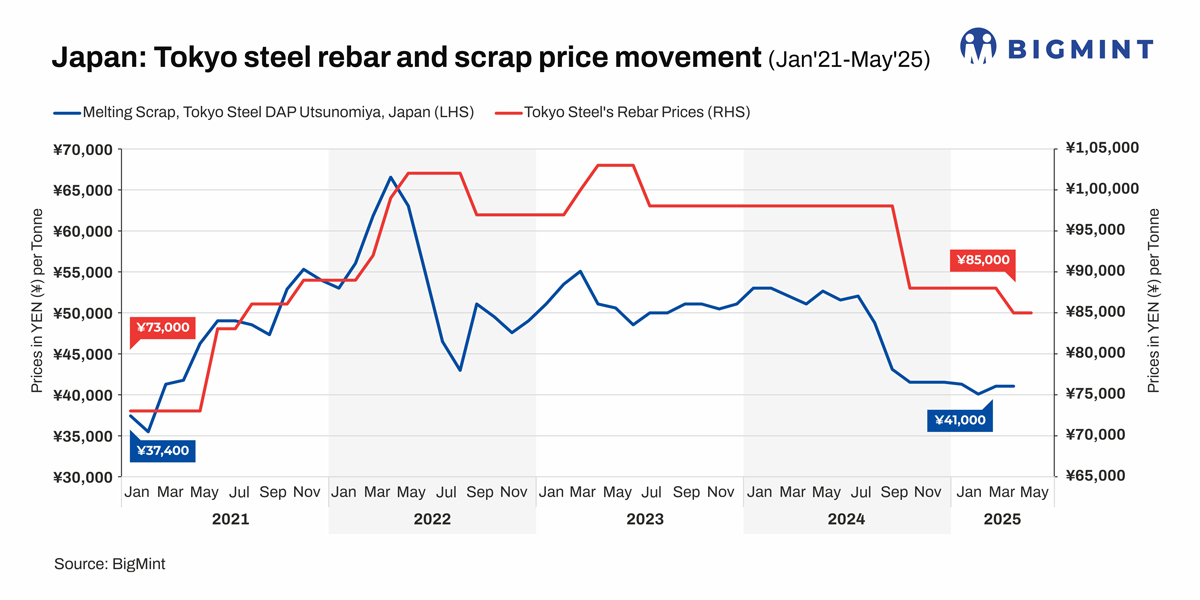
Tokyo Steel, Japan’s leading electric arc furnace (EAF) steel manufacturer, has kept prices of hot-rolled coils (HRCs, 1.7-22 mm) and rebars stable for May 2025 shipments compared to the previous month. However, for the same period, the company has reduced prices of H-beams by JPY 3,000/tonne (t) ($21/t) m-o-m.
Revised prices are as follows:
- HRCs (1.7-22 mm): JPY 89,000/t ($632/t)
- Rebars (D13~25): JPY 85,000/t ($604/t)
- H-beams (100-300 mm): JPY 112,000/t ($796/t)
Factors influencing Tokyo Steel’s pricing
1. Kanto scrap export tender sees drop in bids: The Kanto Iron and Steel Cooperative’s scrap export tender in April saw bids fall by JPY 938/t m-o-m ($7/t). A 15,000-t H2 lot was sold at JPY 43,288/t ($308/t) FAS. This price reduction is attributed to subdued export demand, as buyers maintained downward pressure on prices amid limited consumption and unfavourable macroeconomic conditions.
2. Domestic demand remains under pressure: Japan’s domestic steel demand has been under pressure due to the global economic downturn, with delayed investments and uncertain market conditions. Weak demand for steel products persisted, particularly in the automotive and construction sectors, prompting domestic steel manufacturers to implement measures to rebalance supply and demand, including price adjustments.
3. Key global mills keep prices stable m-o-m: Chinese steel giant Baosteel rolled over HRC and hot-dip galvanised prices for May’25 sales, according to BigMint’s sources. Moreover, CSC also kept steel prices unchanged m-o-m for May sales, especially for HRCs, cold-rolled coils (CRCs), hot-rolled (HR) plates, and hot-dipped galvanised steel coils.
Outlook
The short-term outlook for Japan’s steel market remains cautious, with demand uncertainty and global economic concerns weighing on the industry. However, domestic manufacturers’ proactive measures, such as price reductions and supply control, may help mitigate the downturn and pave the way for a gradual recovery as the market adjusts to new conditions.
Leave a Reply