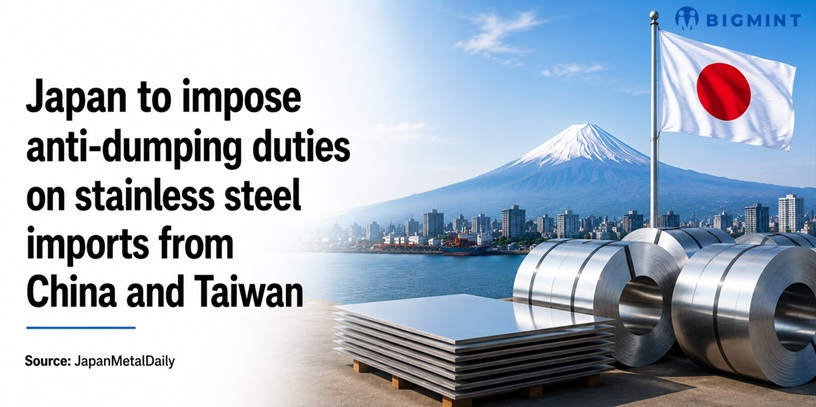
- Duties up to 45% on Chinese imports
- Duties up to 21% on Taiwanese imports
JapanMetalDaily: Japan has announced plans to impose anti-dumping duties on imports of nickel-bearing cold-rolled stainless steel products from China and Taiwan, citing unfair pricing practices that have adversely affected its domestic industry.
The government has determined that imports of nickel-added cold-rolled stainless steel coils, sheets, and strips from both countries were being sold in the Japanese market at unfairly low prices. As a result, anti-dumping duties of up to 45% on Chinese products and up to 21% on Taiwanese products are expected to be implemented as early as next month.
The move follows an investigation by Japanese authorities into allegations that imported stainless steel products were undercutting domestic prices and causing material injury to local producers. The measures are aimed at restoring fair competition and supporting Japan’s stainless steel manufacturing sector.
China and Taiwan account for a significant share of Japan’s stainless steel imports. Chinese shipments represent around 20% of total steel imports into Japan, while Taiwanese products account for approximately 17%. South Korea remains the largest exporter of steel products to Japan, contributing nearly 62% of total imports.
According to the interim findings of Japan’s anti-dumping investigation, the dumping margins for stainless steel imports ranged from 33.29-45.32% for Chinese producers and 3.86-20.71% for Taiwanese producers. Among the companies investigated, China’s Taiyuan Iron & Steel (TISCO) and Yongjin recorded margins of 33.29%, while Zhangjiagang POSCO Stainless Steel (PZSS) faced the highest margin of 45.32%. In Taiwan, Yusco was assigned a margin of 3.86%, while Walsin Lihwa received a margin of 20.71%.
The investigation was initiated in July 2025 following petitions filed by Japanese stainless steel producers, including Nippon Steel, Nippon Yakin Kogyo, Nasu Steel Strip, and Nippon Kinzoku. Japanese authorities concluded that stainless steel products from China and Taiwan were being exported at dumped prices, causing material injury to the domestic industry.
The report noted that Chinese and Taiwanese import prices were frequently referenced during negotiations in the Japanese market, limiting the ability of domestic producers to raise prices and, in some cases, resulting in demands for price reductions. Consequently, Japanese stainless steel manufacturers experienced declining sales volumes and lower capacity utilization. Industry operating rates fell from an index level of 100 in 2022 to 76 in 2023 before recovering modestly to 85 in 2024, highlighting ongoing profitability pressures on domestic producers.
Note: This article is published as part of a content exchange agreement between JapanMetalDaily and BigMint.
Leave a Reply