- Asian HRC prices remain below US levels
- Shipments to China fall below 1 mnt for first time this century
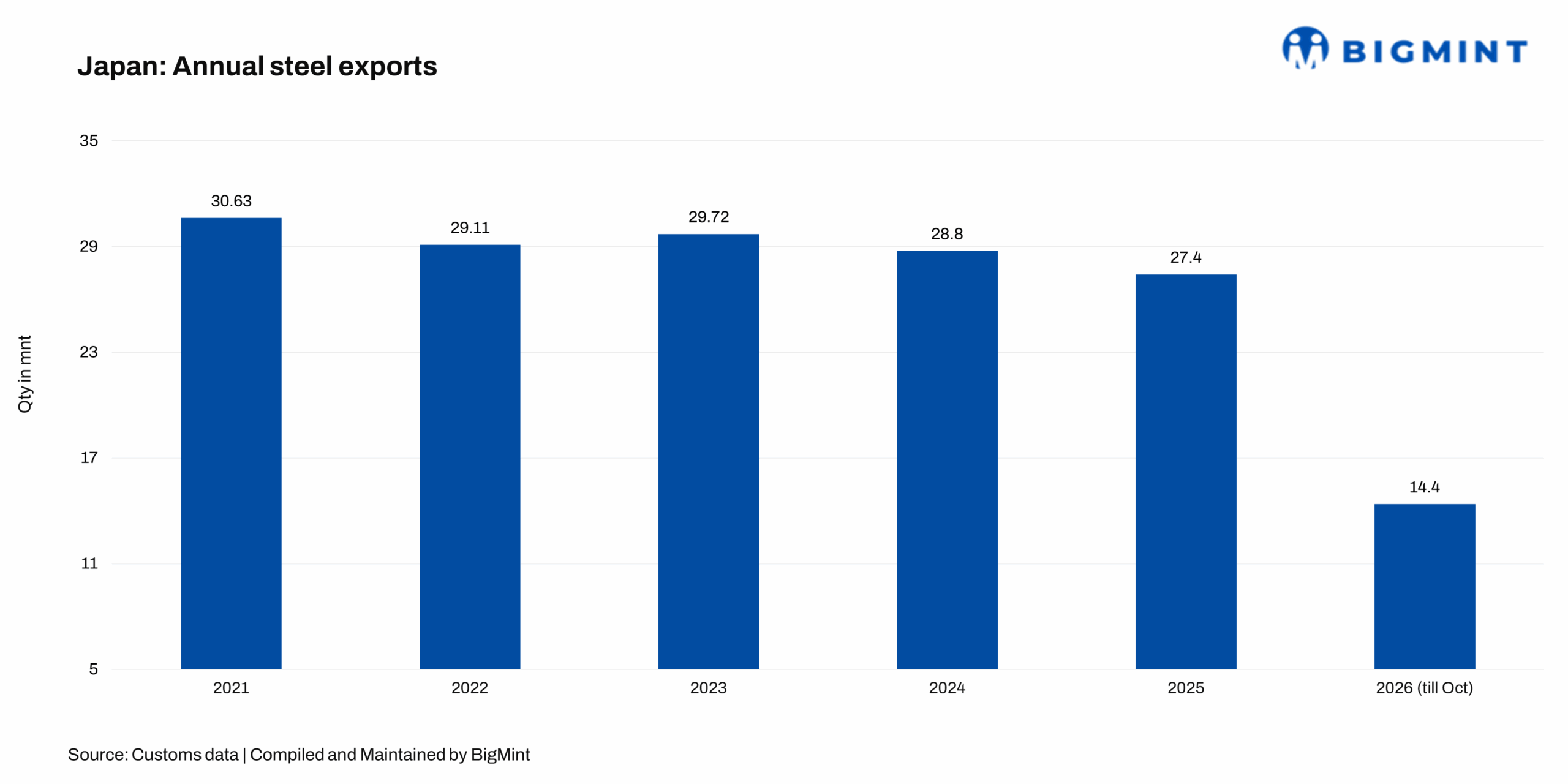
Japan’s steel exports fell by 3.7% y-o-y to 14.373 million tonnes (mnt) in the first half of fiscal year 2026 (April-September), according to data released by the Ministry of Finance on 21 October. Exports have remained below 15 mnt for the second consecutive year during the period. With expanding global trade restrictions and domestic production disruptions caused by typhoons and other factors, exports are expected to remain under pressure in the second half. Full-year shipments could fall below 29 mnt, potentially marking their lowest level since Fiscal Year 2000.
Despite lower export volumes, the value of steel exports rose by 5.9% y-o-y to JPY 2.0311 trillion, crossing JPY 2 trillion for the first time in two years. The increase came amid yen depreciation, with the currency temporarily weakening to around JPY 163 per US dollar, and a modest recovery in Asian steel prices during early spring.
However, export conditions remain challenging, particularly for hot-rolled coil (HRC), Japan’s main steel export product. International prices have diverged between markets with stringent trade measures, including the US, the European Union (EU) and India, and regions facing fewer restrictions. While HRC prices in Asia remain in the low $500s/t, US prices have climbed to around 2.5 times Asian levels amid an additional 50% tariff under Article 232 of the Trade Expansion Act.
Despite tightening supply and persistently high coking coal costs, upward momentum in Asian steel markets remains weak, with export negotiations expected to remain subdued. Japanese and Indian steelmakers are limiting export commitments amid firm domestic demand, while Indonesia’s Dexin Steel has shut one of its three blast furnaces due to drought.
Exports to China and Middle East fall sharply
Japan’s steel exports to major destinations showed mixed trends in H1 FY’26. Shipments to ASEAN declined by 6% y-o-y to 4.634 mnt, while exports to China fell by 14.2% to 977,000 tonnes (t), dropping below 1 mnt for the first time this century. Shipments to the Middle East down by 77.9% to 149,000 t amid regional instability following US and Israeli attacks on Iran from late February.
In contrast, exports to South Korea rose by 13% y-o-y to 2.079 mnt, while shipments to the US increased 29.4% to 662,000 t. Exports to the EU also grew by 7.4% to 326,000 t.
The increase in shipments to South Korea was attributed to Japanese HRC re-exports being excluded from the anti-dumping (AD) measures on Japanese-origin material. In the US, Japan lost its exemption from Article 232 tariffs, although similar tariff conditions applied to other countries. Shipments of some products, including semi-finished steel and slabs, nevertheless increased.
Steel imports decline 12%, ASEAN shipments rise
Japan’s steel imports declined by 12.1% y-o-y to 3.177 mnt in the first half of FY’26. Imports from South Korea fell by 8% to 1.588 mnt, while those from China dropped by 31.3% to 535,000 t. In contrast, imports from ASEAN rose by 17.9% to 206,000 t, and those from the EU increased by 8.1% to 46,000 t. The decline in shipments from South Korea and China came amid trade concerns, including Japan’s provisional anti-dumping (AD) measures on galvanized iron (GI) imports from both countries. Meanwhile, imports from ASEAN increased, while EU shipments of specialty steel recovered from the previous year’s decline caused by shipping schedule disruptions.
Note: This article is published as part of a content exchange agreement between Japan Metal Daily and BigMint.
Leave a Reply