- Japan’s average EAF CO2 intensity at 0.673 kg/t, Chiyoda’s below 0.51 kg/t
- Japan to introduce building lifecycle emissions calculation system soon
Chiyoda Steel Industry Co., Ltd., a manufacturer of electric furnace steel bars, is undertaking a revolution in steel bar rolling at its Ayase Plant (Adachi Ward, Tokyo).
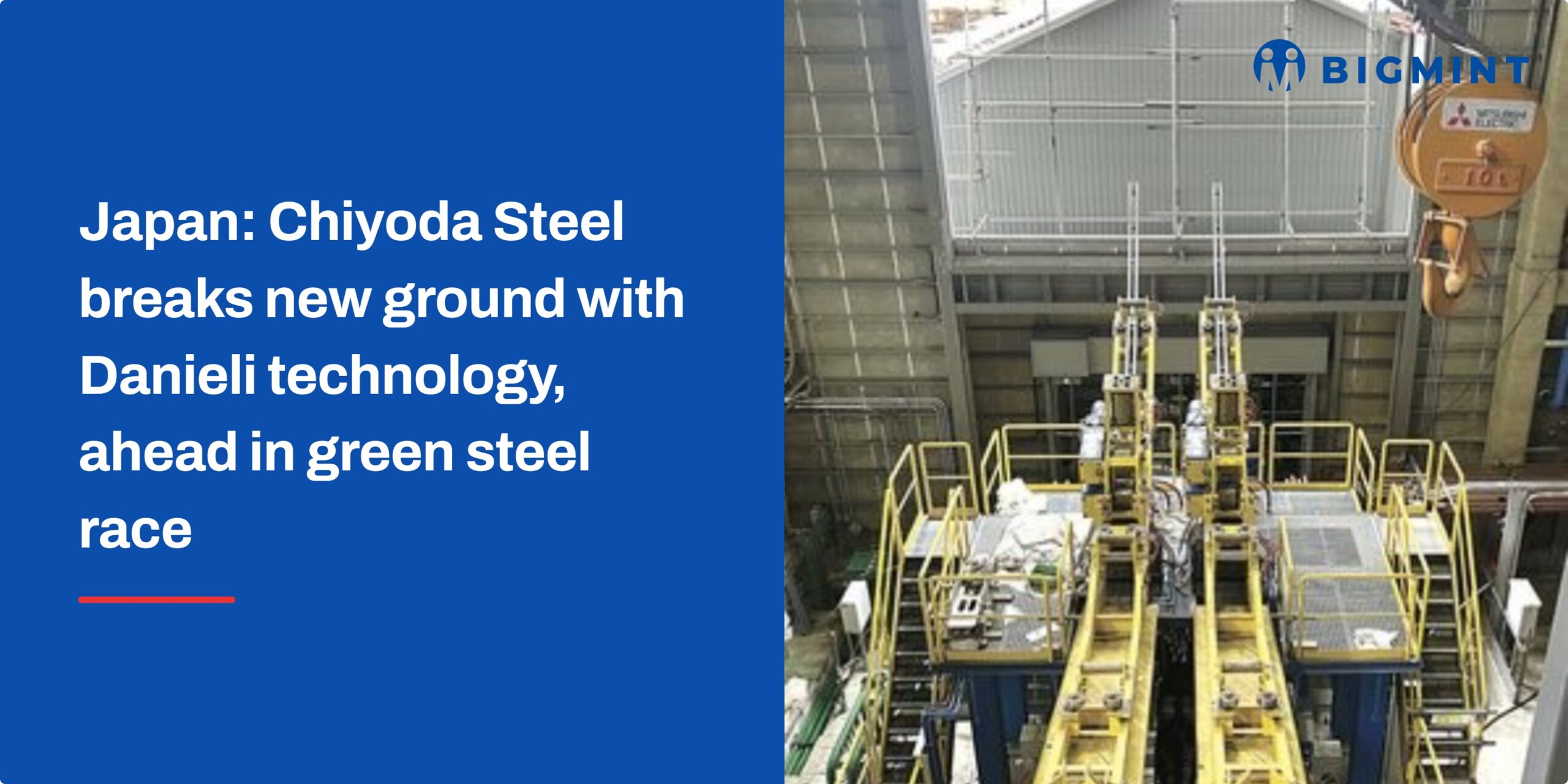
This summer, they introduced a new manufacturing method, the first of its kind in Japan that directly connects a continuous casting machine and a steel bar rolling mill. This will allow for seamless production of reinforcing steel bars from molten steel, thoroughly improving energy efficiency and yield.
Looking ahead, the company envisions expanding product sizes and supplying green steel that reduces greenhouse gas emissions during manufacturing.
Endless rolling
The new “endless rolling” manufacturing method integrates both the continuous casting machine and the bar mill processes. Chiyoda Steel’s concept for endless rolling dates back to 2021. Because their existing continuous casting machines and bar steel mill’s roughing and intermediate rolling mills had been in operation for over half a century, they spent five years introducing state-of-the-art equipment for endless rolling.
The company plans to begin full-scale endless rolling operations in August of this year, and preparations for comprehensive trial runs are currently underway at the site.
While endless rolling mills have never been implemented in Japan, they are already becoming widespread overseas. A prime example is Commercial Metals (CMC), a mid-sized electric arc furnace steelmaker in the United States. Their growth strategy centres on compact, locally-focused EAF facilities designed to meet local construction demand, and they were among the first to introduce the MIDA endless rolling mill manufactured by the Italian steel plant maker Danieli.
Chiyoda Steel’s President noticed this move and explained the background of their investment decision, saying, “We wanted to strategically get ahead of the curve and acquire advanced technologies that will become important in Japan in the future.”
Chiyoda Steel also partnered with Danieli for the installation of new equipment. Taking advantage of MIDA’s feature that allows for partial installation, they modified a portion of their existing bar steel rolling mill in the first phase of construction in 2024. Subsequently, in the second phase of construction in 2026, they installed new equipment, including a dedicated continuous casting machine for the preceding process.
The primary goal of the endless process is to achieve significant energy savings. Unlike conventional methods where the continuous casting machine and the bar mill are separate, the MIDA method does not involve a heating furnace process that uses city gas to heat the billets.
Chiyoda Steel’s emissions profile
At the Ayase plant, carbon dioxide (CO2) emissions per ton of steel produced are expected to be reduced by approximately 7% compared to 2022, to 479 kilograms.
According to the Sustainable Management Promotion Organization (SuMPO), an environmental certification body, the average emissions from the domestic electric furnace industry are 673 kilograms. Chiyoda Steel’s emissions were already below average at 515 kilograms in 2022, but it aims to reach the lowest level in the industry going forward.
The company is also focusing on strengthening its product capabilities. A new weapon in this regard is the company’s first off-furnace refining furnace (LF), newly installed in the post-processing stage of its electric arc furnace. While an LF, which allows for precise temperature and composition control of molten steel, is not strictly necessary for Chiyoda Steel, a manufacturer of small parts, it is essential for introducing the MIDA, which has a high casting speed.
In addition to its primary objective of supporting high-speed casting, the company also aims for additional benefits. By using the LF for secondary refining of molten steel from the electric furnace, it will be possible to mass-produce large-diameter reinforcing bars, such as base sizes, and high-strength reinforcing bars, which the company has not handled before. It plans to gradually expand the product line-up of deformed steel bars from the current five sizes to 10 sizes, starting in 2027.
Building LCA calculation system
The future goal is the mass production of green steel. The government has announced its intention to introduce a “building LCA calculation system”, which will require the calculation of CO2 emissions from construction to demolition for buildings of a certain size or larger.
In response to this trend, the company anticipates that general contractors and other customers will strengthen their procurement of green steel. “Currently, we mainly deal with thin steel, but we want to be able to offer comprehensive green steel solutions that include thicker steel and other sizes as well,” said President Sakata.
In addition to directly reducing CO2 emissions through endless rolling, the company will also focus on reducing CO2 emissions across the entire supply chain, including procuring iron scrap. They plan to establish a green steel supply system by utilising third-party certifications and other measures.
This article is published as part of a content sharing agreement between Japan Metal Daily and BigMint
Leave a Reply