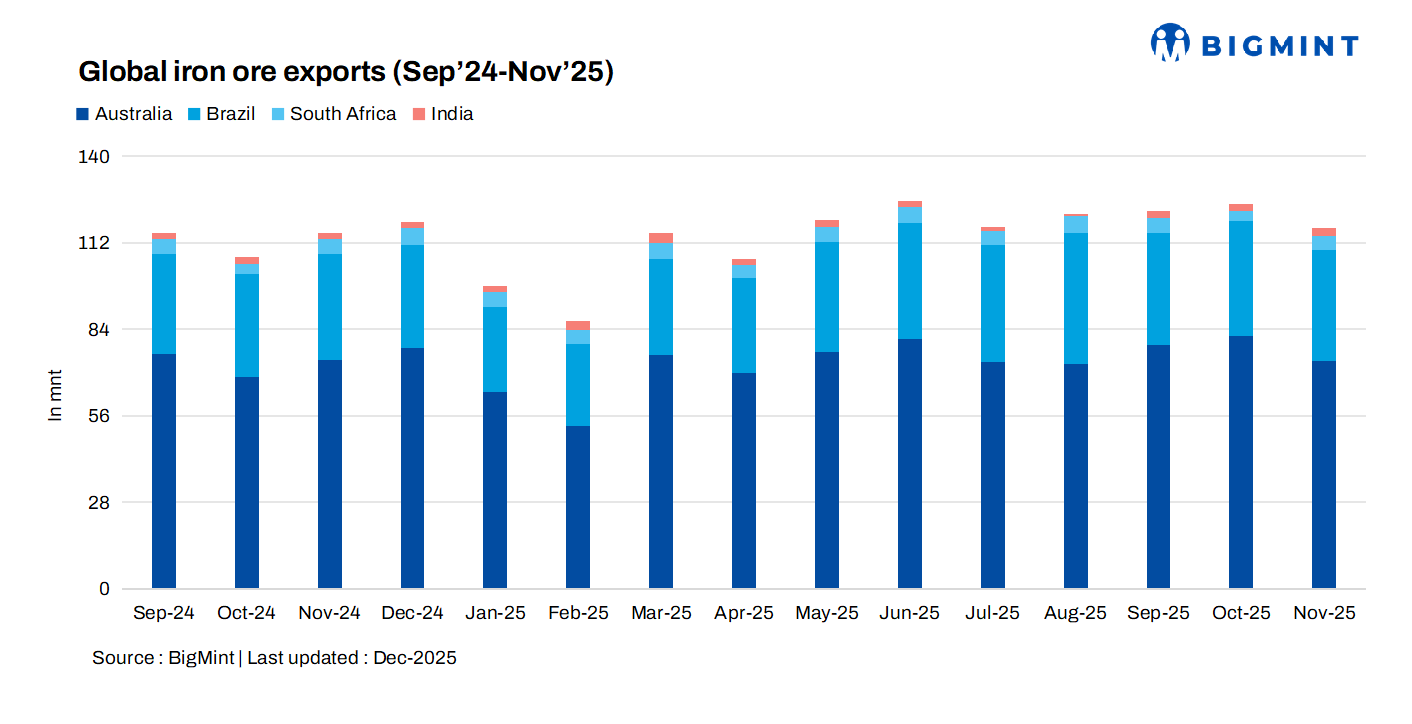
- South African exports rebound up 35% m-o-m
- Indian export remained healthy buyer enquiries
In November, with provisional data showing that overall volumes were lower, iron ore exports from Australia, Brazil, South Africa and India showed mixed trends. Total shipments stood at 117 mnt, down 6% from 124.45 mnt in October. India’s exports rose by 27% m-o-m as post-monsoon supply improved and miners released fresh material. South Africa and India recorded gains, while Australia and Brazil saw declines during the month.
Australian exports edge down 10% m-o-m
Australia’s iron ore and pellet export shipments stood at 73.7 mnt in November, down 10% against 81.9 mnt in October, according to vessel line-up data compiled by BigMint.
China remained the top importer, receiving 63.2 mnt (7.3% lower m-o-m), followed by Japan with 3.8 mnt and South Korea at 3.5 mnt.
BHP was the leading exporter at 25.2 mnt, trailed by Rio Tinto (dip of 19.3% m-o-m) at 24.6 mnt and FMG at 17 mnt.
The slight dip was primarily driven by slower vessel turnaround and ongoing maintenance at major Pilbara ports, including Port Hedland, Walcott and Dampier, coupled with intensified market competition.
Exports from Brazil edge down 3% m-o-m
Brazil’s iron ore exports fell by 2.7% to 36.07 mnt in November against 37.08 mnt in the previous month. However, exports rose by 5.5% from 34.18 mnt in November 2024.
China remained the largest importer, taking in 26.12 mnt, followed by Malaysia at 1.57 mnt and the Netherlands at 0.93 mnt.
Brazil’s exports inched lower as Chinese buyers diversified their sourcing, though initial shipments of new Simandou ore helped cushion the overall volume. However, reduced buying from major Northeast Asian importers added pressure to market sentiment.
South African exports recovers
South Africa’s iron ore exports spiked up by 35% to 4.46 mnt in November as against 3.3 mnt in October, as per vessel line-up data maintained by BigMint. However, export volumes edged down by 11.3% against 5.03 mnt in November 2024.
China remained the leading importer with 1.3 mnt, followed by the Netherlands at 0.35 mnt.
November iron ore exports recovered as improved Transnet rail performance increased mineral flow to ports. Stronger loading and faster vessel turnaround at Saldanha Bay, along with reduced congestion, supported smoother scheduling.
Ongoing coordination between miners and Transnet stabilised the export corridor, contributing to a marked rise in weekly shipments after October’s disruptions from rail delays and operational constraints.
India’s exports surge by 27% m-o-m
India’s iron ore and pellet exports rose by 27.2% m-o-m to 2.76 million tonnes (mnt) in November from 2.17 mnt in October. Moreover, shipments saw an improvement of 51.6% against 1.82 mnt y-o-y in the year-ago period. This is the highest export figure so far in this financial year, earlier it was last seen in March 2025 with 3.13 mnt.
China remained the largest importer with 1.79 mnt, followed by Malaysia with 0.11 mnt.
The increase in exports coincided with a shift in the benchmark from Fe 62% to Fe 61% in sea trades. Prices were favourable, supported by active inquiries from international buyers seeking Indian iron ore. Additionally, mining companies led the market in November, often charging a premium for their single mine cargo. The last month also saw shipments of some lump cargo, primarily handled by exporters based on the West Coast.
Leave a Reply