- Export payments worth INR 2,000 cr stuck as shipments slow
- Domestic basmati prices fall INR 5-10/kg on demand uncertainty
India’s basmati rice market is facing renewed pressure as political unrest and communication disruptions in Iran, its second-largest buyer, have stalled trade flows and delayed export payments, forcing exporters to reassess risk exposure and divert volumes to alternative destinations. The disruption has coincided with a sharp correction in domestic basmati prices, highlighting the market’s dependence on Iranian demand during peak shipment months.
According to trade estimates, nearly INR 2,000 crore ($240 million) worth of payments from Iran are currently stuck after internet blackouts and banking constraints halted communication between Indian exporters and Iranian importers. The uncertainty has slowed fresh contracts and delayed vessel clearances, leaving stocks piled up at ports and in mill warehouses.
Iran’s role in basmati demand
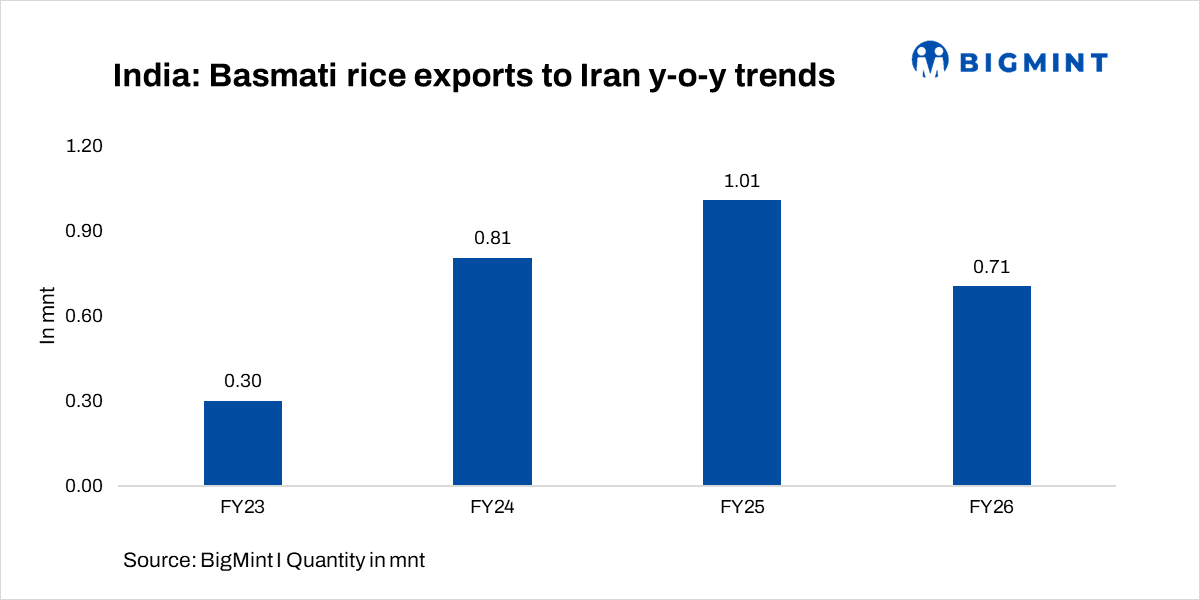
Iran has traditionally been one of the largest destinations for Indian basmati rice, absorbing close to 20–25% of India’s total basmati exports in strong export years. As per BigMint data, Iran’s exports rose from 0.30 million tonnes (mnt)in FY’23 to 0.81 mnt in FY’24, peaking at 1.01 mnt in FY’25, before easing to 0.71 mnt in FY’26 (April-November 2025). Total exports in these four financial years amounted to 2.82 mnt.
Industry experts say Iran-bound basmati shipments are now either delayed or being rerouted through intermediaries in the UAE, increasing transaction costs and elongating payment cycles.
Prices slide as inventories build
The disruption has had an immediate impact on domestic prices. Wholesale basmati prices across key mandis in Haryana, Punjab, and western Uttar Pradesh have declined by 7% over the past week, with select varieties falling by INR 5-10/kg.
Traders attribute the decline to weak buying from exporters, who are unwilling to accumulate Iran-specific inventory amid payment uncertainty. Export-grade basmati, which was trading close to $950/t earlier this quarter, is now quoted closer to $900/t, according sources.
Millers say the correction has been sharper for mid-range varieties, while premium aged basmati has shown relatively better resilience due to steady demand from the US and Europe.
Exporters reassess risk exposure
Exporters have begun tightening credit terms and reassessing counterparty risk on Iran-linked contracts. The Indian Rice Exporters Federation (IREF) has issued an advisory urging members to adopt secured payment mechanisms, avoid over-leveraging inventories meant exclusively for Iran, and diversify export destinations to cushion the impact of prolonged disruptions.
Alternative markets offer limited relief
With Iran trade slowing, exporters are attempting to redirect volumes to West Asia, Africa, and Europe. However, price sensitivity in these regions and competition from Pakistan and Thailand are limiting immediate absorption.
Meanwhile, exporters are closely watching the United States, as BigMint data indicates that basmati shipments to the US have remained steady so far rising from 50,000 t in FY’23 to 240,000 t in FY’24, peaking at 290,000 t in FY’25, and easing to 200,000 t in FY’26 after former President Donald Trump reiterated the threat of a 25% tariff on countries trading with Iran. This uncertainty has added to market caution.
Outlook remains fragile
The near-term outlook for basmati rice remains fragile, with prices likely to stay under pressure until clarity emerges on Iran’s internal situation and payment channels reopen. Traders expect market sentiment to remain cautious through the next few weeks, with buying interest driven more by inventory management than fresh demand.
For now, the basmati market is once again being shaped not by crop fundamentals, but by geopolitics—underscoring the vulnerability of India’s premium rice exports to disruptions beyond the supply chain.
Leave a Reply