- Weak market dynamics, power curbs impact output
- Billet, bloom production declines by over 5% y-o-y
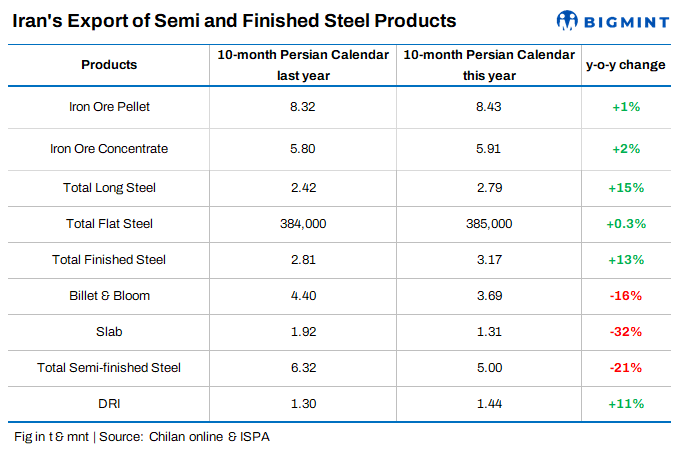
Iran’s semi-finished steel exports in the first ten months of the current Persian year (21 March 2024-20 January 2025) stood at around 5 million tonnes (mnt), a decrease of 21% compared to the same period last year, according to data from Iranian Steel Producers Association (ISPA).
- Of the total semi-finished steel exports, billets and blooms accounted for 3.69 mnt, down by 16% y-o-y.
- Slab export volumes dropped significantly by 32% y-o-y to 1.31 mnt.
However, exports of long products were recorded at 2.79 mnt, up 15% y-o-y, while shipments of flats inched up marginally by just 0.3% y-o-y to 385,000 tonnes (t).
As per sources, weak global market dynamics and electricity restrictions on Iranian steelmakers impacted production levels, ultimately limiting billet export allocations.
Meanwhile, exports of direct reduced iron (DRI) in the period under review were recorded at 1.44 mnt, a rise of around 11% y-o-y.

Semi-finished steel production falls over 5% y-o-y
According to ISPA, Iran’s semi-finished steel output stood at 25.23 mnt in the first ten months of the current Persian year, a decrease of 6% from 26.69 mnt in the same period last year. Production volumes declined due to the Iranian government’s power supply restrictions on steel mills, which were more stringent this year compared to the last.
Billets and blooms accounted for 15.37 mnt of total semis output, down by 7% compared to 16.57 mnt in the year-ago period.
Production of slabs inched down by 3% to 9.05 mnt as against 9.86 mnt in the corresponding period last year (CPLY).
Notably, DRI production stood at 30.12 mnt in the period under review, a slight increase of 0.3% compared to 30.02 mnt in the year-ago period. The increase can be attributed to the operation of new direct regeneration units during last winter and spring of this year.
Outlook
Billet exporters are currently offering less material due to sluggish market demand. This trend is set to continue.
Although the Trade Development Organisation announced that steel value chain exporters are no longer required to submit their export currency to the NIMA system, this decision failed to boost export volumes.
Leave a Reply